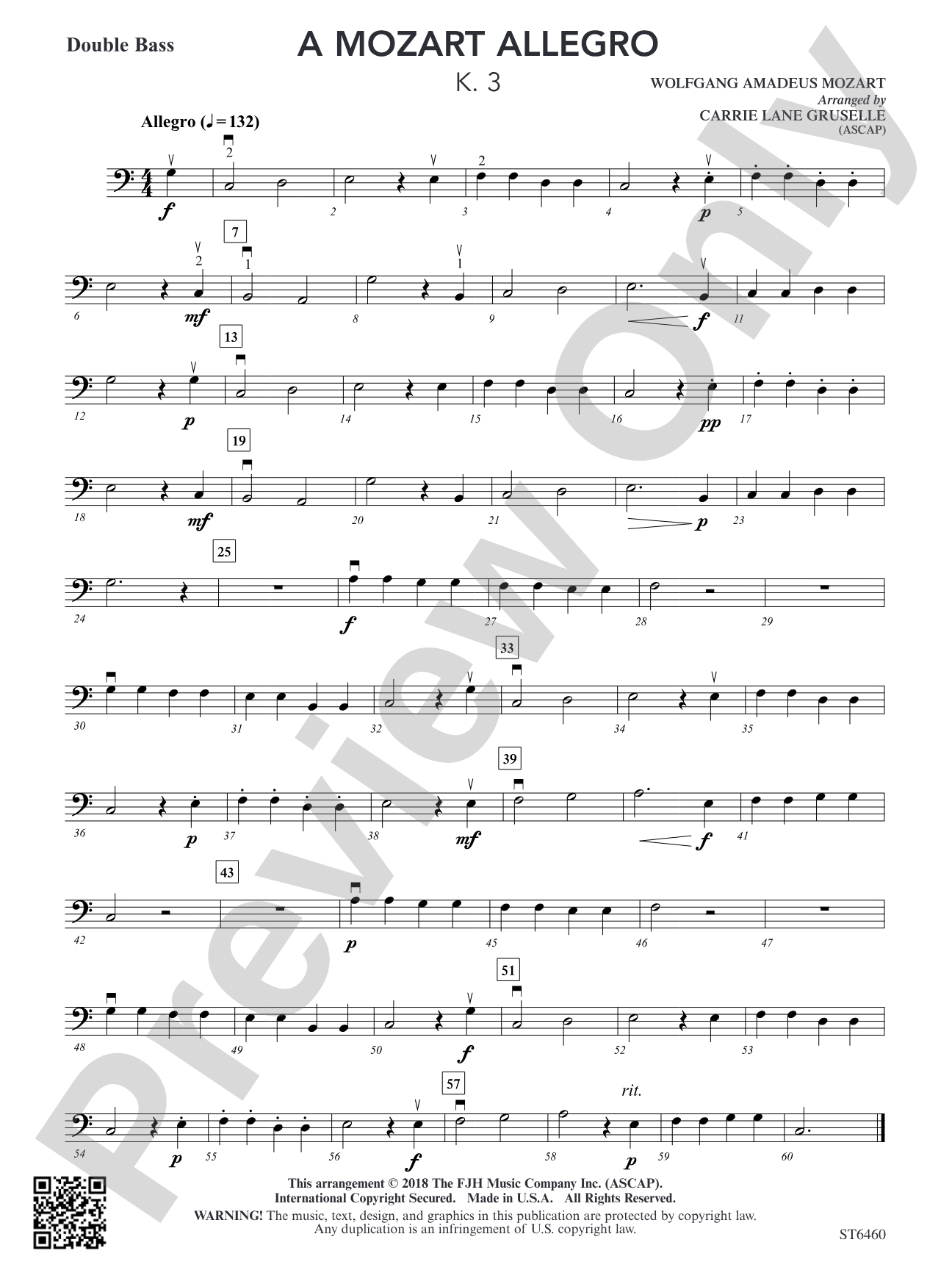
A Mozart Allegro: Double Bass Sheet Music Preview

A Mozart Allegro: Double Bass

By Wolfgang Amadeus Mozart / arr. Carrie Lane Gruselle

Grade: 1.5

Item: 98-PC-DST6460_SB

Digital Download
$7.00
Description
This extremely popular melody was composed when Mozart was a mere 6 years old and surely predicts his remarkable genius! Written for the youngest of musicians, this arrangement features simple phrases infused with contrasting dynamics and articulations.

A Mozart Allegro: Double Bass isn't in MakeMusic Cloud just yet...but it could be. Let us know you'd like to see it, and you'll help shape what comes next. In the meantime, start a free trial and dive into thousands of interactive titles your students can play along with today.

Sample Audio
0:00
0:00
Sample Video
Additional Details
Series: FJH Beginning Strings
Publisher: The FJH Music Company, Inc.
SKU: 98-PC-DST6460_SB

More about this title

About the Composer: Wolfgang Amadeus Mozart

Wolfgang Amadeus Mozart (1756-1791) began his musical training at an extraordinarily young age under his father Leopold's rigorous guidance. A prodigy performer and composer, Mozart had mastered multiple instruments and was touring European courts by age five, creating music that astonished audiences and fellow musicians alike.

Mozart's output across all genres remained staggering throughout his short life. His ability to balance structural clarity with emotional depth, combine accessibility with sophistication, and write idiomatically for every instrument makes his work foundational to string education. Even his juvenilia demonstrates the hallmarks that would define his legacy: elegant phrasing, harmonic fluency, and an instinctive understanding of what instruments can do.

Why we love this

Carrie Lane Gruselle's arrangement respects Mozart's original melodic gift while scaling the ensemble writing for young players still building their foundation. The strategic use of contrasting dynamics and articulations keeps the piece musically engaged without overcomplicating the technical demands, making it an ideal teaching vehicle for introducing interpretive choices at Grade 1.5.

What to expect

The piece has an effortless elegance characteristic of Mozart's gift for melody. Beneath the simplicity lies understated sophistication; the contrasting dynamics and articulations give the arrangement a polished, almost playful quality that young musicians find both accessible and satisfying.

Who it's for

This arrangement is ideal for beginning string orchestras at Grade 1.5 who need rewarding, accessible literature without compromising musical substance. Young players respond well to Mozart's clear melodic writing, and the straightforward technical demands allow them to focus on ensemble blend and interpretive choices.

How to get the most out of it

  • Shape the phrases by thinking in terms of direction rather than individual notes. Young orchestras often play line-by-line; help them hear where each phrase is traveling and how the dynamics support that arc.
  • Lock in the articulation patterns across sections before rehearsing at tempo. Consistent articulation across parts creates the polish that makes even simple writing sound confident.
  • Balance the melody and accompaniment textures by adjusting volume rather than relying solely on part-writing. String orchestras at this level benefit from explicit reminders about who carries the tune and how that relationship shifts.
  • Use the contrasting dynamics as a springboard for discussing musical storytelling. Even a 6-year-old's melody can be performed with intention if the ensemble understands why dynamics change.

How to use it

Program this as an opener or interlude at a young orchestra concert, where its brevity and immediate appeal engage audiences and build confidence in performers. It works equally well in a contest or festival setting, offering judges a clear view of a young ensemble's ability to balance technical clarity with musical interpretation.

Skills your students will build

  • Sustaining phrase momentum across multiple measures
  • Responding to dynamic contrast and articulation changes
  • Playing as an ensemble part rather than individual lines
  • Applying interpretive choices to classical melody

You May Also Like