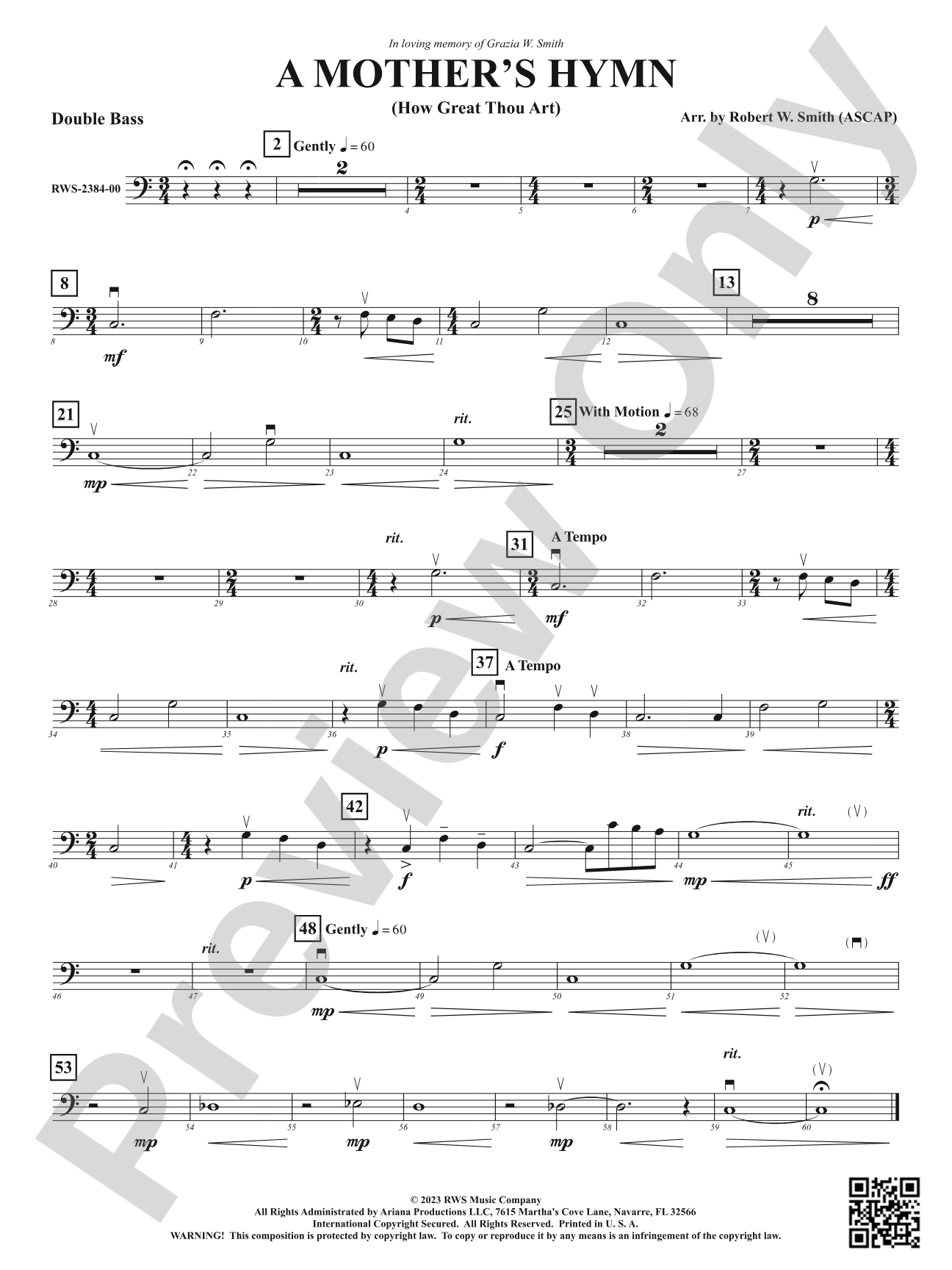
A Mother's Hymn - How Great Thou Art: String Bass Sheet Music Preview

A Mother's Hymn - How Great Thou Art: String Bass

How Great Thou Art

Arranged by Robert W. Smith

Grade: 2.5

Item: 98-PC-RWS2384_SB

Digital Download
$5.99
Description
Simple, poignant and beautiful, A Mother's Hymn by Robert W. Smith creates an artistic experience for both string orchestra and audience. Based on an old Swedish melody also known as How Great Thou Art, this setting is appropriate for any concert or festival performance. An instant standard in the orchestra repertoire.

Original Item#: RWS-2384-00

A Mother's Hymn - How Great Thou Art: String Bass isn't in MakeMusic Cloud just yet...but it could be. Let us know you'd like to see it, and you'll help shape what comes next. In the meantime, start a free trial and dive into thousands of interactive titles your students can play along with today.

Sample Audio
0:00
0:00
Sample Video
Additional Details
Series: RWS - Developing Strings
Publisher: RWS Music Company
SKU: 98-PC-RWS2384_SB

More about this title

About the Arranger: Robert W. Smith

Robert W. Smith

Robert W. Smith stands among America's most frequently performed composers of orchestral and concert band music, with more than 400 published works distributed primarily through Alfred Music. He holds a Bachelor of Music Education from Troy State University and a Master of Music from the University of Miami, and his career has taken him across five continents as both a composer and clinician.

Smith's symphonic works, including The Divine Comedy and The Odyssey, have resonated with musicians worldwide. His settings for developing ensembles, including The Tempest, have become staples in school repertoire. His music has graced everything from international state ceremonies and Olympic broadcasts to television network productions, establishing him as a composer equally fluent in concert hall and popular media contexts.

Why we love this

Smith strips this beloved hymn to its emotional core without overwhelming younger string players. The Grade 2.5 setting respects both the tune's spiritual weight and the technical realities of developing orchestras, making it genuinely singable for the group while sounding complete and mature. It's the kind of arrangement that teaches musicians how to serve a melody with clarity and restraint.

What to expect

Quiet reverence unfolds across the string section, anchored by a melody that carries centuries of devotion. The arrangement honors the hymn's spiritual gravity while letting younger players experience what it means to play with restraint and intention, turning a familiar tune into a moment of genuine connection.

Who it's for

String orchestras in Grades 2-4 seeking a concert or festival piece that feels substantial without excessive technical demand. This works equally well for programs building toward spring performances or looking for a thoughtful closing number that leaves audiences moved rather than entertained.

How to get the most out of it

  • Let the melody singers breathe together. Even though you have a full string section, the piece succeeds when the primary voice line feels like a choir, not a competition between stands.
  • Maintain gentle dynamic control in the middle register. Younger players often force the violas and second violins, which clouds the harmonic warmth this arrangement needs.
  • Shape the phrase endings with slight ritardando rather than sudden tempo drops. The Swedish melody has natural breathing points that invite a graceful deceleration.
  • Balance pizzicato and arco textures carefully if they appear in your parts. Even at this grade level, clarity between articulation types adds sophistication to the sound.

How to use it

Program this as a second-half opener to shift the emotional temperature of a concert, or close your performance with it to send audiences home with something contemplative. It pairs naturally with other devotional or folk-based literature and requires minimal rehearsal time relative to its impact, making it efficient to add late in the season.

Skills your students will build

  • Sustaining tone quality at soft dynamic levels (pp to p)
  • Playing as a unified voice section with shared phrase breathing
  • Reading open string and first-position techniques across all four voices
  • Responding to subtle expressive gestures in conducting
  • Balancing melody and accompaniment roles within the same section

You May Also Like