
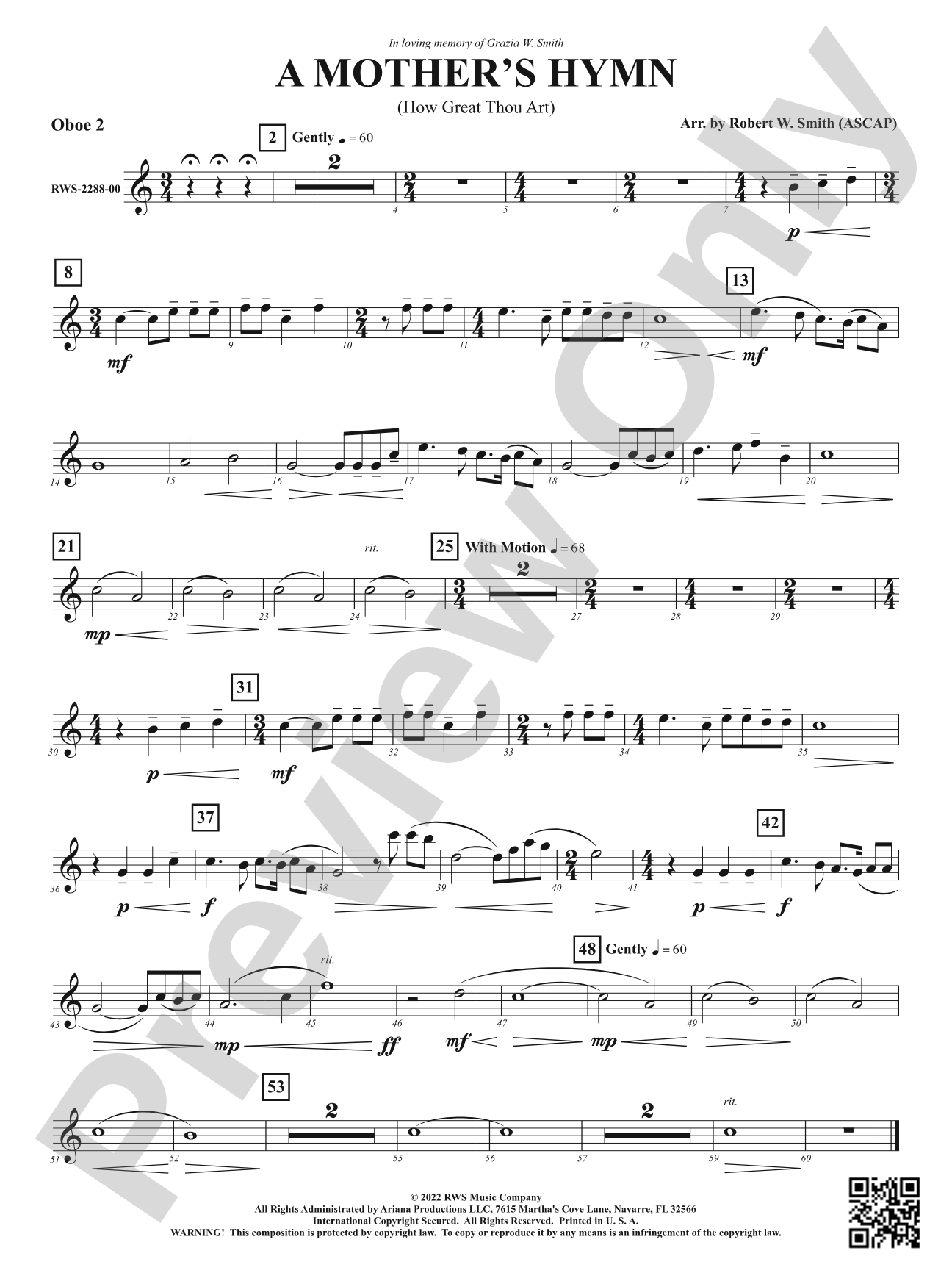

A Mother's Hymn - How Great Thou Art: 2nd Oboe
How Great Thou Art
Arranged by Robert W. Smith
Grade: 3
Item: 98-PC-RWS2288_O2
$3.99
Pickup currently not available
Description
Simple, poignant and beautiful, "A Mother's Hymn" by Robert W. Smith is an artistic experience for both full orchestra and audience. Based on an old Swedish melody also known as "How Great Thou Art," this setting is appropriate for any concert or festival performance. An instant standard in the orchestra repertoire.
Original Item#: RWS-2288-00


Original Item#: RWS-2288-00
A Mother's Hymn - How Great Thou Art: 2nd Oboe isn't in MakeMusic Cloud just yet...but it could be. Let us know you'd like to see it, and you'll help shape what comes next. In the meantime, start a free trial and dive into thousands of interactive titles your students can play along with today.
Request This Title
Tell us you want it.
Start Your Free Trial
Explore everything that's ready to play right now.
Sample Audio
1
Audio File
--:--
0:00
0:00
Sample Video
No sample videos found.
Additional Details
Series:
RWS - Concert Orchestra
Publisher:
RWS Music Company
SKU:
98-PC-RWS2288_O2
More about this title
About the Arranger: Robert W. Smith

Robert W. Smith stands among America's most recorded composers for wind and orchestral ensembles, with more than 400 published works distributed primarily through Alfred Music. He holds degrees in music education from Troy State University and a master's degree from the University of Miami, and his original compositions have been performed across North America, Europe, Australia, and Asia. His symphonic works, including The Divine Comedy and The Odyssey, alongside concert band standards like The Tempest, have become fixtures in professional and educational repertoires worldwide.
Beyond the concert hall, Smith's music has reached audiences through major television broadcasts, Olympic Games coverage, presidential state ceremonies in Japan, the Macy's Thanksgiving Day Parade, and opening day at Dodger Stadium. His work as a guest conductor and clinician has taken him across the United States, Canada, and internationally to Japan, Australia, Italy, Austria, and the United Kingdom, where he continues to influence the direction of orchestral and band music.
Why we love this
Smith's arrangement honors the timeless dignity of "How Great Thou Art" while making it genuinely accessible to developing orchestras. The Grade 3 setting never condescends to the players or the melody; instead, it distributes the harmonic responsibility thoughtfully across the ensemble and lets the tune breathe with spacious orchestration that builds without exhausting younger musicians.
What to expect
The work carries quiet reverence and warmth without sentimentality. The Swedish melody unfolds with natural phrasing, supported by orchestration that feels unhurried and spacious, creating an atmosphere of genuine contemplation. This is music that connects with audiences through sincerity rather than spectacle.
Who it's for
This arrangement serves orchestras at the middle school or early high school level, programs seeking repertoire that satisfies both artistic merit and technical accessibility. It also suits community orchestras and college preparatory ensembles looking for literature that engages audiences without requiring advanced technique.
How to get the most out of it
- Balance the primary melodic line carefully so it emerges clearly above the accompaniment. This is not a tutti work; let lighter textures breathe and support rather than compete.
- Shape the harmonic progressions with gradual dynamic growth. The arrangement's power comes from patient phrasing and subtle layering, not from sudden forte entries.
- Consider the piece as a single arch spanning beginning to end. Avoid overplaying early sections; save interpretive depth for moments where the orchestration thickens.
- Pay particular attention to the string section's role in supporting the melody. Smooth, sustained tone in the violins will anchor the entire ensemble.
How to use it
Program this as a concert opener or as a counterweight to more dramatic or energetic works. The piece works especially well in spring or fall concert settings, before a more substantial orchestral work, or as the closing selection when a reflective, unified moment will resonate with the audience.
Skills your students will build
- Sustaining long melodic lines with consistent tone quality and intonation
- Balancing accompaniment figures against a primary melody across multiple instrumental families
- Reading and executing ensemble dynamic shaping in a slower tempo context
- Conducting and performing with phrase architecture that extends beyond eight-bar periods