
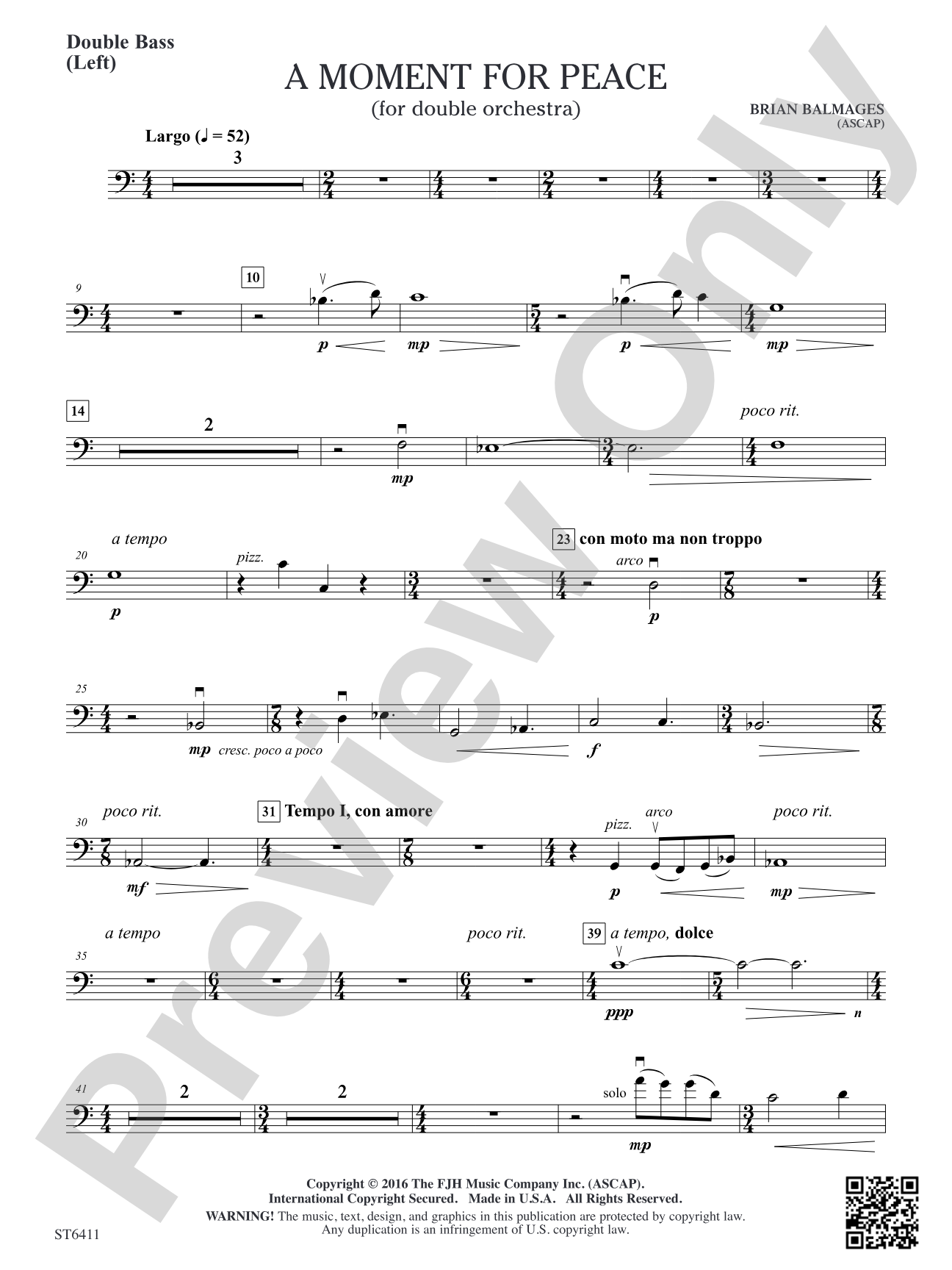

A Moment for Peace: Double Bass (Orchestra 1 – Left)
By Brian Balmages
Grade: 5
Item: 98-PC-DST6411_SB1ORCH1
$7.00
Pickup currently not available
Description
Written as a response to the numerous tragedies occurring throughout the world, this music is meant to draw the performer and listener away from the chaos of the world and into a tranquil space. Inspired by Vaughan Williams' Fantasia on a Theme of Thomas Tallis, the piece is scored for double orchestra but may be played in a traditional seating arrangement. Directors will find that it is also quite effective as a chamber work for smaller orchestras. Stunning, with solo opportunities for every principal player.


A Moment for Peace: Double Bass (Orchestra 1 – Left) isn't in MakeMusic Cloud just yet...but it could be. Let us know you'd like to see it, and you'll help shape what comes next. In the meantime, start a free trial and dive into thousands of interactive titles your students can play along with today.
Request This Title
Tell us you want it.
Start Your Free Trial
Explore everything that's ready to play right now.
Sample Audio
1
Audio File
--:--
0:00
0:00
Sample Video
No sample videos found.
Additional Details
Series:
FJH String Orchestra
Publisher:
The FJH Music Company, Inc.
SKU:
98-PC-DST6411_SB1ORCH1
More about this title
About the Composer: Brian Balmages

Brian Balmages has established himself as a composer and conductor working across orchestral, band, and chamber idioms with equal fluency. His works have been performed by ensembles ranging from professional symphony orchestras to school groups in venues including Carnegie Hall, the Kennedy Center, and the Sydney Opera House. He is a recipient of the A. Austin Harding Award from the American School Band Directors Association, won the 2020 NBA William D. Revelli Composition Contest for Love and Light, and holds membership in the American Bandmasters Association.
As a conductor, Balmages maintains active relationships with all-state ensembles, university orchestras, and professional groups internationally, with notable guest appearances at the Midwest Clinic, Western International Band Clinic, and state ASTA conferences. He was awarded the inaugural James Madison University Distinguished Alumni Award and was commissioned by the University of Miami to compose music for the inauguration of President Julio Frenk. His music was performed at the 2013 Presidential Inaugural Prayer Service attended by President Obama and Vice President Biden. Currently, he serves as Director of MakeMusic Publications and Digital Education for Alfred and MakeMusic.
Why we love this
Balmages captures something rare here: a meditation on peace that never retreats into sentiment or oversimplification. The writing invokes Vaughan Williams' atmospheric string writing while offering every principal player a moment to shine, making this equally rewarding for students seeking solo exposure and conductors building engaged orchestras. At Grade 5, it's sophisticated enough to command serious rehearsal energy while remaining performable by mid-level programs.
What to expect
The piece draws listeners into stillness. Despite its foundation in tragedy, A Moment for Peace unfolds with luminous restraint, inviting contemplation rather than despair. Sustained lines and carefully voiced harmonies create an atmosphere of quiet reflection, broken occasionally by solo voices that emerge and recede like light through leaves.
Who it's for
Directors of Grade 5 string orchestras who want to offer their students a significant concert work that combines technical growth with emotional depth. This score suits both full orchestras and smaller chamber ensembles, making it accessible across varying program sizes. Solo opportunities throughout mean that principal players have material worth preparing seriously.
How to get the most out of it
- Balance the principal lines carefully as the piece moves between orchestral sections. The double orchestra layout means some voices carry harmonic weight while others provide textural support; mark these distinctions clearly in parts so players understand their role in each phrase.
- Take time in the slow passages to establish a unified breath. String players will naturally want to shape lines individually; conduct the phrase architecture to unify their impulses and create true legato across the ensemble.
- Explore the available seating arrangements in your space before settling on the double orchestra configuration. Chamber seating may suit your venue and rehearsal time better, and the piece works beautifully either way.
- Let the solo passages breathe without rushing toward the next entrance. These moments deserve space; a conductor's patience here sets the tone for the piece's meditative quality.
How to use it
Consider opening a concert with this work to establish a reflective mood, or place it midway through a program as a turning point from brighter fare into something more introspective. Its thematic depth makes it ideal for a program with a unifying concept, and the composition's accessibility at Grade 5 means it can anchor a concert without requiring elite technical ability.
Skills your students will build
- Sustaining long-lined melodies with consistent tone quality
- Voicing harmonies across a divided ensemble to create blend and balance
- Responding to a conductor's interpretive gestures in slow, nuanced passages
- Executing solo passages with confidence and musical phrasing
- Understanding how ostinato and harmonic movement work together to create texture
- Reading and performing in both traditional and non-traditional seating arrangements