
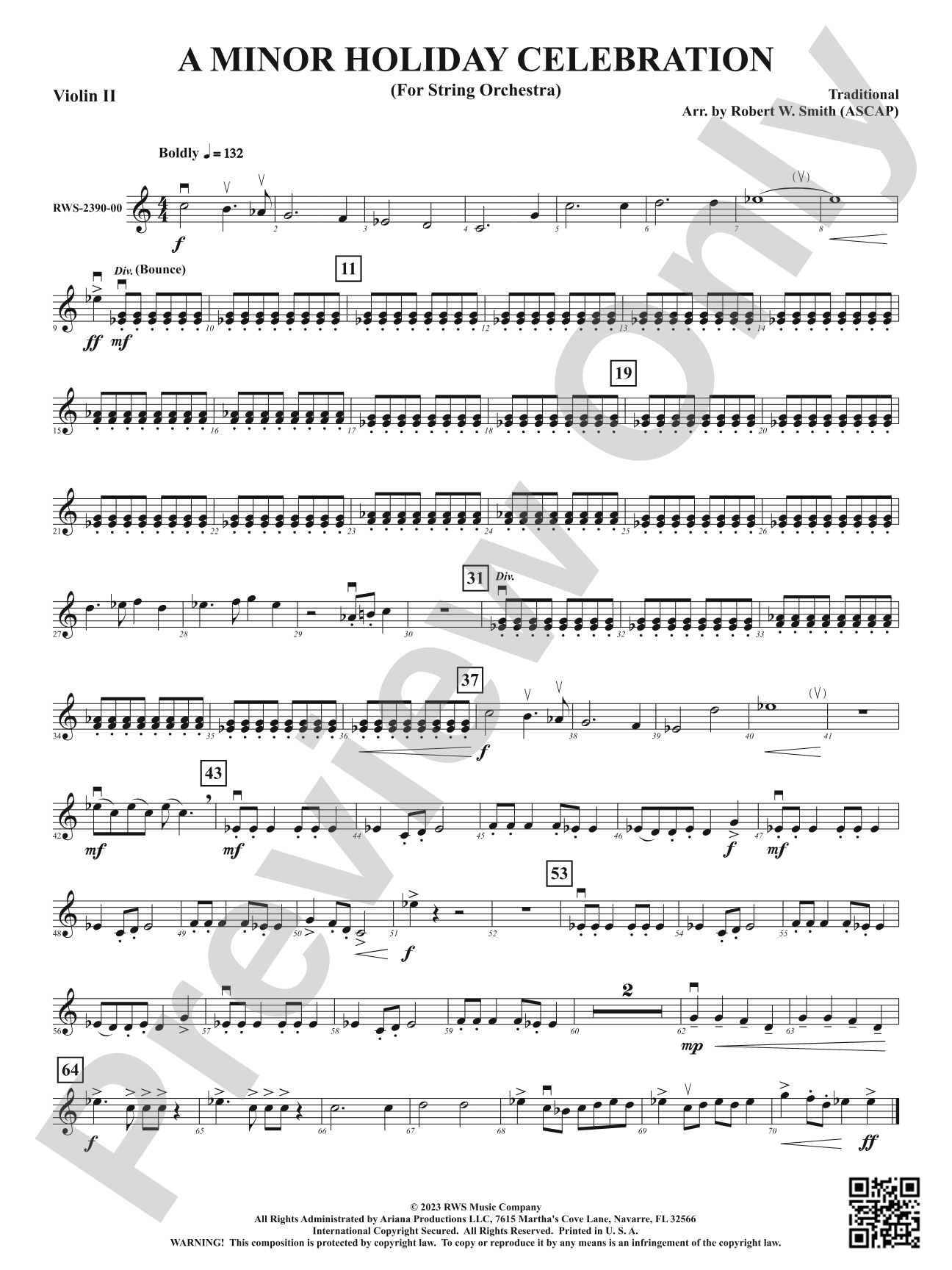

A Minor Holiday Celebration - For String Orchestra: 2nd Violin
For String Orchestra
Arranged by Robert W. Smith
Grade: 2.5
Item: 98-PC-RWS2390_VN2
$5.99
Pickup currently not available
Description
Two Christmas classics have been masterfully re-arranged into a harmonic minor mode providing a new twist on these holiday favorites for string orchestra. Robert W. Smith has woven together "Joy To The World," "Deck The Halls" and "Jingle Bells" with quotes from other familiar melodies including "The Dreidel Song" and "Hallelujah Chorus" A very effective addition to the holiday repertoire for developing strings.
Original Item#: RWS-2390-00


Original Item#: RWS-2390-00
Discover MakeMusic Cloud: thousands of interactive titles your students can play along with today.
Sample Audio
1
Audio File
--:--
0:00
0:00
Sample Video
No sample videos found.
Additional Details
Series:
RWS - Developing Strings
Publisher:
RWS Music Company
SKU:
98-PC-RWS2390_VN2
More about this title
About the Arranger: Robert W. Smith

Robert W. Smith stands among the most recorded composers of orchestral and band music working in America. His catalog exceeds 400 published works, the vast majority released through Alfred Music, and his pieces are performed regularly by ensembles across North America, Europe, Australia, and Asia. He holds degrees in music education from Troy State University and a master's degree from the University of Miami.
Beyond the concert hall, Smith's music has appeared on major television broadcasts, Olympic ceremonies, and ceremonial events spanning from presidential welcomes in Japan to opening day festivities at Dodger Stadium. His symphonies and works for developing ensembles (including The Tempest and The Divine Comedy) have become foundational repertoire in American schools. As a guest conductor and clinician, he has worked with orchestras and bands across multiple continents, bringing direct knowledge of what works for musicians at every level.
Why we love this
Smith transforms familiar holiday melodies into a cohesive harmonic narrative by casting them in minor mode, giving young musicians something genuinely fresh to play rather than yet another straightforward seasonal arrangement. The interwoven quotes from "The Dreidel Song" and the "Hallelujah Chorus" add musical sophistication without overwhelming Grade 2.5 players, and the accessibility of this piece makes holiday programming feel intentional rather than obligatory.
What to expect
These holiday classics arrive in unexpected minor-key territory, giving them an almost wistful or meditative quality rather than purely joyful energy. The interwoven melodies and harmonic sophistication create a tapestry that feels more like a string arrangement than a reduction, maintaining genuine artistic substance from opening to closing.
Who it's for
String orchestra directors looking for a Grade 2.5 holiday piece that respects their students' musicality and doesn't rely on novelty or gimmick. Ensembles performing a mixed winter concert (not exclusively Christmas) will find the minor mode and secular/sacred blend of quotations genuinely inclusive for diverse audiences.
How to get the most out of it
- Lean into the minor tonality as a dramatic choice rather than treating it like a transposition problem. Encourage the orchestra to listen for how the familiar melodies sound darker and more introspective in this harmonic context.
- Balance the layered quotations carefully during tutti passages so no single melody overwhelms the weaving. Mark cues lightly in the parts so players know when their material is primary versus textural.
- Shape phrase endings with slight ritardandos where Smith indicates them; this gives the arrangements space to breathe and prevents the medley feel from becoming rushed.
How to use it
Program this as your centerpiece holiday selection rather than filler, pairing it with a contrasting work in a major key to highlight Smith's harmonic reimagining. It works equally well as a concert opener or as a transition piece between contrasting halves of a winter program, giving audiences something musically substantive to anchor a seasonal concert.
Skills your students will build
- Reading in harmonic minor and identifying familiar melodies across transpositions
- Maintaining ensemble balance when multiple melodic lines occur simultaneously
- Sustaining intonation in minor-key passages, particularly in lower strings
- Responding to phrase-shape and ritardando markings for expressive maturity