
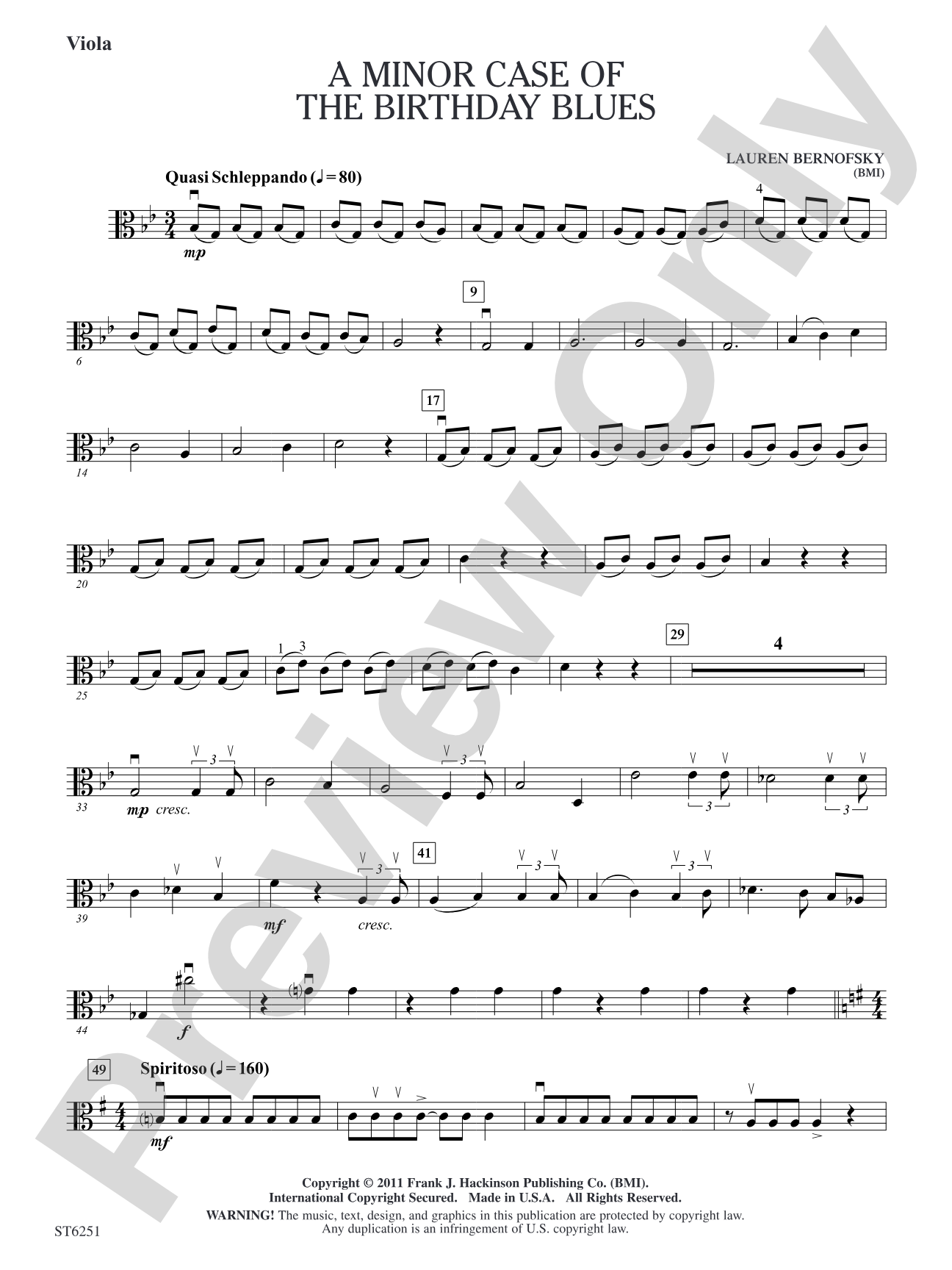

A Minor Case of the Birthday Blues: Viola
By Lauren Bernofsky
Grade: 3.5
Item: 98-PC-DST6251_VA1
$7.00
Pickup currently not available
Description
Even the most humbug-y of audience members will have to laugh at this new take on the traditional birthday song. After the melody is presented in a minor key, it works its way through a series of tongue-in-cheek "serious" transitions before arriving at a zany calypso setting (complete with maracas and claves!). Through all its silliness, the piece is actually a great teaching tool for many techniques your students will encounter in symphonic music, such as imitation, chromatics, tremolo, triplets, and more. Don't forget the cake!


Don't just read it, hear it, play along with it, and watch your students grow with it. In MakeMusic Cloud, A Minor Case of the Birthday Blues: Viola comes alive with professional accompaniment, adjustable tempo, and built-in practice tools that turn solo practice into real progress.
Open in the Player
Jump straight in and assign it today.
Start Your Free Trial
Open this title and explore the full library in minutes.
Sample Audio
1
Audio File
--:--
0:00
0:00
Sample Video
No sample videos found.
Additional Details
Series:
FJH String Orchestra
Publisher:
The FJH Music Company, Inc.
SKU:
98-PC-DST6251_VA1
More about this title
About the Composer: Lauren Bernofsky

Lauren Bernofsky composes across orchestral, operatic, chamber, and choral idioms with a voice that Lukas Foss recognized as masterful. Her catalog exceeds a hundred works, many commissioned by ensembles ranging from chamber groups to regional orchestras and ballet companies. Her accolades include the National Flute Association's Newly Published Music Competition, the Opera Puppets Award at Boston Metro Opera, and recognition as the winning entry of the Dalai Lama Composition Contest, where her choral work Prayer of Shantideva was premiered in the presence of the Dalai Lama himself.
Bernofsky studied violin and composition at The Hartt School, earned a Master's degree at the New England Conservatory, and completed her doctorate in composition at Boston University. She has taught at the Peabody Institute and Interlochen Center for the Arts, and her work has been featured on PBS and in scholarly publications worldwide. Her music is consistently praised for bridging emotional depth with intellectual rigor, blending technical sophistication with lyrical invention.
Why we love this
Bernofsky takes a familiar form and mines it for genuine musicality without sacrificing the joke. The transitions between sections are crafted with real compositional wit, and students encounter legitimate technical challenges (imitation, chromaticism, tremolo, triplets) wrapped in a story that keeps audiences engaged. It's the rare novelty piece that works equally well as concert entertainment and as a teaching vehicle.
What to expect
A wink delivered with polish. The piece begins with genuine minor-key melancholy before spiraling through increasingly absurd interpretations of the birthday song, landing in a infectious calypso groove that feels both ridiculous and irresistible. By the final bars, audiences and performers alike understand they've been on a musical journey rather than sitting through a gimmick.
Who it's for
String orchestras at the Grade 3.5 level who want a concert opener or finale with real substance beneath its humor. Directors seeking material that engages audiences while teaching genuine orchestral technique will find this particularly valuable.
How to get the most out of it
- Lean into the minor key opening with a warm, almost mournful tone. The humor lands harder when the birthday song sounds genuinely blue at first.
- The "serious" transitions ask for clean, coordinated articulation across the section. Rehearse the chromatic passages separately to lock the intonation.
- Let the calypso section breathe. The maracas and claves need room to shine without drowning the strings, so balance carefully in rehearsal.
- Conduct the triplet figures with clarity. They shift the rhythmic feel, and precision here prevents the piece from feeling sloppy rather than playful.
How to use it
Deploy this as a concert finale to send audiences home smiling, or pair it with a more serious opening work to demonstrate range and versatility. It works particularly well in a spring concert where students have earned the right to play something purely fun, or in a festival context where the novelty and technical demands both shine under fresh ears.
Skills your students will build
- Imitation and fugal writing techniques
- Chromatic voice leading and intonation in altered harmony
- Tremolo execution with dynamic control
- Triplet rhythms against the prevailing meter
- Stylistic contrast and tonal character shifts
- Ensemble balance across multiple textures