
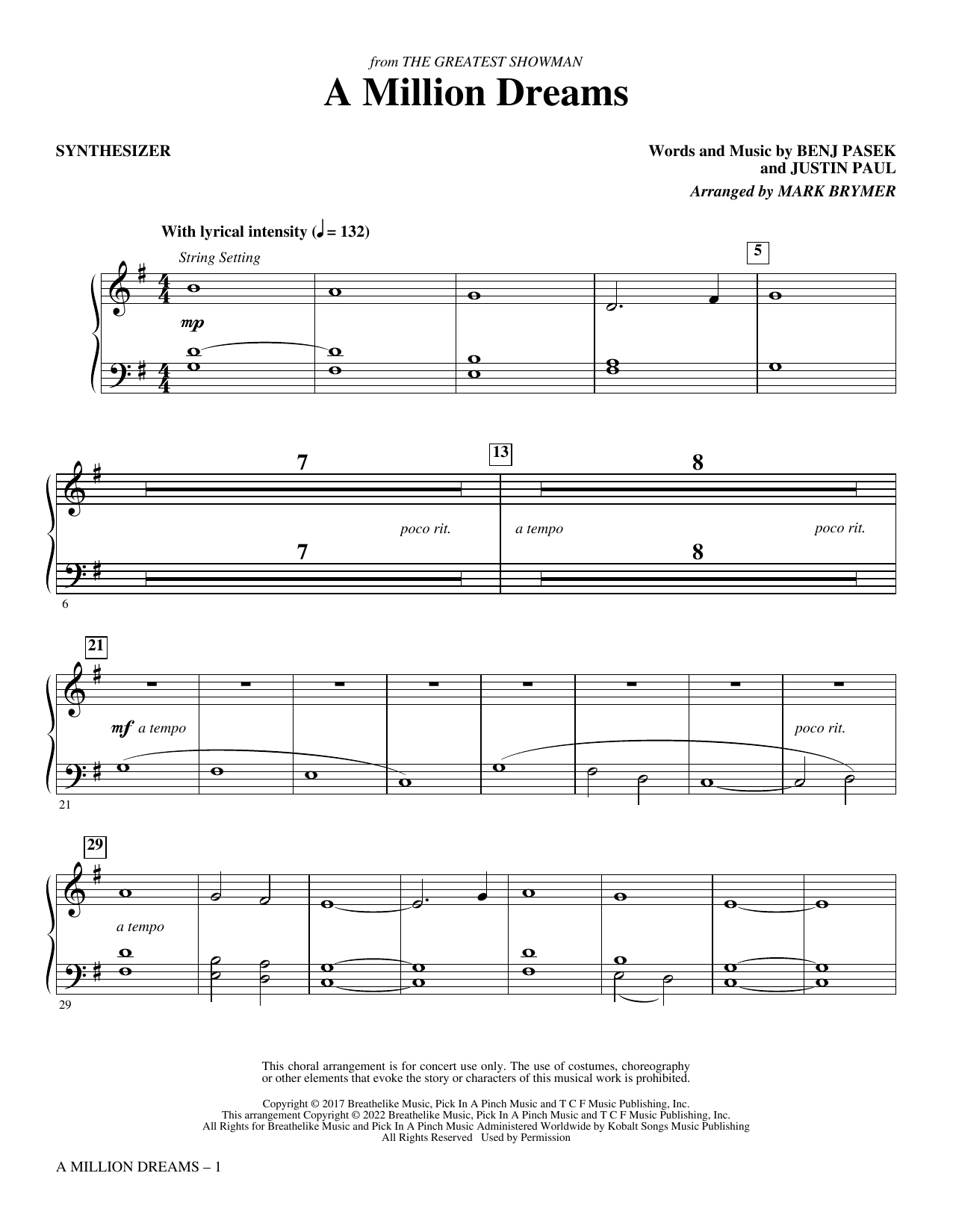

A Million Dreams (from The Greatest Showman) (arr. Mark Brymer): SATB Choral Octavo
Item: 35-PK00680036
$20.00
Pickup currently not available
Buy Extra Parts (Digital PDF Download)
Parts Added to Cart!
Description


A Million Dreams (from The Greatest Showman) (arr. Mark Brymer): SATB Choral Octavo isn't in MakeMusic Cloud just yet...but it could be. Let us know you'd like to see it, and you'll help shape what comes next. In the meantime, start a free trial and dive into thousands of interactive titles your students can play along with today.
Request This Title
Tell us you want it.
Start Your Free Trial
Explore everything that's ready to play right now.
Sample Audio
No sample audio found.
Sample Video
No sample videos found.
Additional Details
Publisher:
Hal Leonard
Page Count:
17
SKU:
35-PK00680036
More about this title
About the Composer: Pasek Paul
Pasek and Paul are the songwriting duo behind The Greatest Showman, the 2017 musical film that introduced "A Million Dreams" to global audiences. Their work on the film earned them an Academy Award nomination and established them as major voices in contemporary musical theatre songwriting. Beyond The Greatest Showman, they have composed for other theatrical projects and continue to shape the landscape of modern musical theatre.
Why we love this
Mark Brymer's arrangement captures the soaring optimism of the original while making it genuinely singable for mixed choirs of varying ability levels. The writing respects the melody's accessibility while adding enough harmonic color to keep singers engaged and the piece musically substantial. Your singers will connect immediately to this material because it lives in their cultural moment.
What to expect
The piece radiates genuine warmth and forward motion. There's an earnestness to the harmony that avoids schmaltz while celebrating the kind of big, optimistic emotions that make audiences lean in. Singing this creates a feeling of uplift that lingers after rehearsal ends.
Who it's for
This works for concert choirs, festival preparations, and pop repertoire units at the high school and early collegiate levels. It's equally at home in a community chorus looking to program something current and accessible. The 17-page score suggests that while singable, it demands solid musicianship and attention to part independence.
How to get the most out of it
- Balance the melody line across voice parts early in rehearsal so all singers understand where the tune sits at any given moment, especially through key modulations.
- Encourage sustained legit tone rather than belted sound; the arrangement's strength lies in its choral elegance, not theatrical oversinging.
- Pay attention to phrase shape and breathe intentionally between phrases to maintain the song's narrative arc and emotional momentum.
- Use the recorded accompaniment sparingly during early rehearsals to develop independent reading, then layer it in as intonation and confidence solidify.
How to use it
Program this in a second-half slot where you want to shift mood and reconnect with your audience's emotional investment in the concert. It pairs well alongside other contemporary musical theatre selections or serves as a bridge between classical repertoire and more modern programming. The piece also works as a standalone showcase for a winter concert or spring pops program.
Skills your students will build
- Sustaining legit, non-belted vocal production across phrase lengths
- Tracking melodic material across multiple voice parts and key areas
- Part independence within homophonic texture
- Shaping long phrases with appropriate dynamics and breath control
- Balancing familiar melodic content with ensemble blend