A Mighty Fortress Is Our God Sheet Music Preview

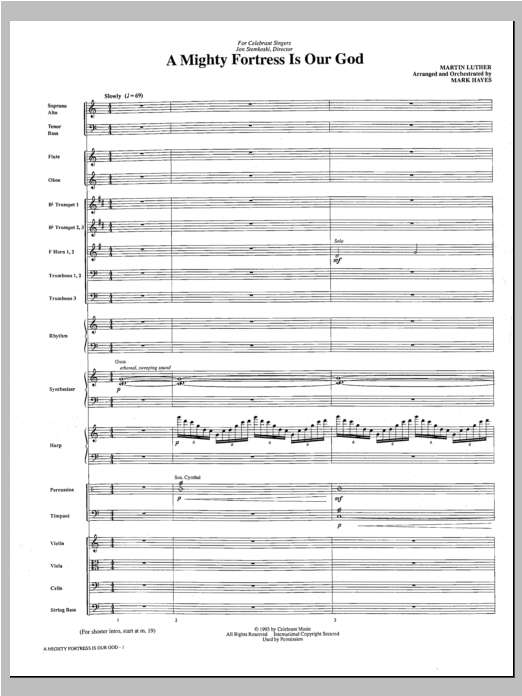
A Mighty Fortress Is Our God: Choral Instrumental Pak

By Martin Luther / Arranged by Mark Hayes

Item: 35-PK00253332

Digital Download
$74.95

One moment…

Description
In this contemporary setting of Martin Luther's timeless hymn, vigorous rhythms and creative harmonies emphasize the powerful text. Use the fully-orchestrated accompaniment to further enhance this dramatic arrangement.

A Mighty Fortress Is Our God: Choral Instrumental Pak isn't in MakeMusic Cloud just yet...but it could be. Let us know you'd like to see it, and you'll help shape what comes next. In the meantime, start a free trial and dive into thousands of interactive titles your students can play along with today.

Sample Audio
No sample audio found.
Sample Video
Additional Details
Publisher: Hal Leonard
SKU: 35-PK00253332

More about this title

About the Composer: Martin Luther

Martin Luther (1483-1546) was a theologian and religious reformer whose influence extended far beyond doctrine into the musical life of the church. He believed congregational singing was essential to worship and composed or adapted numerous hymn texts and melodies that became foundational to Protestant sacred music. His hymns remain central to choral repertoire today, studied and performed by choirs seeking to understand the intersection of theology, text, and musical expression.

Why we love this

Mark Hayes's treatment of this Reformation staple strips away gentleness and leans into the fortress metaphor with rhythmic drive and harmonic color. The fully orchestrated accompaniment transforms what could feel antiquarian into something with real dramatic stakes, making it equally powerful in a concert setting or sacred context.

What to expect

Energetic and declarative. The driving rhythms and creative harmonies create a sense of conviction and forward momentum, transforming a familiar hymn into something that commands attention without losing its spiritual core.

Who it's for

Choirs looking for substantial sacred repertoire with orchestral scope and modern compositional thinking. This works well for mixed ensembles seeking concert pieces that honor hymn traditions while avoiding arrangement clichés.

How to get the most out of it

  • Balance the choir's rhythmic energy with the orchestral foundation; the accompaniment track supports rather than overpowers, so singers must commit to their part's forward motion.
  • Pay attention to Hayes's harmonic language in the arrangement; unexpected chord progressions reward listeners who have heard the tune in its traditional form.
  • Shape the text with attention to Luther's powerful language about faith and protection; the vigorous rhythms should serve the meaning, not obscure it.

How to use it

Pair this with lighter contemporary sacred works or use it as an anchor for a concert built around Reformation themes and music. The orchestral accompaniment makes it particularly effective as a closing number where its dramatic weight can resonate with an audience.

Skills your students will build

  • Singing with rhythmic precision in a contemporary harmonic context
  • Balancing choral blend with orchestral accompaniment
  • Interpreting text through Hayes's dynamic and harmonic choices
  • Managing ensemble articulation in rhythmically active passages

You May Also Like