
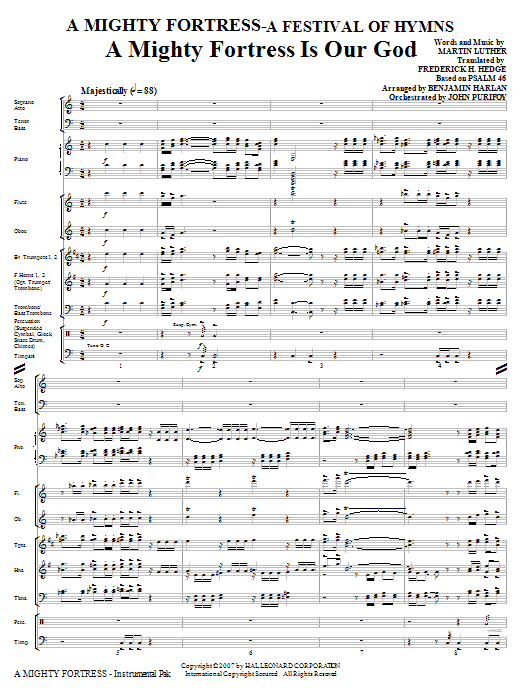

A Mighty Fortress - A Festival of Hymns: Choral Instrumental Pak
As performed by Benjamin Harlan
Item: 35-PK00037045
$60.00
Pickup currently not available
Buy Extra Parts (Digital PDF Download)
Parts Added to Cart!
Description
Six settings of beloved hymns for choir, congregation and orchestra. Service readings and responses are also included featuring scripture passages and historical origins of each hymn. Ideally suited for a community-wide hymn festival or as a service of worship. Titles include "A Mighty Fortress Is Our God," "The Church's One Foundation," "Abide with Me," "Praise God, from Whom All Blessings Flow," "For All the Saints," and "All Creatures of Our God and King." Instrumental ePak includes score and parts for Flute, Oboe, Trumpet 1, 2, Horn 1, 2 (sub. Trumpet/Trombone), Trombone, Bass Trombone, Timpani and Percussion. Duration (if performed as entire work): Approx. 25 min.


A Mighty Fortress - A Festival of Hymns: Choral Instrumental Pak isn't in MakeMusic Cloud just yet...but it could be. Let us know you'd like to see it, and you'll help shape what comes next. In the meantime, start a free trial and dive into thousands of interactive titles your students can play along with today.
Request This Title
Tell us you want it.
Start Your Free Trial
Explore everything that's ready to play right now.
Sample Audio
No sample audio found.
Sample Video
No sample videos found.
Additional Details
Publisher:
Hal Leonard
SKU:
35-PK00037045
More about this title
About the Artist: Benjamin Harlan
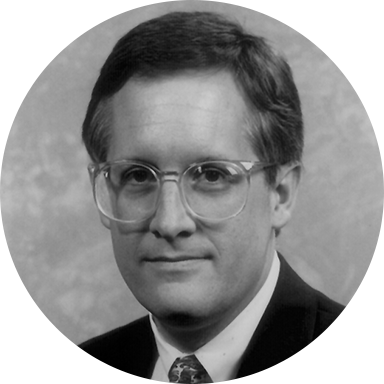
Benjamin Harlan serves as Dean of the School of Church Music at Southwestern Baptist Theological Seminary in Fort Worth, Texas, where he shapes the next generation of church musicians. His compositions and arrangements appear across the catalogs of major music publishers, and he has earned ASCAP recognition annually since 1990. He holds degrees from Baylor University (B.M. and M.M.) and a D.M.A. from SBTS, and maintains active membership in the American Choral Directors Association, ASCAP, and the Southern Baptist Church Music Conference.
Harlan's career reflects deep roots in congregational music. He has served as Associate Professor at New Orleans Baptist Theological Seminary and held positions as Minister of Music at several Louisiana churches before his current academic role. His work consistently bridges the gap between scholarly rigor and the practical needs of church musicians and worship leaders.
Why we love this
Harlan gives you six substantial hymn settings that work equally well in a festival context or as a complete worship service, with the added bonus of scripture readings and historical notes. The orchestration is practical without being thin; the instrumental ePak covers the full range of a mid-size ensemble without demanding resources most communities cannot field. This is the kind of repertoire that brings genuine joy to both singers and audiences because it honors the hymns themselves while giving them fresh musical life.
What to expect
Reverent yet alive. These arrangements honor the timeless melodies while the orchestration brings color and depth without overwhelming the text. There is real warmth here, especially when voices and instruments lock together in the fuller sections, and the variety across the six hymns keeps the whole program from feeling repetitive even at 25 minutes.
Who it's for
Church music directors and choir conductors planning a hymn festival or special worship service, and conductors seeking quality arrangements that can accommodate both singers and congregation. This works equally well for a mid-size community church with a volunteer choir and orchestra as it does for a university or seminary chapel.
How to get the most out of it
- Balance the choir and orchestra carefully during full ensemble passages. The brass and timpani can easily overshadow singers who are less experienced with projecting over orchestral accompaniment.
- Rehearse the congregation's role separately if you plan to include them. Mark clear cutoffs and entry points so they know exactly when to join the paid singers.
- Use the provided historical notes and scripture readings in your bulletin or program booklet. They deepen the listening experience and help congregants reconnect with why these hymns matter.
- Shape the longer settings with intentional tempo variation and dynamic contrast. These are not background music; each hymn deserves its own interpretive arc.
How to use it
Build an entire worship service or special festival around this collection, or extract individual settings to anchor a concert featuring other choral works. This is equally at home as a Thanksgiving or Christmas season offering, a reformation-themed service, or a general celebration of hymn traditions.
Skills your students will build
- Blending choir and orchestra in hymn-based repertoire
- Conducting and shaping sectional textures (choir alone, orchestra alone, full ensemble)
- Sight-reading orchestral parts for winds and brass
- Understanding harmonic language within traditional hymn contexts
- Collaborative musicianship across choir and instrumental musicians