
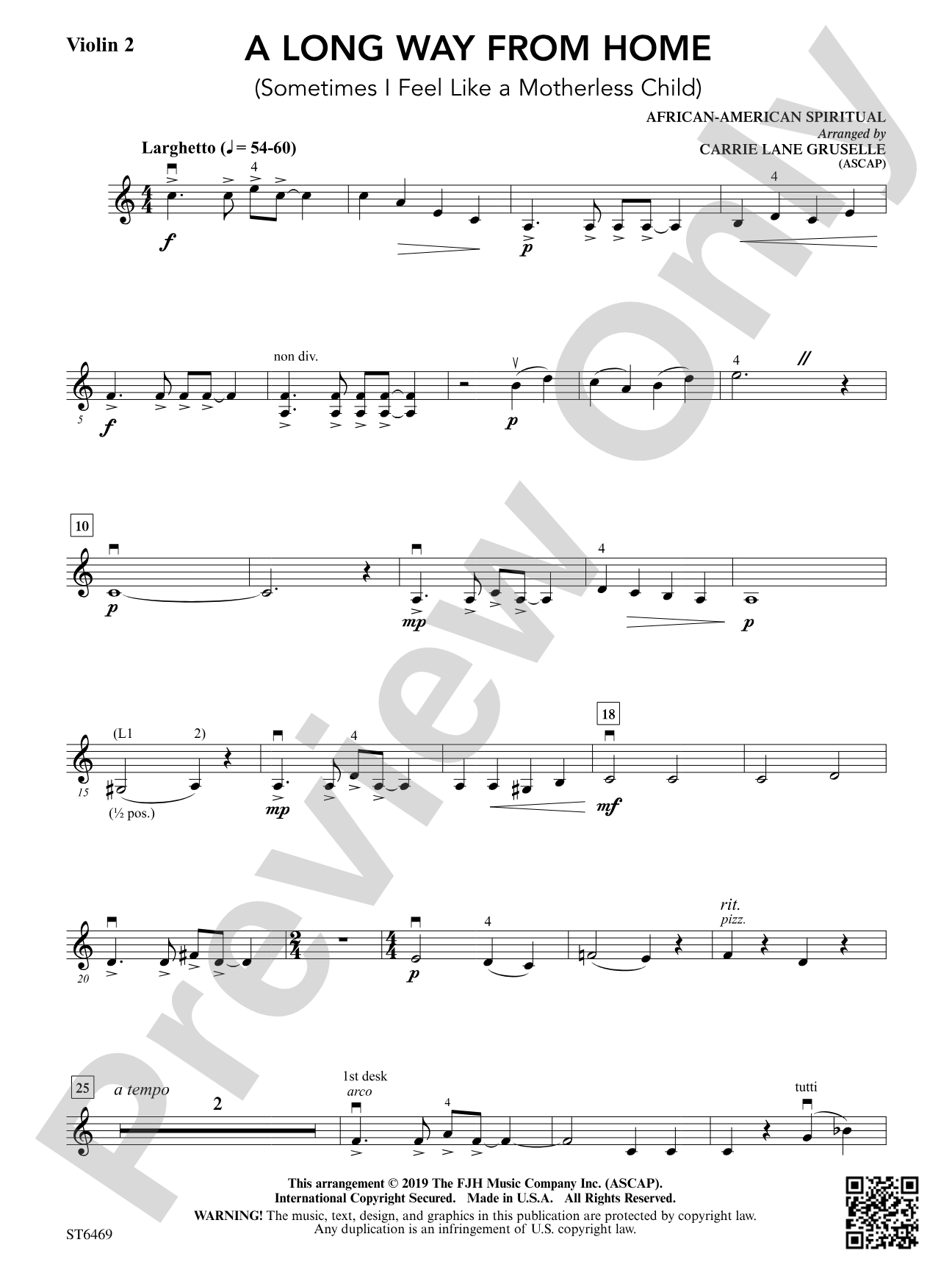

A Long Way from Home: Violin 2
Arranged by Carrie Lane Gruselle
Grade: 3.5
Item: 98-PC-DST6469_VN2
$7.00
Pickup currently not available
Description
From the intensity of despair and despondency to the tranquility of peace and hope, this arrangement will challenge the musical maturity of your group. The opening violin solo leads to a range of textures and harmonic twists as the music takes the listener on a beautiful, yet intense emotional journey. Stunning.


A Long Way from Home: Violin 2 isn't in MakeMusic Cloud just yet...but it could be. Let us know you'd like to see it, and you'll help shape what comes next. In the meantime, start a free trial and dive into thousands of interactive titles your students can play along with today.
Request This Title
Tell us you want it.
Start Your Free Trial
Explore everything that's ready to play right now.
Sample Audio
1
Audio File
--:--
0:00
0:00
Sample Video
Additional Details
Series:
FJH String Orchestra
Publisher:
The FJH Music Company, Inc.
SKU:
98-PC-DST6469_VN2
More about this title
About the Arranger: Carrie Lane Gruselle

Carrie Lane Gruselle earned her Bachelor of Music Education from the University of Wisconsin–Eau Claire and went on to complete a Master of Music Education with Suzuki emphasis from the University of Wisconsin–Stevens Point. She has taught elementary and middle level strings for the Appleton Area School District while also serving as cello instructor for the Lawrence University Arts Academy in Appleton, Wisconsin.
Gruselle's background in both traditional string pedagogy and Suzuki methodology informs her approach to arranging. Her work bridges accessible musicality with genuine artistic depth, creating pieces that respect young musicians' capabilities while refusing to compromise on emotional authenticity.
Why we love this
This arrangement captures genuine emotional architecture without relying on saccharine orchestration. The opening violin solo immediately establishes vulnerability, and Gruselle's harmonic choices throughout create real musical tension rather than simply layering parts. At Grade 3.5, the writing respects what young string players can execute while demanding real interpretive maturity from your ensemble.
What to expect
The opening catches you in isolation; a single voice reaching outward. As layers accumulate, the harmonic landscape becomes more complex and sometimes unsettled, mirroring internal struggle. By the end, that complexity resolves into genuine serenity, not glossy resolution but earned peace.
Who it's for
This score suits string orchestras at the intermediate-advanced level who are ready to engage with emotional storytelling through arrangement. Your students should have foundational ensemble skills and enough individual security to balance support of a narrative arc with their own technical demands.
How to get the most out of it
- Shape the opening violin solo as a character study. This isn't virtuosity for its own sake; the soloist sets an emotional tone that colors everything that follows. Encourage rubato and genuine phrasing rather than metronomic accuracy.
- Balance texture shifts carefully. When harmonic complexity enters, resist the urge to simply play louder. The piece's power comes from color and independence between sections, not volume.
- Attend to tuning during sustained passages and chord changes. The 'tranquility' described in the piece won't register if intonation becomes muddy during those vulnerable moments.
- Mark the transition from despair to hope explicitly in rehearsal. Your musicians need to understand this emotional arc is intentional, not accidental shifts in dynamics or tempo.
How to use it
Program this piece as a centerpiece for a concert exploring spirituality and resilience across cultures. Its relatively compact scope makes it an ideal pairing with contrasting repertoire; consider placing it between a bright opening work and something else substantial to avoid programming fatigue. This also works effectively in festival or contest contexts where emotional maturity and ensemble cohesion carry weight.
Skills your students will build
- Reading and executing varied harmonic textures within a Grade 3.5 idiom
- Balancing solo and ensemble roles while maintaining ensemble integrity
- Shaping long-form emotional narratives through phrasing and dynamic nuance
- Sustaining intonation and tone quality during extended passages
- Responding to shifts in musical character and tempo relationships