
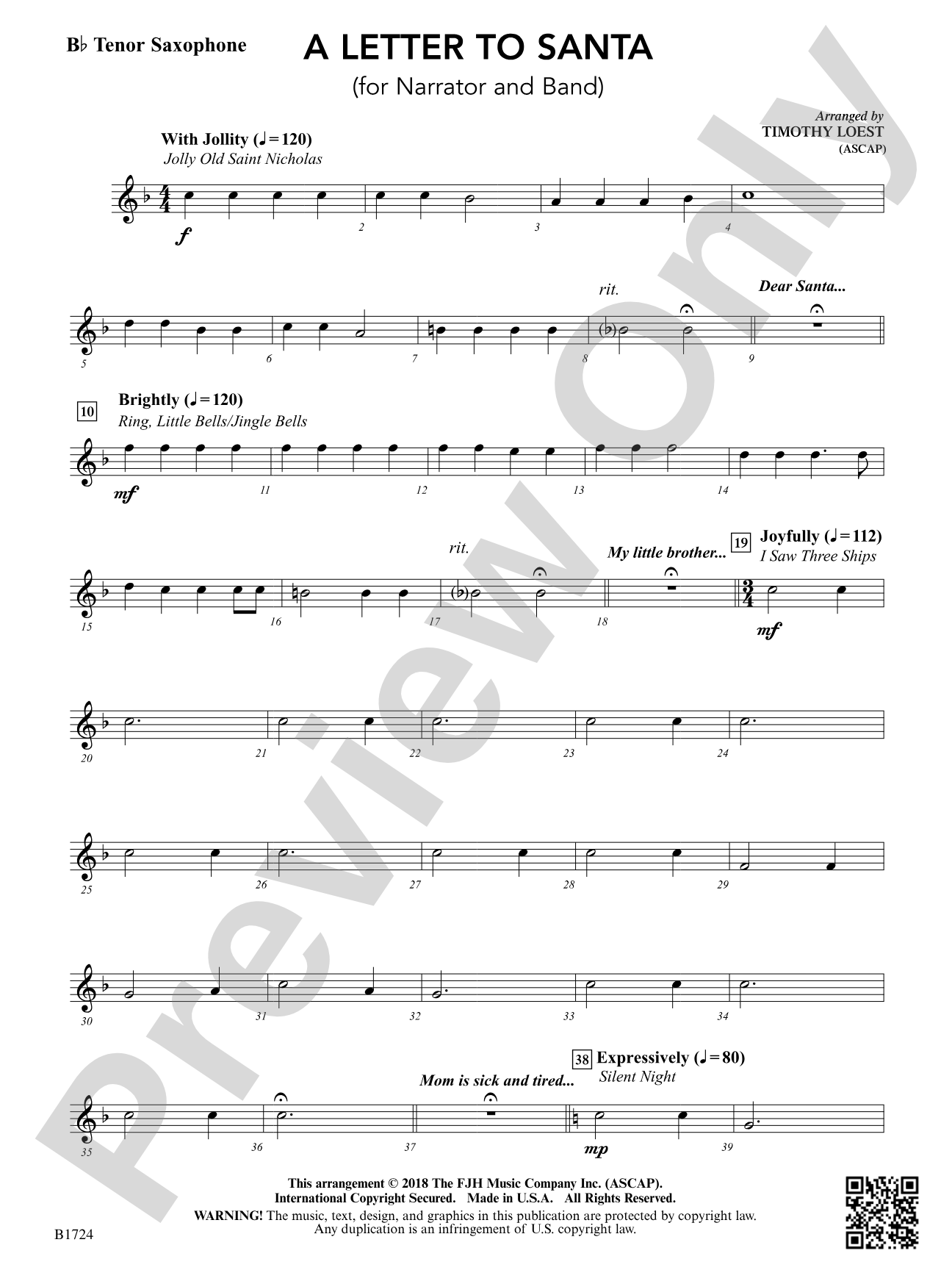

A Letter to Santa: B-flat Tenor Saxophone
Arranged by Timothy Loest
Grade: 1;1.5
Item: 98-PC-DB1724_TX1
$7.00
Pickup currently not available
Description
This magical work for student narrator(s) and band brings to life the centuries old tradition of writing a letter to Santa. Beginning with Jolly Old St. Nicholas and ending with We Wish You a Merry Christmas, each gift request is followed by a delightfully arranged carol including Ring Little Bells, Jingle Bells, I Saw Three Ships, Silent Night, O Christmas Tree, I Have a Little Dreidel, and Auld Lang Syne. An adorable yuletide gem destined to be the hit of your next holiday program!


Don't just read it, hear it, play along with it, and watch your students grow with it. In MakeMusic Cloud, A Letter to Santa: B-flat Tenor Saxophone comes alive with professional accompaniment, adjustable tempo, and built-in practice tools that turn solo practice into real progress.
Open in the Player
Jump straight in and assign it today.
Start Your Free Trial
Open this title and explore the full library in minutes.
Sample Audio
1
Audio File
--:--
0:00
0:00
Sample Video
Additional Details
Series:
FJH Beginning Band
Publisher:
The FJH Music Company, Inc.
SKU:
98-PC-DB1724_TX1
More about this title
About the Arranger: Timothy Loest

Timothy Loest has spent over three decades in the classroom, where his deep understanding of student musicians directly informs every arrangement and composition he writes. His works have reached audiences globally, from performances at Chicago's Millennium Park to appearances on network television programs including The Tonight Show Starring Jimmy Fallon and Good Morning America. In 2017, he received the Illinois Grade School Music Association's highest honor, the Cloyd Myers Memorial Award for Excellence in Music Education, recognizing his sustained impact on young musicians and music educators.
Loest's publishing history spans four decades and includes collaborations with major music publishers including Warner Bros. Publications, C.L. Barnhouse Company, and FJH Music Company. He is known for his pedagogical method books, most notably Measures of Success: A Comprehensive Musicianship Band Method, which has shaped instrumental instruction nationwide. In 2022, he founded Fanfare Music Press to continue producing high-quality band compositions and arrangements. Loest holds degrees from Illinois State University and Northwestern University and maintains membership in ASCAP.
Why we love this
Loest structures this piece so that the narrator's conversational letter-writing frames familiar carols, turning each song into a gift request that lands with genuine charm rather than saccharine sentiment. The arrangement choices respect young players' technical limitations while keeping the sound full and celebratory; younger bands won't feel like they're playing 'simplified' versions. Programming this guarantees an audience moment that feels both genuinely theatrical and immediately accessible to your community.
What to expect
Nostalgic and playful, moving from the anticipation in a child's letter to Santa through beloved carols that audiences recognize immediately. The piece captures the simplicity and genuine wonder of the season without cynicism, letting young musicians share something genuinely joyful rather than overly produced.
Who it's for
This score and parts collection is designed for Grade 1 and 1.5 bands performing holiday concerts where mixing spoken word and instrumental music creates programming variety and audience engagement. The straightforward arrangements and familiar melodies make this accessible to bands new to programming narrated works or those with limited rehearsal time before a winter concert.
How to get the most out of it
- Balance the narrator's voice with the band by positioning them downstage or using a subtle microphone; the story matters as much as the instrumental sound, so clarity of spoken text prevents the band from drowning out the dramatic arc.
- Let younger students experience the joy of playing familiar melodies by assigning carols to different sections (woodwinds on one verse, full band on the next); this keeps attention high and gives everyone a featured moment.
- Shape phrasing around the narrator's natural speech rhythm rather than imposing strict metronomic timing; a slight flexibility between spoken and sung sections creates intimacy.
- Assign the narrator role to a student or parent with genuine comfort on stage; confidence in storytelling makes the piece memorable regardless of musical polish.
How to use it
Place this as the finale or centerpiece of a holiday concert where it can anchor the show with both musical substance and theatrical engagement; the variety of carols sustains audience interest longer than a single selection. Alternatively, program it early in the concert to establish a warm, inclusive tone before transitioning to other seasonal or classical repertoire.
Skills your students will build
- Balancing ensemble tone across multiple melodic phrases
- Playing recognizable melodies with stylistic consistency across different orchestrations
- Responding to conductor cues while maintaining musical independence in ensemble sections
- Adapting tempo and phrasing to accommodate a spoken narrator
- Reading and executing Grade 1-1.5 range articulations and dynamics across diverse carols