
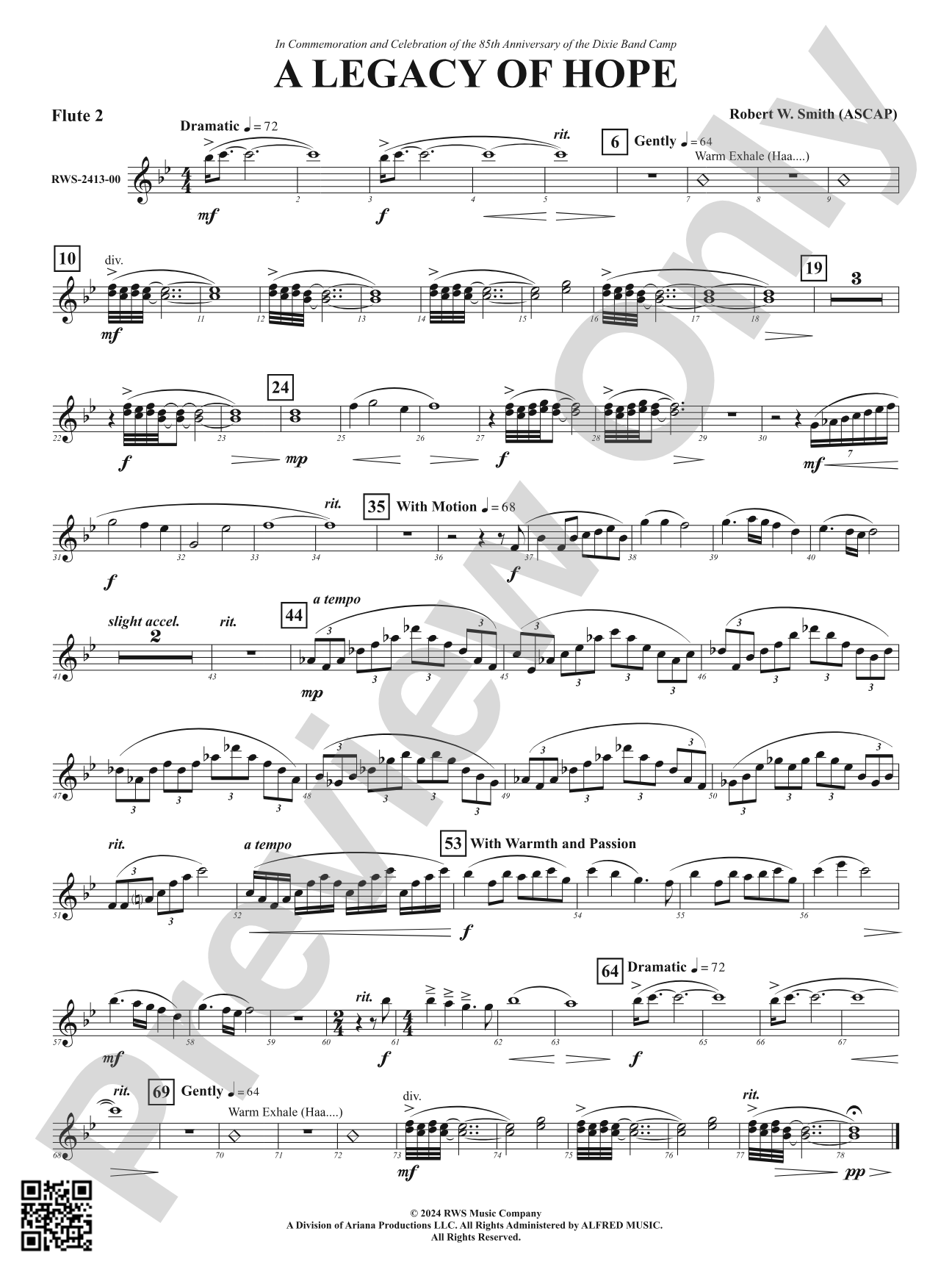

A Legacy of Hope: 2nd Flute
By Robert W. Smith
Grade: 4.5
Item: 98-PC-RWS2413_F2
$3.99
Pickup currently not available
Description
Written as a commission in celebration of a loving and innovative music educator and the 85th Anniversary of the Dixie Band Camp, A Legacy of Hope is beautiful final statement from Robert W. Smith, filled with soaring lines and masterful scoring. The impact of every teacher is their legacy of hope. You will want to explore this musical journey and make a special musical memory for your students with this meaningful work.(4:51)


A Legacy of Hope: 2nd Flute isn't in MakeMusic Cloud just yet...but it could be. Let us know you'd like to see it, and you'll help shape what comes next. In the meantime, start a free trial and dive into thousands of interactive titles your students can play along with today.
Request This Title
Tell us you want it.
Start Your Free Trial
Explore everything that's ready to play right now.
Sample Audio
1
Audio File
--:--
0:00
0:00
Sample Video
Additional Details
Series:
RWS - Symphony Band
Publisher:
RWS Music Company
SKU:
98-PC-RWS2413_F2
More about this title
About the Composer: Robert W. Smith

Robert W. Smith has established himself as a defining voice in American concert band and orchestral composition, with over 400 published works performed across North America, Europe, Australia, and Asia. He holds degrees in music education from Troy State University and a master's degree from the University of Miami, and has worked extensively as both a conductor and clinician on international stages.
Smith's catalog includes ambitious large-scale works like his symphonies The Divine Comedy and The Odyssey, as well as foundational pieces for developing ensembles that have become repertoire standards. His music has appeared in contexts ranging from Olympic broadcasts to presidential ceremonies and major network television events, reflecting the broad appeal and craftsmanship of his writing.
Why we love this
A Legacy of Hope arrives as Smith's final statement to the concert band world, combining emotional resonance with the sophisticated orchestration you expect from a master of the medium. This commemoration of a transformative educator and the Dixie Band Camp's 85-year legacy gives the piece a genuine narrative weight that resonates with conductors seeking repertoire with substance and meaning. The soaring melodic writing and careful scoring make it immediately engaging for students while offering enough musical depth to reward serious preparation.
What to expect
A Legacy of Hope unfolds with warmth and aspiration, its soaring melodies suggesting both reflection and forward motion. The orchestration carries a sense of importance without heaviness, inviting the ensemble into a musical conversation about growth, inspiration, and the ripple effects of excellent teaching. There's an understated dignity here, the feeling of witnessing something both personal and universal.
Who it's for
Directors programming a concert band festival or contest event will find A Legacy of Hope both accessible and impressive for Grade 4.5 ensembles. The piece engages students across all sections with meaningful musical material while remaining performable without excessive rehearsal time. It pairs well with programs that include both lighter fare and serious artistic statements, filling the role of a centerpiece work that audiences remember.
How to get the most out of it
- Shape the soaring lines with long-term phrasing rather than stopping at phrase marks; let the melodic arcs breathe across full sections to capture the emotional arc Smith intended.
- Balance the inner harmonic voices carefully during sustained chords, especially in the woodwinds and brass, so the piece's richness emerges without losing transparency.
- Attend to dynamic transitions between sections to avoid abrupt shifts; many of Smith's most effective moments come from gradual builds and gentle reductions that reflect the work's contemplative character.
- Invest time in rhythmic precision during mixed-meter passages to maintain the forward momentum Smith establishes, allowing the piece to flow naturally rather than feeling mechanically managed.
How to use it
Feature this as the closing work on a concert celebrating educational milestones, anniversaries, or themes of growth and mentorship. Its moderate length (4:51) makes it an ideal centerpiece that holds attention without dominating the program, and its accessible grade level ensures broad musical engagement from your ensemble. Consider pairing it with music from different eras to highlight its role as a contemporary statement piece that honors tradition while looking forward.
Skills your students will build
- Sustaining long melodic lines with consistent tone and control
- Balancing chords within dense harmonic textures
- Executing clean dynamic transitions across full ensemble sections
- Responding to expressive conducting cues in contemporary concert band literature
- Maintaining phrase shape and ensemble cohesion in lyrical, non-march-based structures