
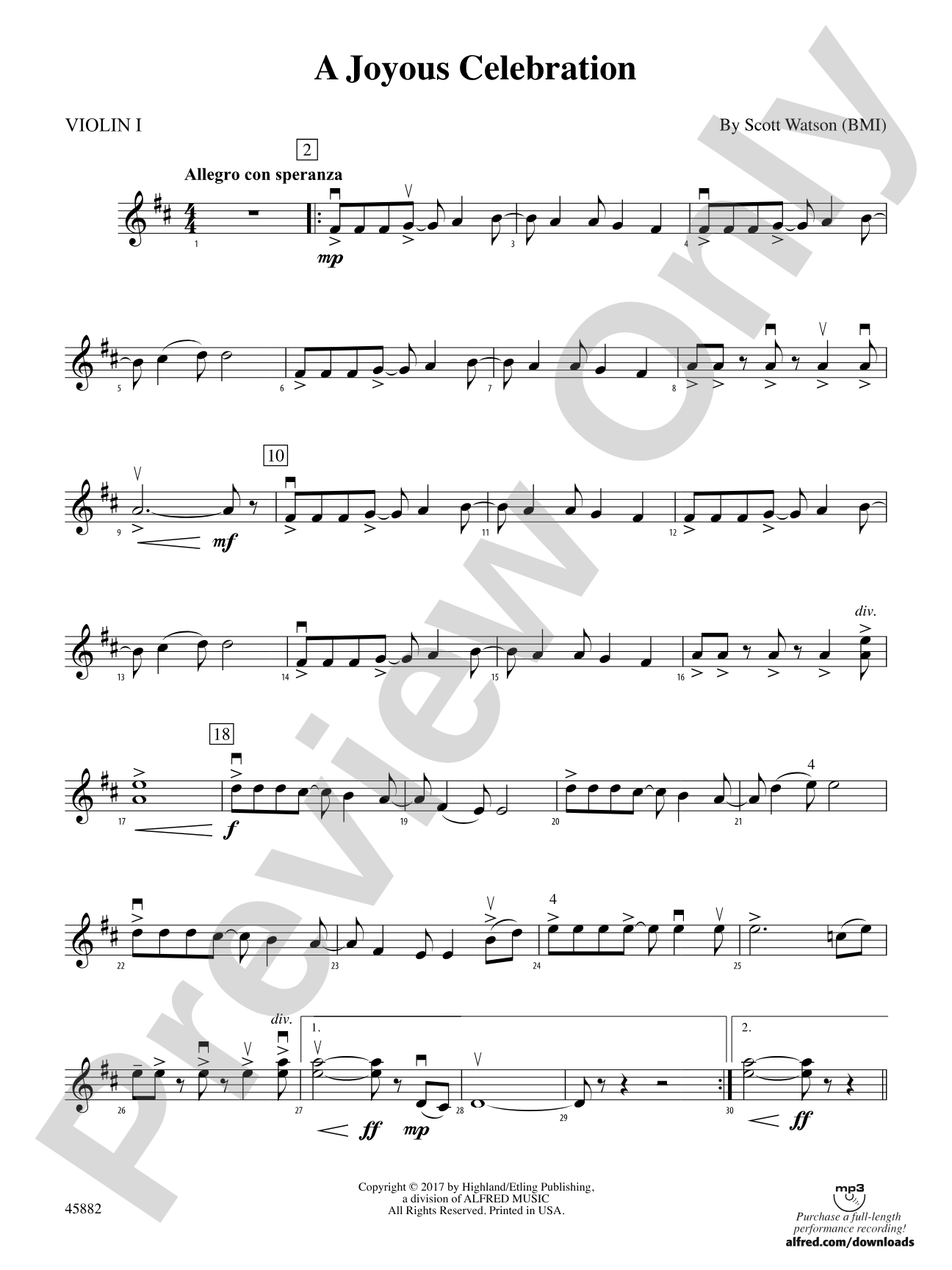

A Joyous Celebration: 1st Violin
By Scott Watson
Grade: 2.5
Item: 00-PC-0017680_VN1
$5.99
Pickup currently not available
Description
With its bright, hopeful melody and infectious rhythms, this original piece by Scott Watson is perfect to program for any celebratory occasion, or to open or close your concert. Optimistic harmonies and recurring syncopations in the opening section give way to broad, expansive strokes in a brief, contrasting section. A fortissimo climax leads to the welcome return of the jubilant opening theme. The joyful music drives to a sparkling finish, conveying the feeling that anything is possible! (2:55)


Don't just read it, hear it, play along with it, and watch your students grow with it. In MakeMusic Cloud, A Joyous Celebration: 1st Violin comes alive with professional accompaniment, adjustable tempo, and built-in practice tools that turn solo practice into real progress.
Open in the Player
Jump straight in and assign it today.
Start Your Free Trial
Open this title and explore the full library in minutes.
Sample Audio
1
Audio File
--:--
0:00
0:00
Sample Video
Additional Details
Series:
Highland/Etling String Orchestra
Publisher:
Alfred Music
Page Count:
110
SKU:
00-PC-0017680_VN1
More about this title
About the Composer: Scott Watson

Scott Watson brings three and a half decades of classroom experience to his work as a composer and music educator. After spending 35 years teaching instrumental and elective music in the Parkland School District near Allentown, Pennsylvania, where he directed the high school bands and coordinated the elementary strings and band program across the district, he now serves as Associate Professor of Music at Cairn University in Langhorne, Pennsylvania.
Watson's catalog includes more than 120 published works for concert band, string orchestra, and chamber ensembles spanning all levels. His compositions draw equally from his immersion in contemporary concert art music and his intimate knowledge of the school music world. His pieces have reached audiences internationally and at major American venues including the Academy of Music in Philadelphia, the Midwest Clinic in Chicago, and the White House. He is an exclusive composer and clinician for Alfred Publications, a frequent guest conductor at honor and festival bands, and the author of "Using Technology to Unlock Musical Creativity" (Oxford University Press, 2011). More information is available at www.scottwatsonmusic.com.
Why we love this
Watson's gift for crafting memorable, singable themes and his instinctive sense of orchestration shine throughout this piece. The architecture is elegant: syncopated energy in the opening gives way to genuine contrast in the middle section before building to a satisfying climax and reprising the main theme. String orchestras at this level rarely get music that sounds this polished without requiring orchestral maturity they don't yet have.
What to expect
Sunlit and energetic, with a melody that immediately makes listeners feel something good is about to happen. The syncopations give the piece momentum and contemporary edge, while the full-orchestra moments and the broad contrasting section remind you this is music built for real occasions, not just exercise.
Who it's for
String orchestras in grades 2-3 who want music that sounds celebratory and complete without requiring advanced technical skills or maturity. This piece works equally well for ensembles preparing their first major concert and for those looking to open a festival or contest performance with confidence.
How to get the most out of it
- Shape the opening theme's melodic contour deliberately. The "bright, hopeful" character depends on clear phrasing and forward motion through the syncopated sections rather than letting them become rhythmically static.
- Bring out the contrast between the opening and the "broad, expansive" middle section by adjusting your conducting gesture and ensemble energy. This contrast makes the return of the jubilant theme feel earned.
- Build the fortissimo climax gradually. Resist the temptation to arrive at full volume too early; let the intensity and volume grow through the final approach to create genuine excitement at the finish.
- Support the violin melody in the opening with balanced accompaniment from violas and cellos. The "infectious rhythm" works only if the harmonic foundation stays transparent.
How to use it
Open your spring concert with this piece to set an optimistic tone for the entire program. Its natural brightness and strong sense of closure also make it an excellent finale if you want audiences to leave on an uplift. At festivals and contests, it works as an opener that establishes your ensemble's musicality right away.
Skills your students will build
- Playing syncopated rhythms with rhythmic precision and ensemble clarity
- Shaping a complete musical phrase with clear beginning, middle, and end points
- Balancing melody and accompaniment across the string section
- Responding to conductor gestures that indicate contrasting character and dynamic levels
- Building dynamic intensity through crescendo without losing control of intonation