
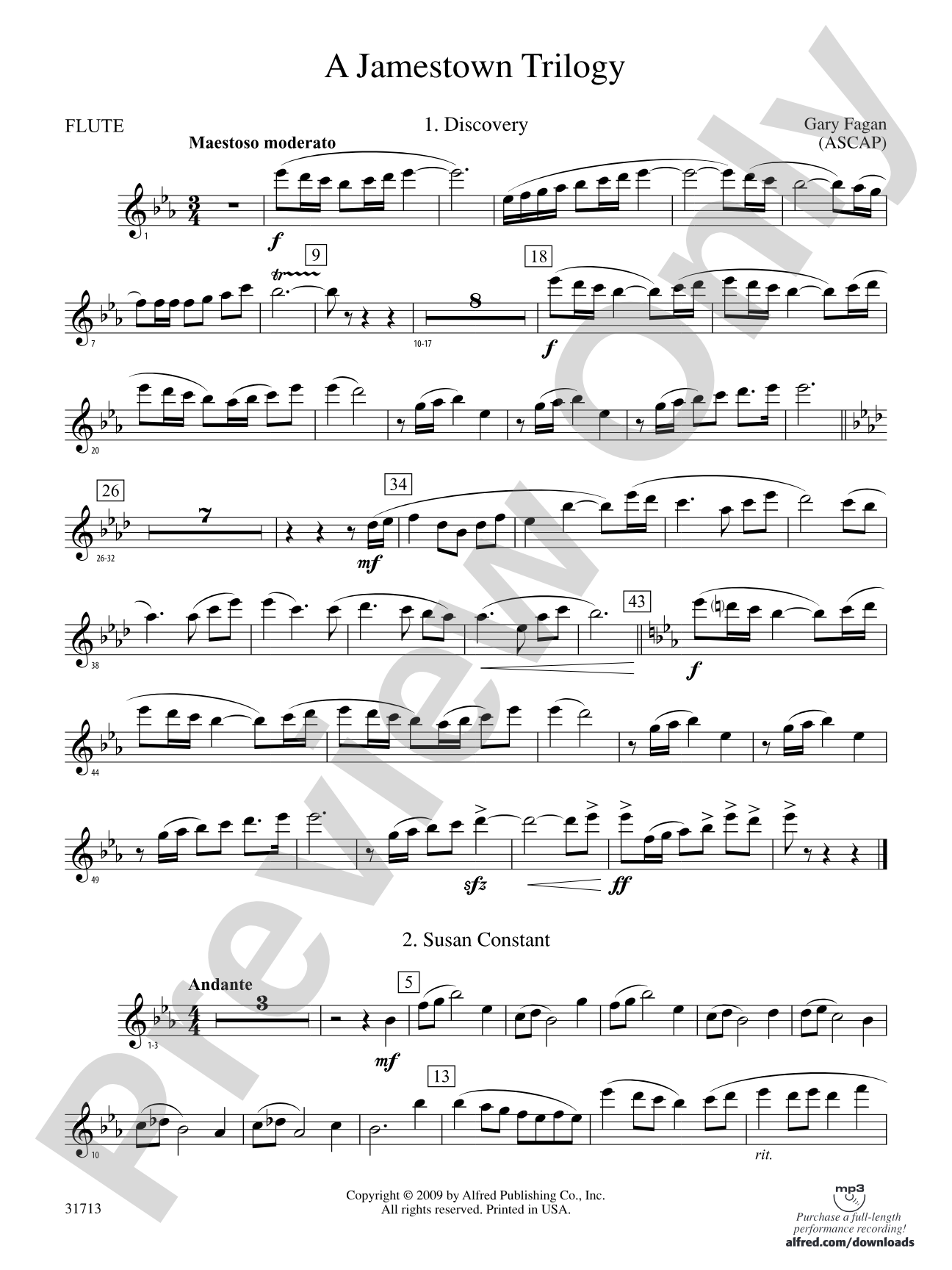

A Jamestown Trilogy: Flute
By Gary Fagan
Grade: 2.5 (Medium Easy)
Item: 00-PC-0001808_F1
$3.00
Pickup currently not available
Description
A Jamestown Trilogy is a three-movement suite inspired by the story of Captain John Smith and his crew, who sailed from England on December 20, 1606 in three small ships, the Discovery, Susan Constant and Godspeed. They first landed at Cape Henry on April 26, 1607 and then sailed up the James River where, on May 14, 1607, they landed on a site they named Jamestown.
In 1608, Smith was captured by the Powhatan Indians. Legend has it that he was considered a threat to the Indians because of his interest in metals and in searching for a waterway west. Smith was sentenced to death and placed on a stone alter to be killed when a twelve year old Indian Princess rescued him. Matoaka, nicknamed Pocahontas (Playful One), the daughter of Powhatan, chief of the confederacy, threw her body across Smith's and saved his life.


In 1608, Smith was captured by the Powhatan Indians. Legend has it that he was considered a threat to the Indians because of his interest in metals and in searching for a waterway west. Smith was sentenced to death and placed on a stone alter to be killed when a twelve year old Indian Princess rescued him. Matoaka, nicknamed Pocahontas (Playful One), the daughter of Powhatan, chief of the confederacy, threw her body across Smith's and saved his life.
Don't just read it, hear it, play along with it, and watch your students grow with it. In MakeMusic Cloud, A Jamestown Trilogy: Flute comes alive with professional accompaniment, adjustable tempo, and built-in practice tools that turn solo practice into real progress.
Open in the Player
Jump straight in and assign it today.
Start Your Free Trial
Open this title and explore the full library in minutes.
Sample Audio
1
Audio File
--:--
0:00
0:00
Sample Video
No sample videos found.
Additional Details
Series:
Young Symphonic
Publisher:
Alfred Music
Page Count:
260
SKU:
00-PC-0001808_F1
More about this title
About the Composer: Gary Fagan

Gary Fagan brings three decades of band directing experience to his compositional work, having shaped young musicians throughout a 36-year tenure in Albemarle County schools before transitioning to university supervision at James Madison University. His music has reached audiences at prestigious venues including the Midwest Band and Orchestra Clinic, the White House, and official state ceremonies, establishing him as a respected voice in American band composition.
Beyond the podium, Fagan contributes to the profession as an adjunct arranger at JMU, active clinician, and adjudicator across Virginia and beyond. He serves as Assistant Director of the Charlottesville Band and holds memberships in ASCAP, the National Band Association, and Phi Beta Mu Bandmasters Fraternity. His teaching excellence has been recognized with awards from the University of Virginia's Phi Delta Kappa chapter, the Virginia Governor's School for the Visual and Performing Arts, and the Piedmont Council of the Arts.
Why we love this
Fagan's gift for programmatic storytelling combined with genuine accessibility makes this suite a rare find at the Grade 2.5 level. The historical narrative structure gives concert and festival performances genuine dramatic arc without requiring advanced technical demands from your ensemble, and the three-movement form provides natural pacing for young musicians learning to sustain focus across longer works.
What to expect
The music unfolds like the voyage itself: the first movement breathes the anticipation and determination of ocean crossing, the second captures the tension and danger of encounter, and the third resonates with the complexity of connection and sacrifice across cultures. Fagan's orchestrations stay transparent enough for young musicians to hear themselves while maintaining the sweep and grandeur the subject deserves.
Who it's for
Band directors working with Grade 2 through Grade 3 ensembles who want substantial concert or contest repertoire with genuine cultural and historical weight. This suite works equally well for middle school bands seeking engaging full-length programmatic music and upper-level beginner high school groups building their performance confidence.
How to get the most out of it
- Shape each movement's arc distinctly; lean into the narrative arc of exploration in the first movement, capturing the sense of venture and discovery through dynamic contrast rather than technical flash.
- Give yourself time to establish the cultural and historical context with your students before rehearsals begin. Understanding who these people were and why their meeting mattered will deepen musical choices throughout.
- Balance the programmatic elements with strong fundamentals in intonation and balance across sections. The story is compelling on its own; clear ensemble sound lets the music speak.
- Use the full 260 pages of score and parts to study how Fagan distributes thematic material across the band. Pay attention to which voices carry the narrative in each movement.
How to use it
Program this as a centerpiece for a concert exploring American history through music, pairing it with earlier colonial-era pieces or later American folk traditions to create thematic coherence. The three-movement structure and accessible difficulty make it ideal for a full-length feature that showcases your band's growth without overshadowing other works on the same concert.
Skills your students will build
- Sustained phrasing across multiple-measure sections
- Dynamic control and expression within Grade 2.5 technical parameters
- Ensemble balance when thematic material moves between sections
- Listening to programmatic elements as guides for musical interpretation
- Reading from full conductor score while managing individual parts