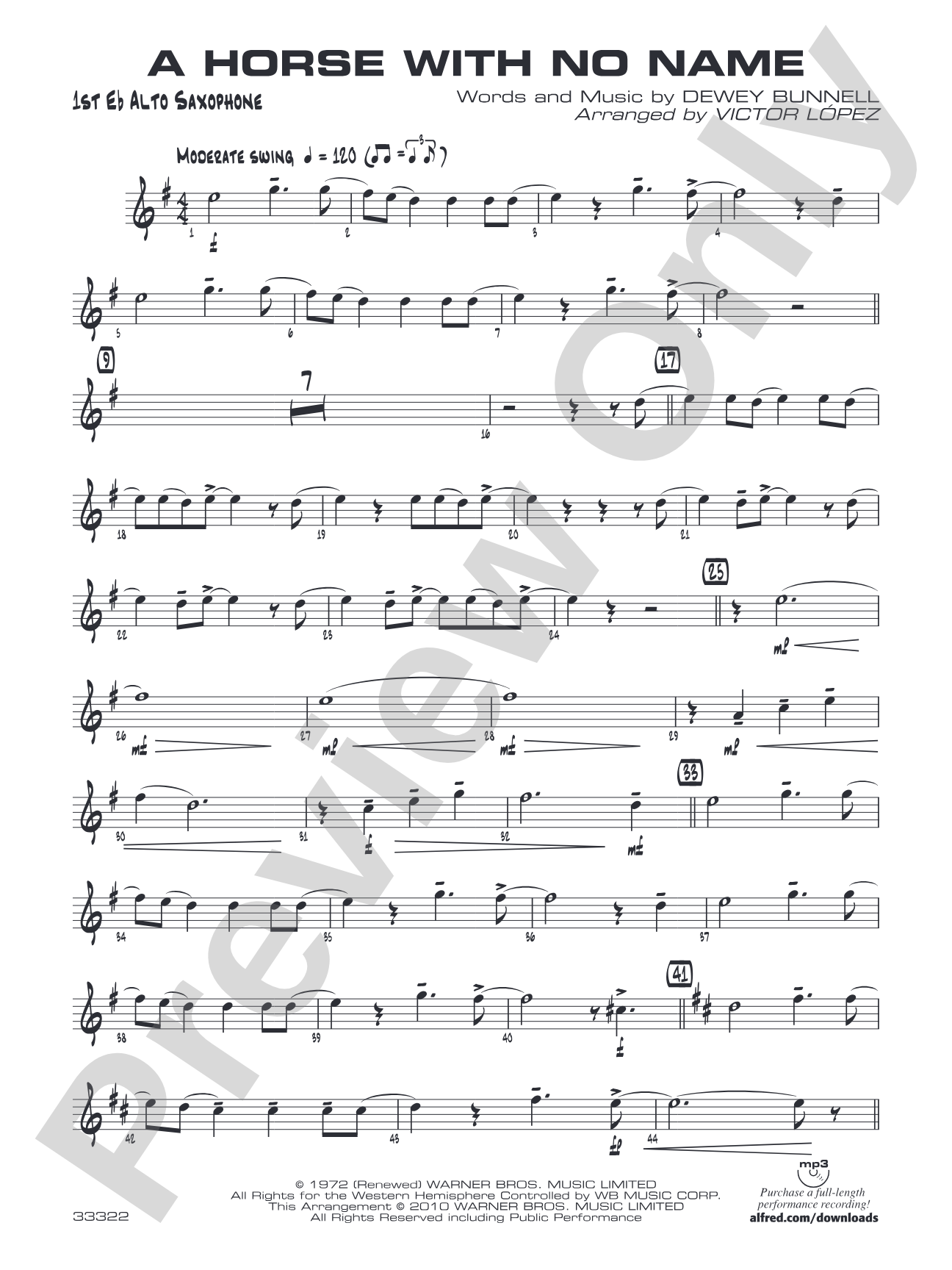
A Horse with No Name: E-flat Alto Saxophone Sheet Music Preview

A Horse with No Name: E-flat Alto Saxophone

Words and music by Dewey Bunnell [America] / arr. Victor López

Grade: 1 (Easy)

Item: 00-PC-0017163_AX1

Digital Download
$3.00
Description
A Horse With No Name is part of the Jazz Beginning Series designed for very beginning jazz ensembles using limited ranges and rhythms. Instrumentation includes 2 alto saxophones, 2 tenor saxophones, 2 trumpets, 2 trombones, piano, bass, and drumset. Reduced instrumentation is playable by 2 saxophones, 1 trumpet, 1 trombone, piano, bass and drumset. Optional parts include 2 flutes, 2 B-flat clarinets, baritone saxophone, tuba, horn in F, baritone T.C./tenor sax, and guitar. Solos are written out with chord changes and rhythm section parts are fully notated with guitar chord frames.

Don't just read it, hear it, play along with it, and watch your students grow with it. In MakeMusic Cloud, A Horse with No Name: E-flat Alto Saxophone comes alive with professional accompaniment, adjustable tempo, and built-in practice tools that turn solo practice into real progress.

Sample Audio
0:00
0:00
Sample Video
Additional Details
Series: Jazz Beginnings Series
Publisher: Alfred Music
Page Count: 86
SKU: 00-PC-0017163_AX1

More about this title

About the Composer: Dewey Bunnell

Dewey Bunnell co-founded America in 1970 and has remained the band's primary songwriter and creative force for over five decades. His gift for crafting accessible, memorable melodies with substantive harmonic content makes his compositions natural teaching vehicles for ensemble musicians at all levels.

Why we love this

Victor López's arrangement strips this iconic hit down to its essential groove without sacrificing musicality, making it an ideal entry point for young jazz ensembles learning to balance written parts with rhythmic flexibility. The written-out solos and fully notated rhythm section parts mean your students spend rehearsal time developing jazz language rather than deciphering lead sheets, while optional instrumentation lets you build the piece around the players you have.

What to expect

Laid-back and introspective, with a gentle rhythmic pocket that invites players to breathe and listen to one another. The familiar melodic hook combined with straightforward harmonic language creates immediate accessibility while the jazz voicings and groove patterns expose students to genuine jazz vocabulary.

Who it's for

Beginning jazz ensembles with mixed instrumentation and limited experience reading jazz notation. This works equally well for full instrumentation or reduced groups, and the optional parts mean you can accommodate whatever winds, brass, and strings you have available.

How to get the most out of it

  • Balance the written solo lines by having the featured section voice the melody clearly while the supporting saxophones and brass lock in tight harmony underneath.
  • Keep the rhythm section anchored to a relaxed, steady pulse; the groove depends on restraint rather than pushing the tempo forward.
  • Reference the guitar chord frames in the score to help your pianists and bass players internalize the harmonic movement, even when the notation is fully written out.
  • Encourage your soloists to phrase naturally across the bar lines rather than accent each beat; the original song's strength lies in its conversational, flowing melody.

How to use it

Program this early in the jazz ensemble season when students are still building confidence with jazz fundamentals, or use it as a bridge piece between concert band and jazz repertoire for ensembles with mixed experience. Its recognition factor makes it an excellent concert opener or family-friendly finale that engages audiences unfamiliar with jazz.

Skills your students will build

  • Reading and executing written jazz articulations and phrasing
  • Playing with a relaxed swing feel and consistent groove
  • Balancing melody and harmony in a jazz texture
  • Interpreting chord changes and harmonic movement
  • Listening and responding to rhythm section in real time

You May Also Like