
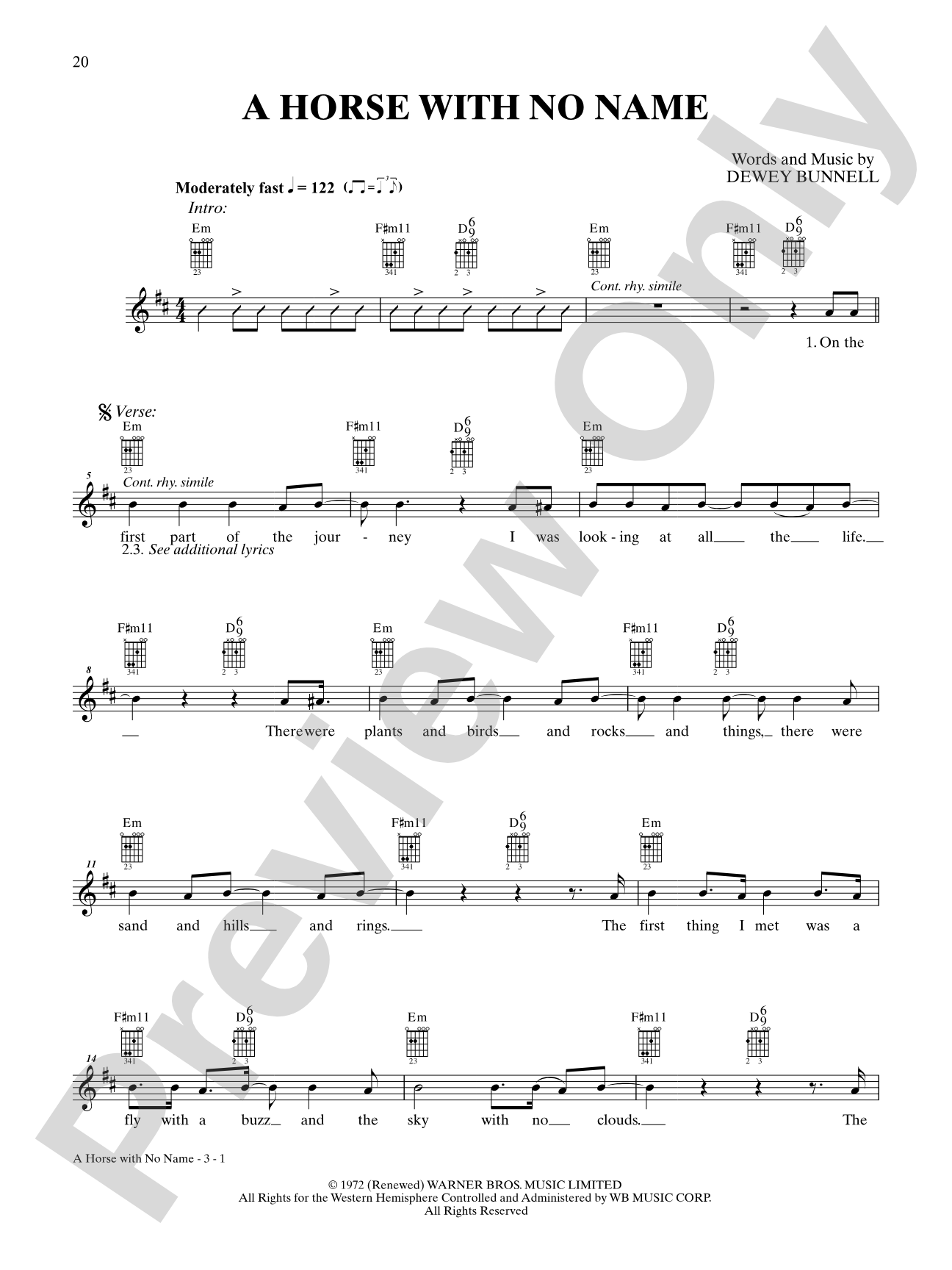

A Horse With No Name: Interm./Easy Guitar TAB
12 Great Songs -- Just a Few Chords
Item: 00-PS-0006266
$4.99
One moment…
Related Items
Margaritaville: Interm./Easy Guitar TAB |
$4.99
|
View | |
Take Me Home, Country Roads: Interm./Easy Guitar TAB |
$4.99
|
View | |
As Tears Go By: Interm./Easy Guitar TAB |
$4.99
|
View | |
Gloria: Interm./Easy Guitar TAB |
$4.99
|
View | |
Good Riddance (Time of Your Life): Interm./Easy Guitar TAB |
$4.99
|
View | |
Moondance: Interm./Easy Guitar TAB |
$4.99
|
View | |
Big Yellow Taxi: Interm./Easy Guitar TAB |
$4.99
|
View | |
Peaceful Easy Feeling: Interm./Easy Guitar TAB |
$4.99
|
View |
Description
Easy Rock Guitar is designed for your total enjoyment. Each featured song is inherently simple, with just a few chords. All the tunes are arranged from the actual guitar parts, simplified just enough to keep them fun and musically satisfying. Titles: As Tears Go By (The Rolling Stones) * Big Yellow Taxi (Joni Mitchell) * Casey Jones (Grateful Dead) * Gimme Some Lovin' (The Spencer Davis Group) * Gloria (Them) * Good Riddance (Time of Your Life) (Green Day) * A Horse with No Name (America) * Margaritaville (Jimmy Buffett) * Moondance (Van Morrison) * Peaceful Easy Feeling (Eagles) * Take It Easy (Eagles) * Take Me Home, Country Roads (John Denver).


A Horse With No Name: Interm./Easy Guitar TAB isn't in MakeMusic Cloud just yet...but it could be. Let us know you'd like to see it, and you'll help shape what comes next. In the meantime, start a free trial and dive into thousands of interactive titles your students can play along with today.
Request This Title
Tell us you want it.
Start Your Free Trial
Explore everything that's ready to play right now.
Sample Audio
No sample audio found.
Sample Video
No sample videos found.
Additional Details
Series:
Just for Fun
Publisher:
Alfred Music
Page Count:
56
SKU:
00-PS-0006266
More about this title
About the Composer: Dewey Bunnell
Dewey Bunnell co-founded America in 1970 and served as the band's primary songwriter and guitarist. His accessible songwriting approach, evident in "A Horse with No Name" and other early hits, helped define the soft rock sound of the 1970s with melodies that stick with listeners and arrangements built on clean guitar work.
Bunnell's compositions have remained staples in music education and popular culture for decades, valued for their straightforward musicality and their appeal to players across skill levels. His work demonstrates how effective songwriting doesn't require complexity; it requires clarity and memorable phrasing.
Why we love this
This collection captures the spirit of 1970s rock and folk without overwhelming intermediate players with technical demands. The arrangements are transcribed from the actual recordings but simplified just enough to remain musically honest; students play something recognizable and satisfying rather than a skeletal version of the tune. Programming these classics gives your students songs they already love to hear and are motivated to master.
What to expect
These arrangements capture the laid-back groove and melodic warmth of 1970s songwriting. You'll find open chords, clean fingerpicking patterns, and rhythmic simplicity that let the songs' natural appeal shine through without studio gloss or unnecessary ornamentation.
Who it's for
Intermediate and easy-level guitarists who want to expand their repertoire with songs from the classic rock and singer-songwriter canon. This book works especially well for students who learn better when the material sounds like real music they recognize rather than purely pedagogical exercises.
How to get the most out of it
- Pay attention to the rhythm notation around any palm-muted sections; these add texture and help you match the recorded feel without needing advanced technique.
- Work through one or two songs per practice session rather than rushing through all twelve; repetition builds fluency and lets you focus on tone and timing.
- Experiment with the recorded versions to hear where emphasis falls in the vocal line; mirror that phrasing in your guitar part to shape the melody.
- If a chord shape feels awkward, check whether dropping a finger or using a partial voicing keeps the essential notes while staying in a comfortable position.
How to use it
Use this as a bridge between beginner method books and more complex modern repertoire. Students gain confidence tackling recognizable material at a manageable technical level, and you can assign individual songs as performance pieces for recitals, casual student showcases, or end-of-term jam sessions.
Skills your students will build
- Reading guitar tablature and standard notation together
- Switching between basic open chord shapes efficiently
- Playing rhythmic patterns that support vocal melodies
- Matching recorded phrasing and dynamics in well-known songs
- Building finger strength and dexterity through repetition with musically rewarding material