
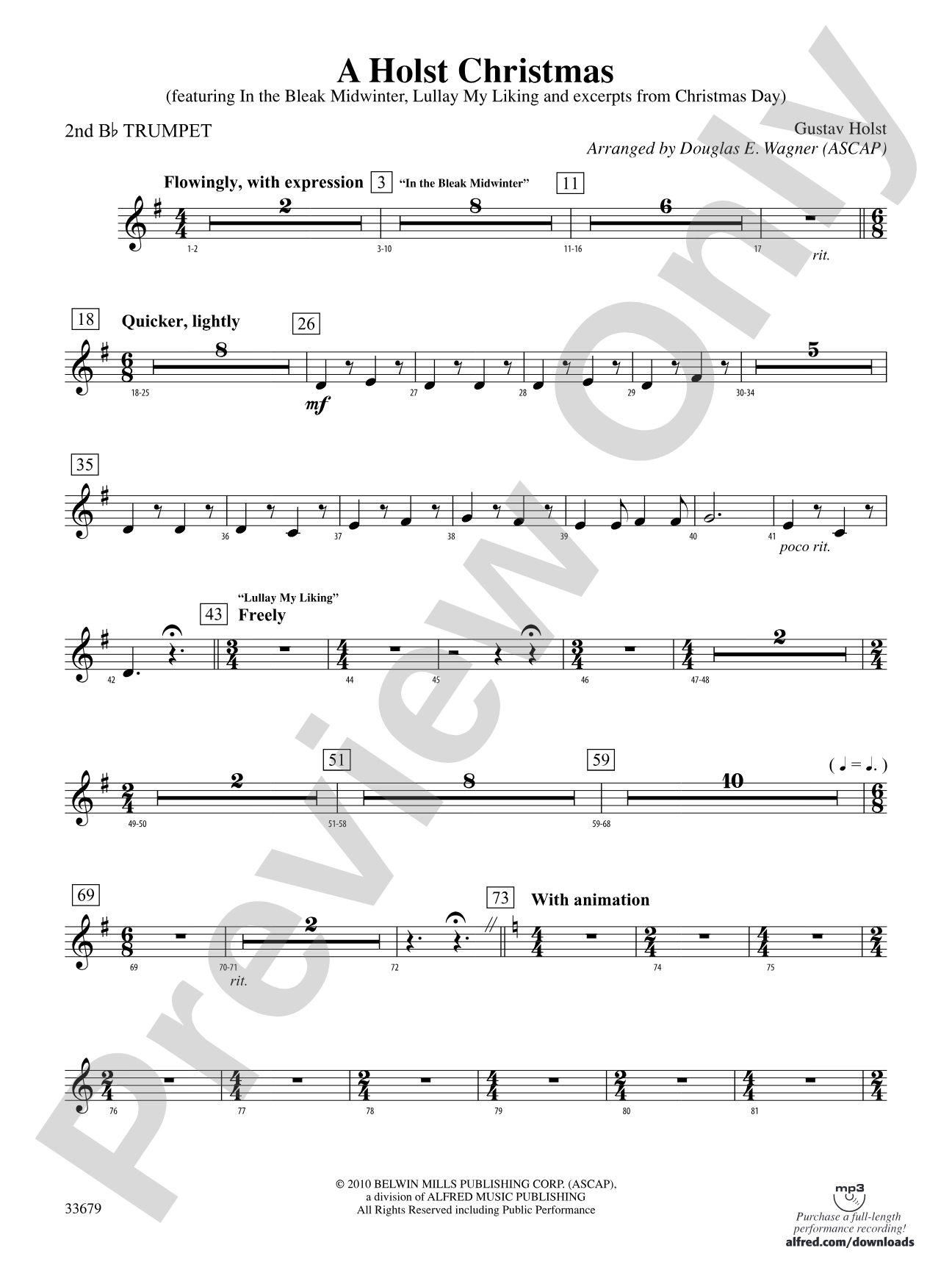

A Holst Christmas: 2nd B-flat Trumpet
Featuring: In the Bleak Midwinter / Lullay My Liking / Excerpts from "Christmas Day"
By Gustav Holst / arr. Douglas E. Wagner
Grade: 3
Item: 00-PC-0014470_T2
$3.00
Pickup currently not available
Description
Written as a sequel to the highly successful A Vaughan Williams Christmas, this artfully crafted medley brings to the stage several of Holst's best known and loved Christmas titles, including "In the Bleak Midwinter," "Lullay My Liking," and "Christmas Day." The rich scoring creates a satisfying musical experience, with care taken to insure that all technical demands are well within the parameters at this level. The arrangement may be played by strings alone, or with the addition of any combination of wind and/or percussion parts.


Don't just read it, hear it, play along with it, and watch your students grow with it. In MakeMusic Cloud, A Holst Christmas: 2nd B-flat Trumpet comes alive with professional accompaniment, adjustable tempo, and built-in practice tools that turn solo practice into real progress.
Open in the Player
Jump straight in and assign it today.
Start Your Free Trial
Open this title and explore the full library in minutes.
Sample Audio
1
Audio File
--:--
0:00
0:00
Sample Video
No sample videos found.
Additional Details
Series:
Belwin Intermediate String/Full Orchestra
Publisher:
Alfred Music
Page Count:
224
SKU:
00-PC-0014470_T2
More about this title
About the Composer: Gustav Holst
Gustav Holst (1874–1934) was an English composer whose orchestral works have become cornerstones of the classical music repertoire. Beyond his famous Planets suite, Holst drew deeply from folk traditions, hymn texts, and literary sources throughout his career, creating music that balances modernist sensibilities with lyrical warmth. His gift for melody and orchestration made him a natural fit for choral and sacred music, and his Christmas arrangements have endured as beloved seasonal staples in concert halls and schools alike.
Why we love this
Wagner's medley honors Holst's gift for vocal melody by presenting three beloved carols through orchestral textures that respect the original lines while enriching them with intelligent counterpoint and balance. The scoring flexibility (strings alone or with winds and percussion) means you can shape the piece to match your ensemble's strengths, and the Grade 3 technical demands let musicians focus on musicality and ensemble cohesion rather than technical survival. This is the kind of arrangement that feels generous to play; every section has something rewarding to do.
What to expect
Warm, intimate, and steeped in the quiet reflection that these familiar carols invite. The orchestration opens these melodies gently, letting them breathe without overwhelming them; there's a sense of tradition meeting craftsmanship. The movement between the three carols feels natural and connected, building an emotional arc that mirrors the progression from winter darkness to the peace of Christmas Day.
Who it's for
Conductors of full orchestras at the intermediate level (Grade 3) who want reliable, musically substantial Christmas programming that works whether you have a complete ensemble or partial instrumentation. This is equally at home in school holiday concerts, church services, and community orchestra seasons where time-tested, accessible repertoire with depth is valued.
How to get the most out of it
- Let the string section carry the harmonic foundation and establish the singing quality that defines these melodies. The carols themselves demand a lyrical approach, and the orchestration supports this naturally.
- Balance the addition of winds and percussion carefully during rehearsal. Experiment with different combinations to find the texture that serves your space and your orchestra's character.
- Shape each carol as if it were a hymn or devotional piece. Holst's originals have spiritual roots, and that reverence translates directly to how your orchestra will interpret dynamic curves and phrase breathing.
- Use the conductor score to identify moments where individual sections (woodwinds, brass, percussion) double or complement the strings. Calling these out explicitly prevents anyone from feeling secondary.
How to use it
Close your winter concert with this medley to send audiences out with the musical equivalent of a carol service. The progression of three shorter pieces also works well as a suite that sits naturally between more dramatic or virtuosic selections, offering contrast and a centering moment in the program.
Skills your students will build
- Balancing ensemble texture across multiple choirs (strings, winds, percussion)
- Shaping lyrical melodic lines with sustained tone and elegant phrasing
- Reading conductor score and understanding how different instrumental families function within orchestration
- Adapting to flexible instrumentation and making musical choices based on what's available
- Maintaining rhythmic precision across carols with different meters and tempos