
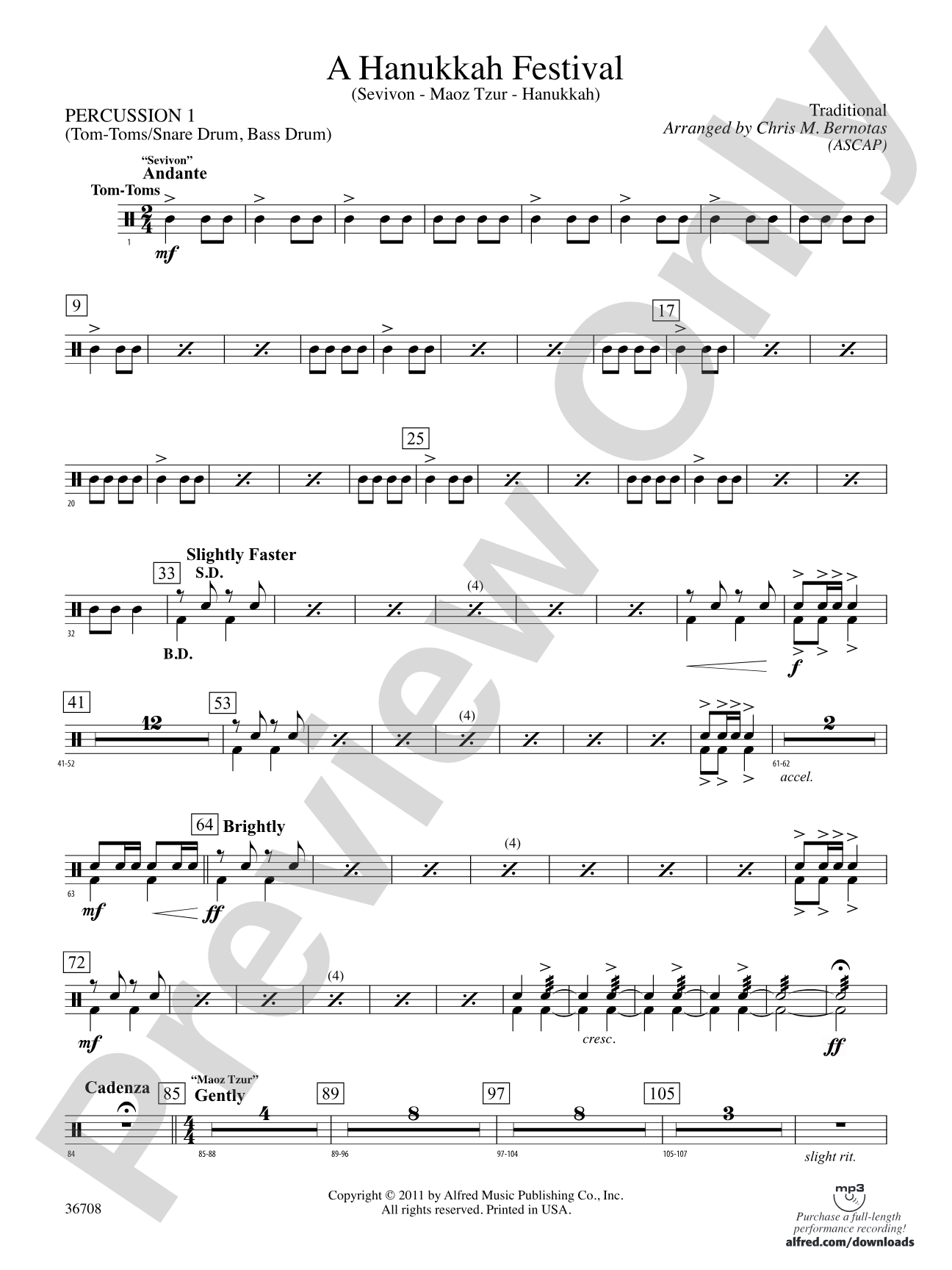

A Hanukkah Festival: 1st Percussion
Featuring: Sevivon / Maoz Tzur / Hanukkah
By Chris M. Bernotas
Grade: 3.5 (Medium)
Item: 00-PC-0015136_PC1
$5.99
Pickup currently not available
Description
A Hanukkah Festival is a medley of three traditional Hanukkah songs, "Sevivon," "Maoz Tzur," and "Hanukkah." "Sevivon" has a dramatic melody and is written with a variety of accompaniment leading to a brief, but impressive, clarinet cadenza that leads into "Maoz Tzur." This traditional piece is scored with full, rich voicings along with the beautiful melody. "Hanukkah" is the festival of lights and the last section of the piece. It is a bright playful march with an exciting conclusion. A Hanukkah Festival is filled with memorable tunes that students and audiences will enjoy while paying homage to this important holiday. (5:17)


Don't just read it, hear it, play along with it, and watch your students grow with it. In MakeMusic Cloud, A Hanukkah Festival: 1st Percussion comes alive with professional accompaniment, adjustable tempo, and built-in practice tools that turn solo practice into real progress.
Open in the Player
Jump straight in and assign it today.
Start Your Free Trial
Open this title and explore the full library in minutes.
Sample Audio
1
Audio File
--:--
0:00
0:00
Sample Video
Additional Details
Series:
Alfred Concert Band
Publisher:
Alfred Music
Page Count:
276
SKU:
00-PC-0015136_PC1
More about this title
About the Composer: Chris Bernotas
Chris Bernotas is a prolific composer and arranger whose works span educational and professional concert settings. His music appears regularly in school band and orchestra programs across the country, known for accessible writing that doesn't sacrifice musical substance.
Bernotas has developed a particular gift for holiday and thematic concert works that engage both performers and audiences. His arrangements and original compositions balance technical clarity with genuine musicality, making him a trusted voice in the educational band repertoire.
Why we love this
Bernotas constructs this medley with clear architectural thinking: each song builds naturally into the next, the clarinet cadenza punctuates the transition between movements with genuine solo weight, and the closing march lands with real swagger without overreaching the band's ability. A three-section form gives directors breathing room to shape distinct musical characters while the arc stays cohesive.
What to expect
The piece opens with urgency and drama, then mellows into the resonant, almost hymn-like warmth of a traditional folk melody, before closing in celebratory brightness. You move through three distinct emotional territories without feeling jarred, as if the songs belong together in the same story.
Who it's for
Concert bands at the intermediate level (grades 7-10 and non-traditional ensembles) looking for programming that honors cultural tradition without requiring advanced technical facility. Directors seeking a winter concert work with genuine substance that students will remember and audiences will recognize.
How to get the most out of it
- Balance the accompaniment figures in 'Sevivon' so the dramatic melody cuts through; these supporting voices set up the cadenza's impact by creating forward momentum.
- Shape the clarinet cadenza with rubato and dynamic breathing room; the solo needs air to land as the earned climax it is, not a rushed technical display.
- Bring out the march character in the final section by locking the articulation across the ensemble, especially the snare drum's interaction with the low brass punctuation.
- Find the warmth in 'Maoz Tzur's' voicings by letting sustained chords breathe slightly rather than driving straight through; the richness of the scoring should feel unhurried.
How to use it
Program this as a concert centerpiece that honors Hanukkah while inviting audiences of all backgrounds into the celebration. At 5 minutes and 17 seconds, it pairs well with other seasonal works in a winter concert or stands alone as a statement piece for a multicultural program.
Skills your students will build
- Managing dramatic phrasing and rubato within a structured arrangement
- Playing subordinate melodic lines that support rather than compete
- Executing a clarinet solo with appropriate weight and musical maturity
- Maintaining ensemble precision in march time with rhythmic interplay between sections
- Balancing chord voicings to reveal inner voices and harmonic movement