
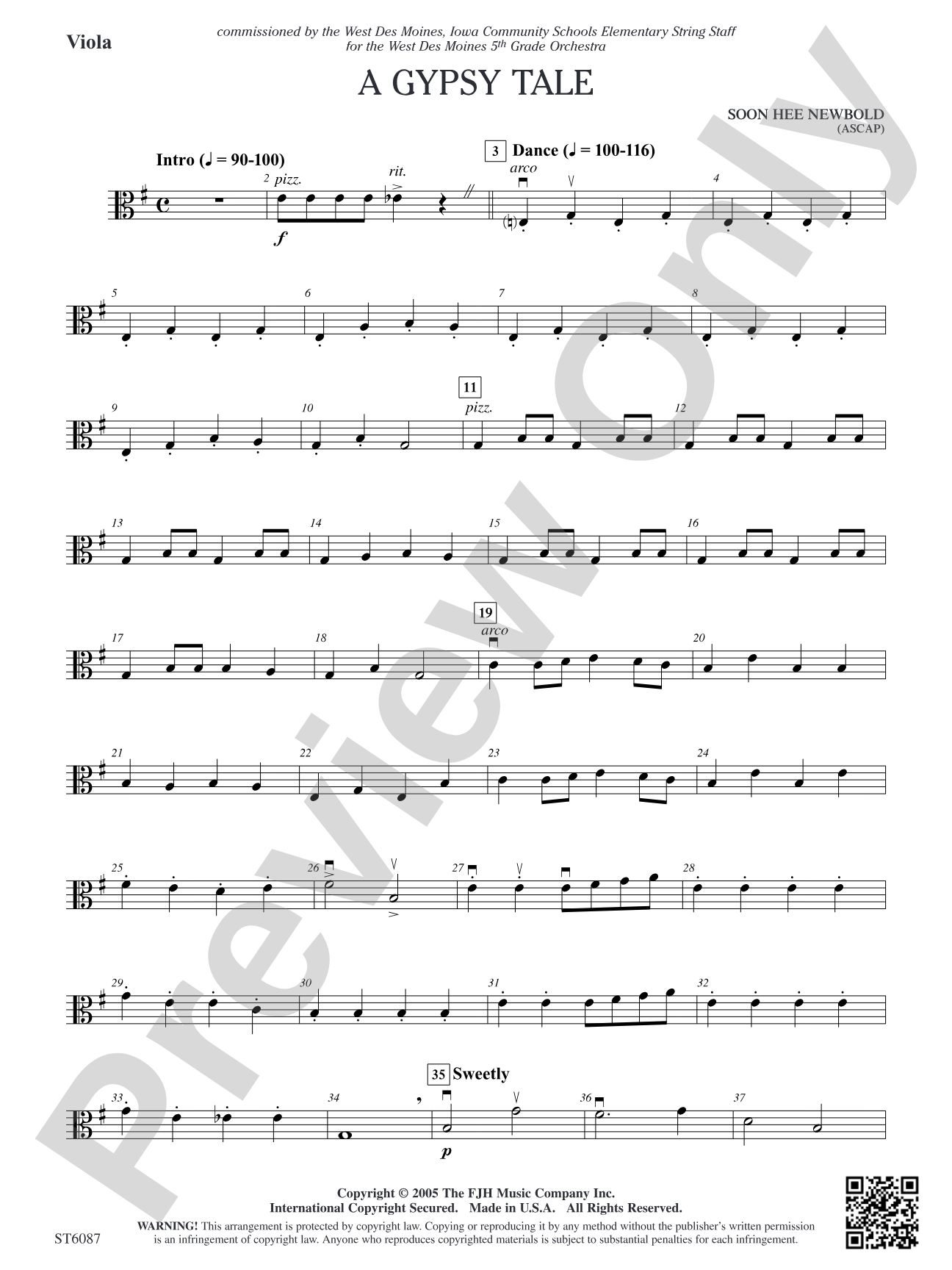

A Gypsy Tale: Viola
By Soon Hee Newbold
Grade: 2
Item: 98-PC-DST6087_VA1
$7.00
Pickup currently not available
Description
Crystal balls, hoop earings, and traveling caravans are some common images associated with Gypsies. Soon Hee Newbold brings these images to life in this exciting new work in the style of Hungarian dances and traditional gypsy music. Inspired by classic violin pieces such as Tzigane and Csárdás, A Gypsy Tale is sure to become a favorite with your developing string players. Optional trills and grace notes add more difficulty and style.


Don't just read it, hear it, play along with it, and watch your students grow with it. In MakeMusic Cloud, A Gypsy Tale: Viola comes alive with professional accompaniment, adjustable tempo, and built-in practice tools that turn solo practice into real progress.
Open in the Player
Jump straight in and assign it today.
Start Your Free Trial
Open this title and explore the full library in minutes.
Sample Audio
1
Audio File
--:--
0:00
0:00
Sample Video
No sample videos found.
Additional Details
Series:
FJH Developing Strings
Publisher:
The FJH Music Company, Inc.
SKU:
98-PC-DST6087_VA1
More about this title
About the Composer: Soon Hee Newbold

Soon Hee Newbold's compositional voice draws from her decades of international performance and collaboration. Beginning her musical training at age five on piano and violin at seven, she performed as a concert artist across professional ensembles worldwide before turning her attention to composition. Her works now span from beginning elementary groups to professional symphony orchestras, with performances at Carnegie Hall, the Kennedy Center, Lincoln Center, Wolf Trap, Disney Hall, and international venues in the Netherlands, Belgium, Australia, Indonesia, Singapore, and China.
Newbold's distinctive approach integrates cultural and ethnic musical traditions into her scores, shaped by her extensive global experiences and travel. Beyond concert music, she has composed for film and recording projects in Hollywood. She is frequently invited to conduct, guest-teach, and deliver keynote addresses at festivals and clinics, making her a visible figure in music education circles across multiple continents.
Why we love this
Newbold captures the energy and character of traditional Hungarian and Gypsy music without demanding virtuosic technique, making it accessible and gratifying for Grade 2 ensembles. The optional ornaments (trills and grace notes) let you build the piece's sophistication as your students develop, and the evocative imagery gives players a real story to inhabit musically. This is exactly the kind of novelty work that energizes developing orchestras while respecting their genuine capabilities.
What to expect
A vivid narrative unfolds as the orchestra travels through the imagery of crystal balls, hoop earrings, and rolling caravans. The Hungarian dance idioms create an energetic, slightly exotic atmosphere that feels both storytelling and celebratory, inviting the ensemble into a musical journey that's romantic without being overly sentimental.
Who it's for
String orchestras at the early intermediate level, particularly ensembles working through the Developing Strings series or similar Grade 2 repertoire. This piece engages players who are ready for concert literature with cultural substance but still building fundamental ensemble skills and intonation security.
How to get the most out of it
- Shape the primary melodic line with a clear sense of direction; the folk-dance character depends on confident phrasing rather than technical precision.
- Balance your upper voices against the supporting harmony so the Hungarian-inspired melody sings through the texture without the accompaniment sounding thin.
- If you include the optional ornaments, rehearse them separately at a slow tempo first, then gradually bring them up to performance speed to ensure they sit naturally in the musical flow.
- Consider the character of the caravans and movement imagery in the program notes; let that visual language guide your tempo choices and dynamic shaping.
How to use it
Pair this with other folk-inspired or cultural-exchange pieces to build a spring concert theme around world music traditions. Its Grade 2 accessibility makes it ideal for mid-year festivals and competitions where developing ensembles benefit from a work that sounds ambitious and complete despite technical modesty.
Skills your students will build
- Stylistic interpretation of folk and traditional music idioms
- Balanced ensemble voicing across two-staff orchestration
- Execution of grace notes and trills as optional expressive elements
- Phrasing and direction in melody-driven textures
- Intonation control in double-stop passages and sustained harmony