
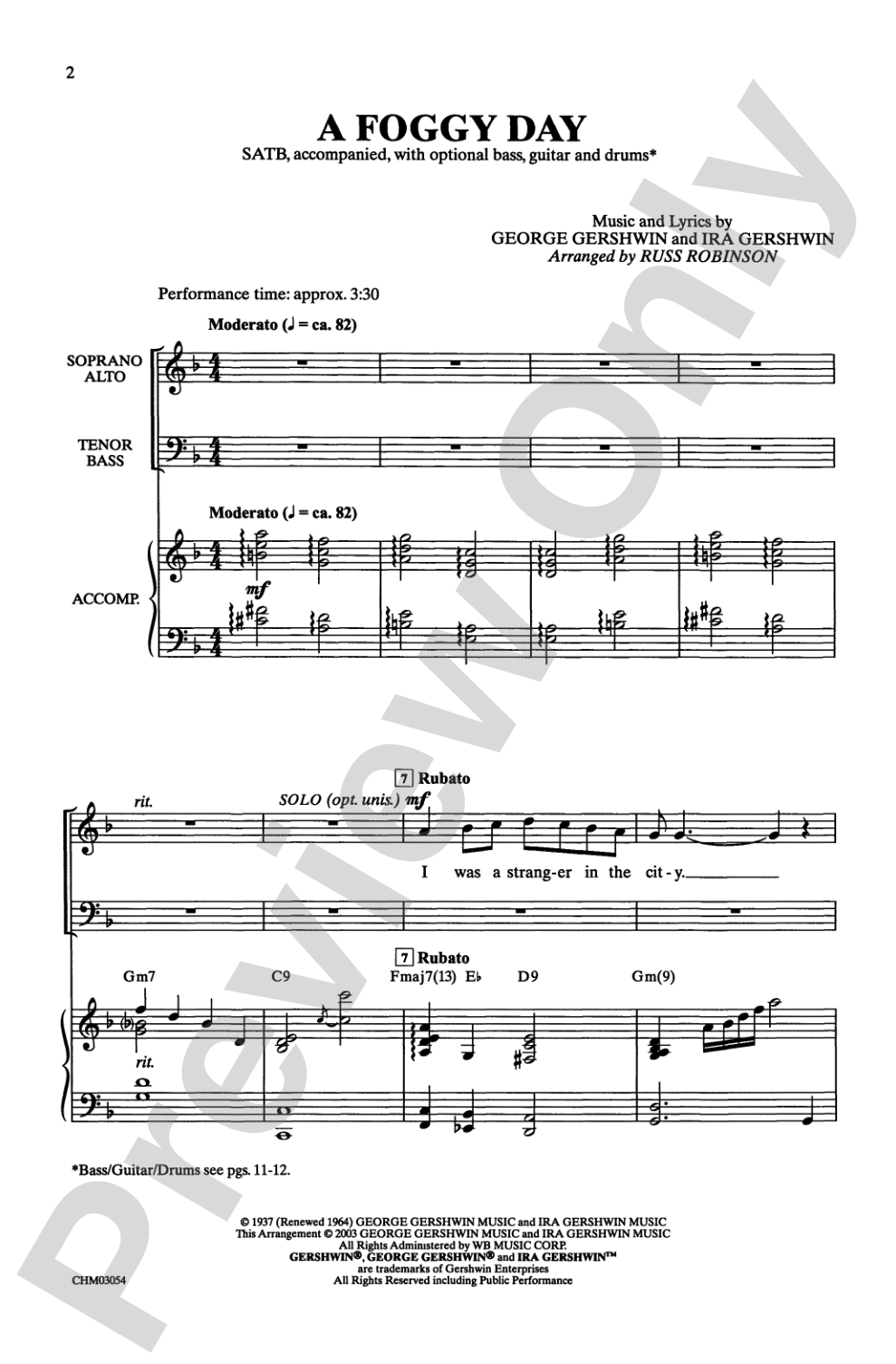
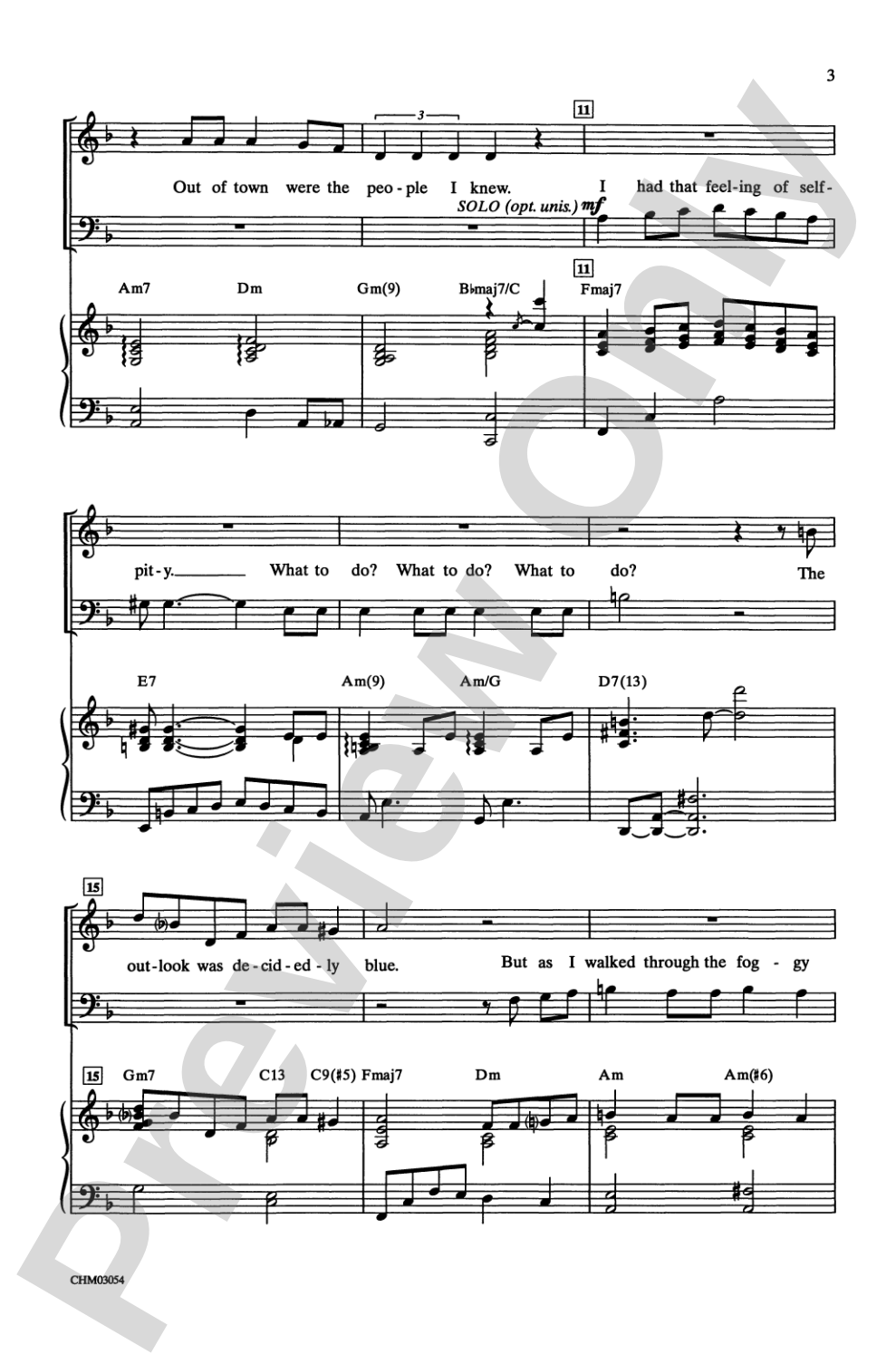
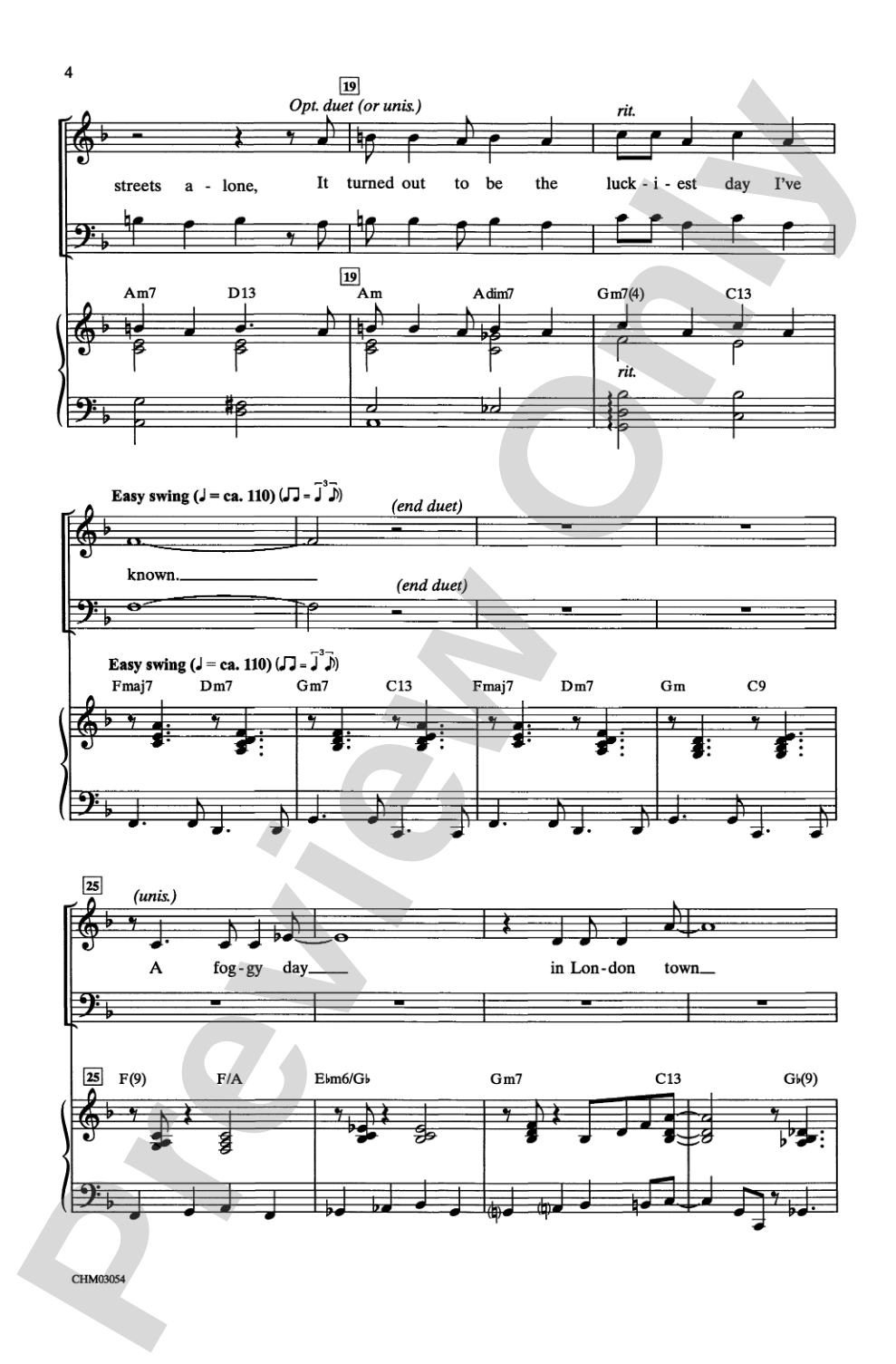

A Foggy Day: SATB Choral Octavo
Music and lyrics by George Gershwin and Ira Gershwin / arr. Russell Robinson
Level: Moderate
Item: 00-PO-0002559
$2.25
Minimum order quantity: 20 copies
One moment…
Description
A very singable vocal jazz setting of the Gershwin® favorite from Russell Robinson. It's got a few challenges but it's well worth the effort. A welcome addition to any concert program.


A Foggy Day: SATB Choral Octavo isn't in MakeMusic Cloud just yet...but it could be. Let us know you'd like to see it, and you'll help shape what comes next. In the meantime, start a free trial and dive into thousands of interactive titles your students can play along with today.
Request This Title
Tell us you want it.
Start Your Free Trial
Explore everything that's ready to play right now.
Sample Audio
1
Audio File
--:--
0:00
0:00
Sample Video
No sample videos found.
Additional Details
Series:
Alfred Archive Edition: Alfred Pop Choral Series
Publisher:
Alfred Music
Page Count:
12
SKU:
00-PO-0002559
More about this title
About the Composer: George Gershwin
George Gershwin (1898-1937) bridged concert hall and popular song with an ease that few composers have matched. His melodies became standards because they sing naturally, yet harmonically they contain the sophistication of a trained classical musician. "A Foggy Day" emerged from the 1937 film "Damsel in Distress," written with his brother Ira, and it remains one of the most beloved American compositions.
For music educators, Gershwin's catalog offers an ideal entry point into jazz idioms and American popular song. His works sit comfortably in the middle ground between classical rigor and accessible melody, making them invaluable for choirs seeking to expand beyond traditional repertoire while maintaining musical substance.
Why we love this
Russell Robinson's arrangement captures the wistful sophistication of Gershwin's melody without overwhelming singers at the Grade 3 level. The vocal jazz voicing feels modern and energetic while remaining idiomatic to the song's character, making it a natural fit for concerts that mix classical and contemporary material. Your singers will recognize the tune immediately, and that familiarity becomes a springboard for learning how jazz arrangers reimagine standards.
What to expect
A London fog rolling in—there's melancholy in the opening, yet the harmonic movement suggests hope and resilience underneath. The arrangement wraps Gershwin's memorable tune in warm jazz sonorities that feel intimate despite the four-part texture, creating a piece that feels both nostalgic and alive.
Who it's for
Choirs with singers who read at Grade 3 level and have basic experience with jazz idioms or swing feel. This works equally well for auditioned high school choirs seeking crossover repertoire and community or semi-professional ensembles looking to refresh their standard alongside classical and art song programming.
How to get the most out of it
- Balance the sustained lines in the upper voices with the rhythmic movement underneath; the harmonic sophistication comes through when each strand is heard clearly rather than blended into one mass of sound.
- Treat the swing feel as a learned gesture, not an afterthought. Rehearse the rhythm section (or recorded accompaniment) independently until the groove sits solidly before layering in the four-part writing.
- Shape the phrase endings with intention. Jazz standards thrive on subtle releases and breath placement that feels natural to speech rhythm rather than purely musical phrasing.
How to use it
Slot this into a concert that pairs American classics with other twentieth-century works, or use it as a bridge between a formal first half and a lighter second half. The twelve-page length and moderate difficulty make it substantial enough to anchor a set of shorter pieces without demanding rehearsal time that a longer work would require.
Skills your students will build
- Reading jazz-influenced harmony and seventh chord voicings
- Swing rhythm and syncopation
- Blend and balance in four-part jazz writing
- Interpreting jazz phrasing and articulation markings
- Collaborating with recorded accompaniment