
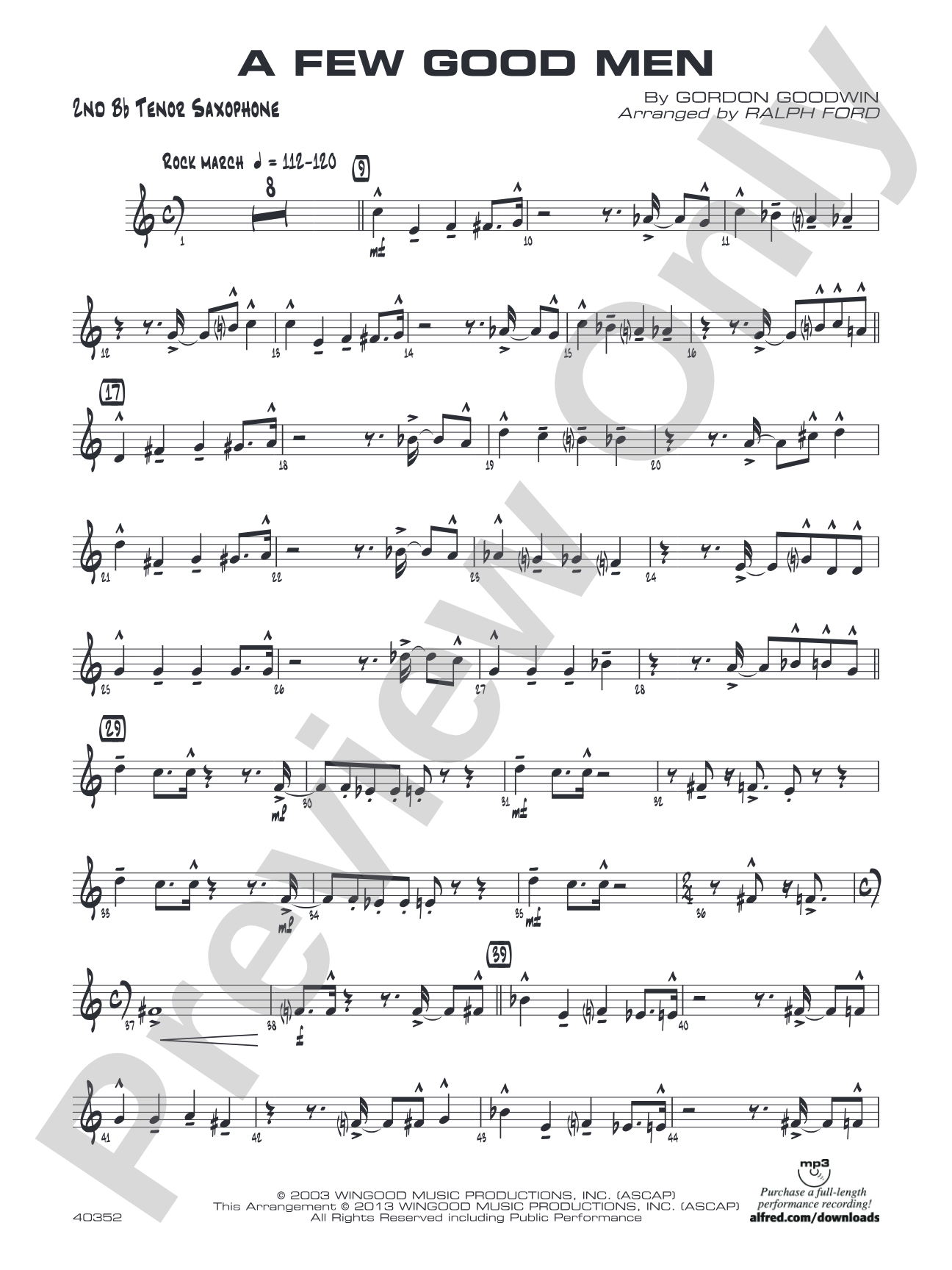

A Few Good Men: 2nd B-flat Tenor Saxophone
By Gordon Goodwin / arr. Ralph Ford
Grade: 2 (Medium Easy)
Item: 00-PC-0017251_TX2
$3.00
Pickup currently not available
Description
Adapted for the younger player from Gordon Goodwin's original Big Phat Band chart. It's a rock-march that begins with a drum cadence then into the funky-rock groove at 114 BPM. Includes written-out solos for tenor and trumpet 2, lead trumpet range is to written A above the staff and clear rhythm section parts with vibes. Hot! This title is available in MakeMusic Cloud.


Don't just read it, hear it, play along with it, and watch your students grow with it. In MakeMusic Cloud, A Few Good Men: 2nd B-flat Tenor Saxophone comes alive with professional accompaniment, adjustable tempo, and built-in practice tools that turn solo practice into real progress.
Open in the Player
Jump straight in and assign it today.
Start Your Free Trial
Open this title and explore the full library in minutes.
Sample Audio
1
Audio File
--:--
0:00
0:00
Sample Video
No sample videos found.
Additional Details
Series:
Young Jazz Ensemble
Publisher:
Alfred Music
Page Count:
104
SKU:
00-PC-0017251_TX2
More about this title
About the Composer: Gordon Goodwin

Gordon Goodwin heard complete compositions in his head from age five and had the discipline to write them down in full. By thirteen, he'd already created his first big band chart, a gift that would define his trajectory through television, film, and live performance. His work has earned three Emmy Awards and multiple Grammy nominations, with orchestrations heard in films ranging from Bad Boys II to Remember the Titans.
Over decades of writing for artists including Christina Aguilera, Quincy Jones, and Ray Charles, Goodwin developed a reputation for crafting music that balances sophistication with accessibility. He founded Gordon Goodwin's Big Phat Band in 2000, establishing himself as both a leading composer-arranger and conductor of one of Los Angeles' most celebrated jazz ensembles. His ability to write across idioms—from Hollywood scores to high-energy big band charts—makes his music instantly recognizable.
Why we love this
Goodwin's original Big Phat Band chart translates seamlessly into this Grade 2 adaptation without losing the groove or attitude that makes the piece such a draw. Ralph Ford's arrangement respects the funky-rock energy while keeping ensemble parts accessible; the written-out solos give your section leaders a genuine feature moment, and the clean rhythm section writing means your rhythm section can lock in immediately. This is a chart that sounds and feels like real jazz, not a simplified knockoff.
What to expect
The drum cadence sets an air of anticipation before the funky-rock groove lands at 114 BPM with undeniable swagger. What follows is a modern big band sound informed by rock and funk sensibilities; the groove has weight and forward motion, and the ensemble writing swings hard without requiring virtuosic chops. This is music that makes your students feel like working musicians playing something that matters.
Who it's for
Jazz ensembles at the high school level (and strong middle school programs) with players ready to handle contemporary groove-based writing and featured solo passages. Directors who want their students to experience the energy and sophistication of real big band jazz without overwhelming them technically will find this chart exactly right. This is ideal for ensembles with a working rhythm section and section leaders confident enough to carry written solos.
How to get the most out of it
- Start the rehearsal by sitting with the rhythm section and nailing the drum cadence to groove transition. Once that pocket is solid, the ensemble will lock in much faster.
- Balance the vibes in the mix so they cut through the horn section without overwhelming the texture. In a school setting, they often disappear; push them forward.
- Have your tenor and trumpet 2 soloists listen to Goodwin's original Big Phat Band recording before rehearsals begin. They'll absorb the stylistic nuances and attitude that make these solos sing.
- Work the lead trumpet range carefully. The written A above the staff is achievable at this level, but it demands solid fundamentals in the upper register and consistent air support.
How to use it
Program this as your closer or penultimate piece on a jazz concert where you want to leave the audience energized and impressed. The contemporary groove and high production value make it a natural fit alongside other modern big band repertoire, and it works equally well as a feature for a jazz combo showcase or full ensemble concert. Consider pairing it with a ballad earlier in the set to show range; this chart's momentum and attitude will be even more impactful by contrast.
Skills your students will build
- Reading and executing funk-influenced rhythmic figures across ensemble parts
- Locking in as a section within a rock-march groove at tempo
- Executing written-out solos with appropriate jazz phrasing and articulation
- Balancing ensemble density while maintaining clarity in the horn section
- Reading and interpreting lead trumpet range up to written A above the staff
- Supporting and following the rhythm section's timekeeping in a contemporary jazz context