
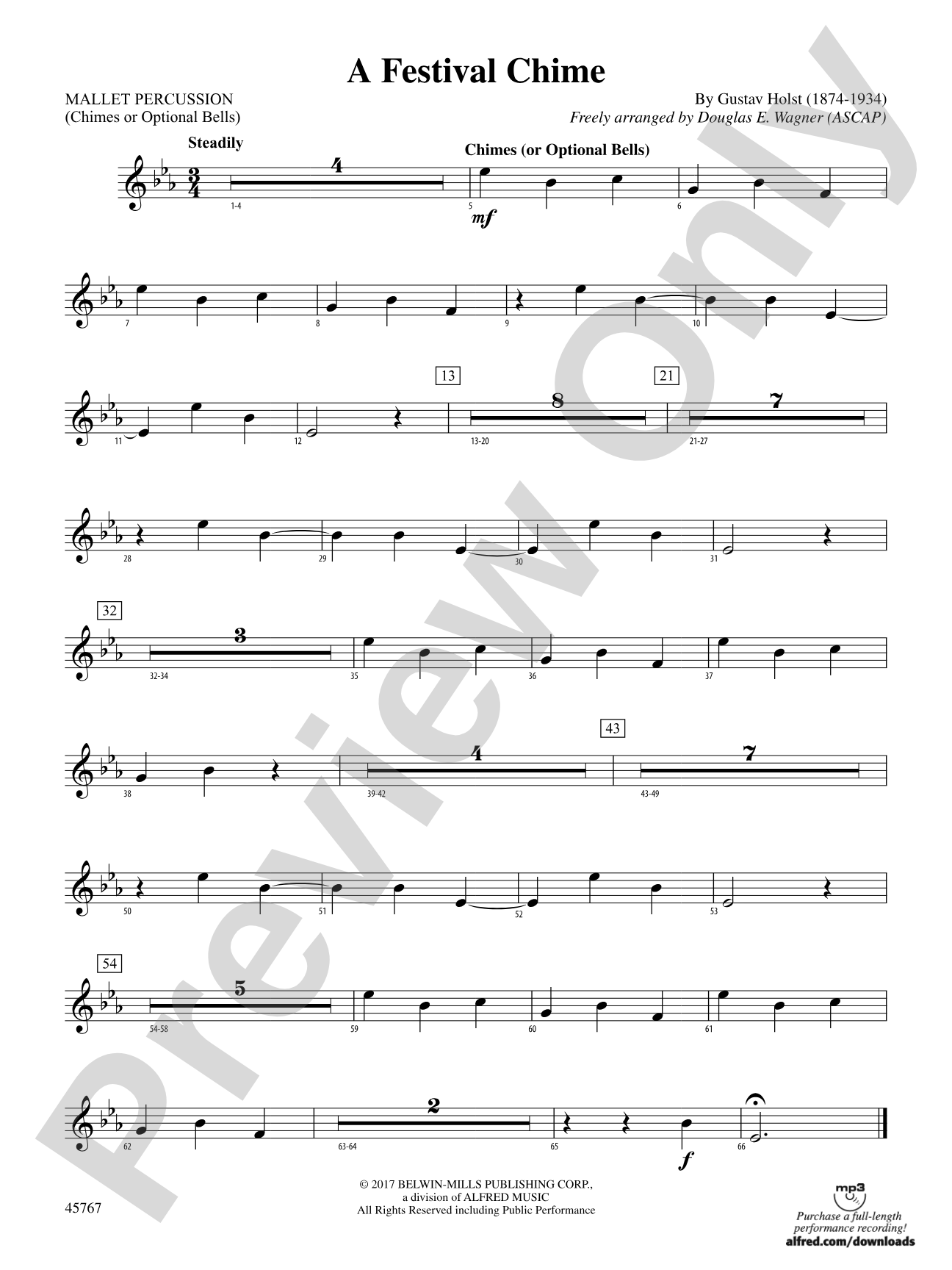

A Festival Chime: Mallets
By Gustav Holst / freely arranged by Douglas E. Wagner
Grade: 1 (Very Easy)
Item: 00-PC-0017578_M1
$3.00
Pickup currently not available
Description
The third movement of Opus 34 (Three Festival Choruses), which Gustav Holst penned in 1916, was originally scored for chorus with piano, orchestra, or military band. The easily recognized melody is a nineteenth century Welsh ballad, known to most as the hymn tune "St. Denio," set to the words of English poet, Clifford Bax. In 3/4, this characteristically delightful Holst theme has been freely arranged to incorporate elements of his original score with additional material included to heighten musical interest for contemporary concert bands and audiences alike. As the title implies, chimes are an integral part of this arrangement; however, there are alternate options provided in the program notes if a suitable instrument is unavailable. This musical setting is complete with a variety of teaching and performance opportunities and a perfect fit for beginning concert bands. (2:00)


Don't just read it, hear it, play along with it, and watch your students grow with it. In MakeMusic Cloud, A Festival Chime: Mallets comes alive with professional accompaniment, adjustable tempo, and built-in practice tools that turn solo practice into real progress.
Open in the Player
Jump straight in and assign it today.
Start Your Free Trial
Open this title and explore the full library in minutes.
Sample Audio
1
Audio File
--:--
0:00
0:00
Sample Video
Additional Details
Series:
Belwin Beginning Band
Publisher:
Alfred Music
Page Count:
130
SKU:
00-PC-0017578_M1
More about this title
About the Composer: Gustav Holst
Gustav Holst (1874-1934) was an English composer whose gift for melody and orchestration shaped twentieth-century band and choral music. Though trained in the Romantic tradition, Holst developed a distinctly modern voice, drawing inspiration from English folk song, Hindu philosophy, and medieval poetry. His works for band and chorus remain cornerstones of the repertoire, valued for their accessibility and emotional directness.
Holst's Festival Choruses (Opus 34), written in 1916, exemplify his ability to transform traditional melodies into rich musical statements. Set to texts by poet Clifford Bax, these choruses were conceived in multiple scorings, allowing them to reach amateur musicians across different ensembles. His commitment to writing music that served both performers and audiences without compromise established him as a champion of democratic music-making.
Why we love this
Douglas Wagner's arrangement captures everything that makes Holst's melody so enduring while providing an idiomatic concert band setting that beginning players can execute with confidence. The inclusion of chimes with practical alternatives shows real teaching awareness; students get to perform with color and texture rather than settle for less. Programming a Grade 1 work by a major composer signals that artistry and musical integrity matter at every level.
What to expect
Warm and ceremonial, like a festival procession. The Welsh ballad moves with gentle dignity in 3/4, supported by straightforward harmonies that give the melody room to breathe. Holst's characteristic directness shines through; there are no pretenses here, just genuine musical substance scaled for young players.
Who it's for
Beginning concert bands seeking Grade 1 repertoire that connects students to established musical literature and builds confidence through a melody most audiences will recognize. This arrangement works equally well for groups building their first festival repertoire or teachers introducing young players to how masterwork melodies are adapted across different scorings.
How to get the most out of it
- Balance the melody across your instrumentation so the Welsh ballad "St. Denio" sings through clearly, even as surrounding voices provide harmonic support.
- Attend closely to the chime part (or its substitute) to shape phrases and add sparkle without drowning out the band's fundamental tone.
- Shape the hymn-like quality of the piece through careful attention to breath points and phrase endings, allowing students to feel the structural integrity beneath the familiar tune.
How to use it
This is an ideal opener for a concert or festival program, setting a reflective tone and establishing musicality early. It also pairs well with other Grade 1-2 classics or contemporary works, giving your band a memorable anchoring point that audiences will carry with them. Consider programming it alongside other hymn-based arrangements to explore how folk melodies work across different cultural and musical contexts.
Skills your students will build
- Sustaining phrases in 3/4 meter with proper breath placement
- Balancing melody and accompaniment voices within a homophonic texture
- Reading concert band instrumentation and transpositions in a Grade 1 context
- Performing with sensitivity to the hymn-like character and ceremonial quality of the piece
- Executing parts that require dynamic shaping and attention to harmonic function