
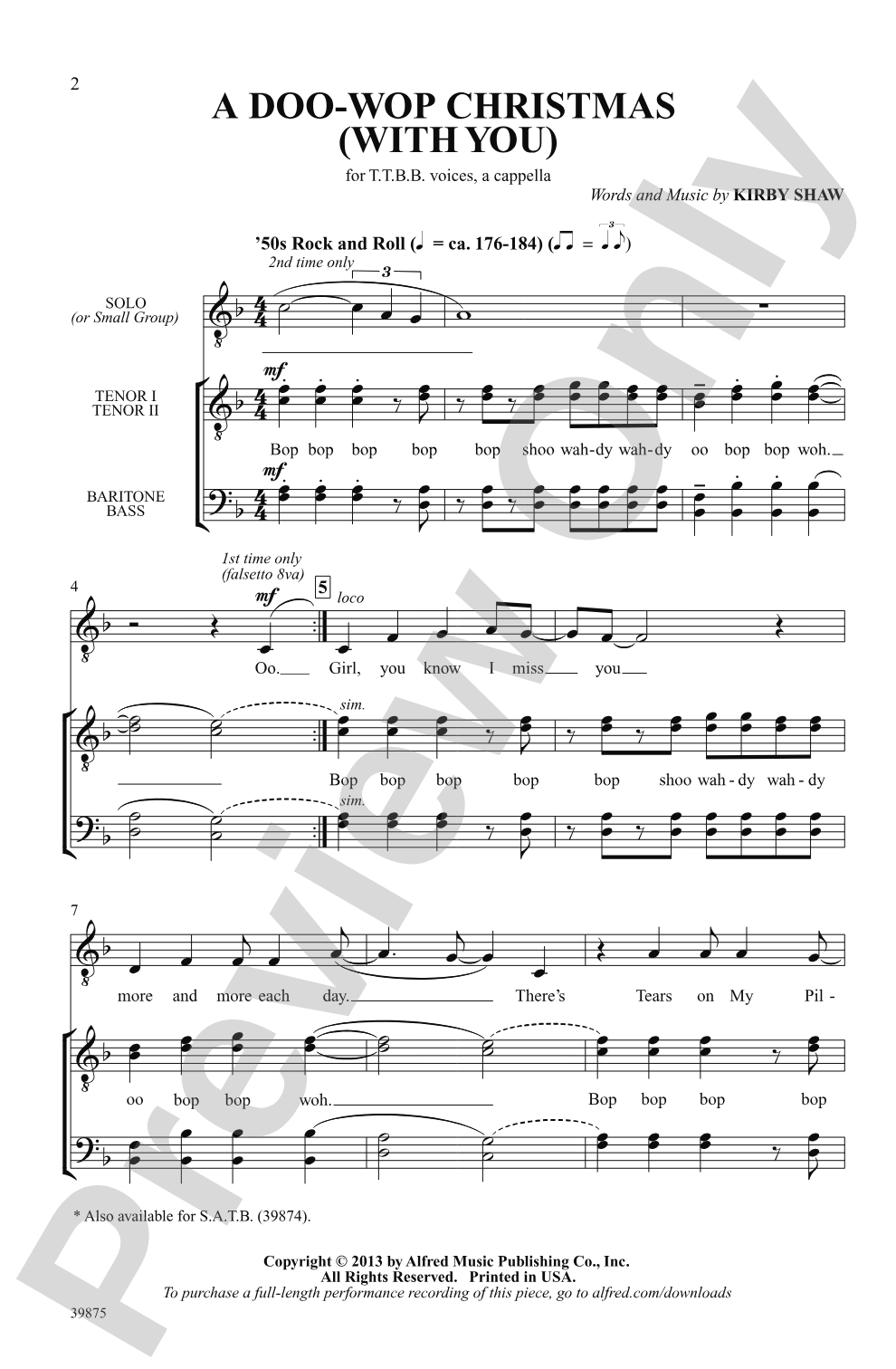

A Doo-Wop Christmas (With You): TTBB, a cappella Choral Octavo
Words and music by Kirby Shaw
Item: 00-PO-0001674
$2.05
Minimum order quantity: 20 copies
Pickup currently not available
Description
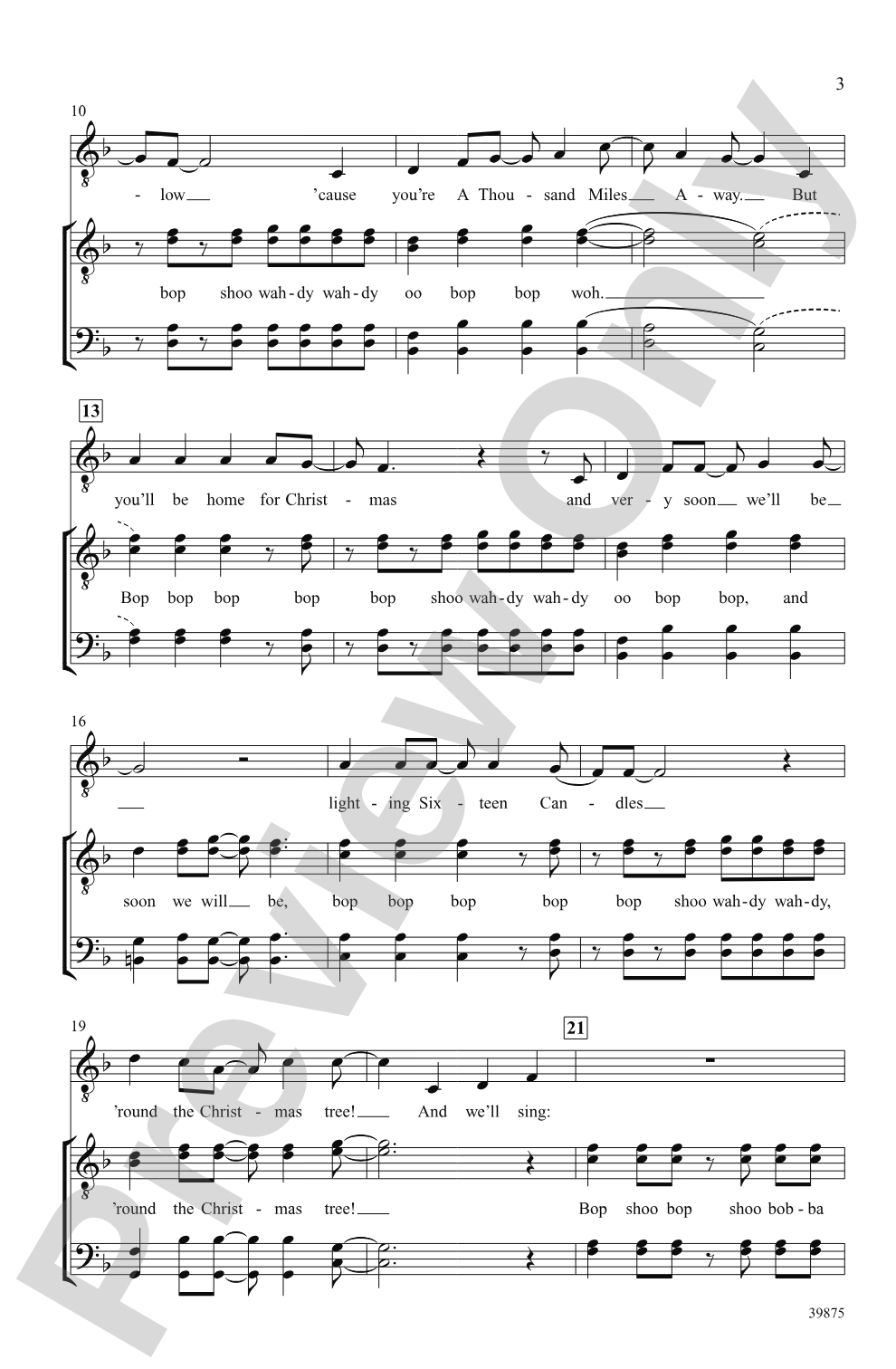
This clever a cappella original is reminiscent of doo-wop groups from the '50s and '60s. The choir sings a "bop-bop-bop" refrain alternately with classic back-ups, as a soloist or small group croons the flirtatious text, weaving in popular song titles from back in the day.


A Doo-Wop Christmas (With You): TTBB, a cappella Choral Octavo isn't in MakeMusic Cloud just yet...but it could be. Let us know you'd like to see it, and you'll help shape what comes next. In the meantime, start a free trial and dive into thousands of interactive titles your students can play along with today.
Request This Title
Tell us you want it.
Start Your Free Trial
Explore everything that's ready to play right now.
Sample Audio
1
Audio File
--:--
0:00
0:00
Sample Video
No sample videos found.
Additional Details
Series:
Alfred Choral Designs
Publisher:
Alfred Music
Page Count:
8
SKU:
00-PO-0001674
More about this title
About the Composer: Kirby Shaw

Kirby Shaw's influence spans music education across North America, Europe, and beyond, having conducted workshops in 45 states and internationally in Canada, Australia, the Bahamas, Sweden, The Netherlands, Italy, Spain, and Germany. He holds degrees in Music Education and Choral Composition from San Jose State University and a DMA in Choral Conducting from the University of Washington. His teaching combines rigorous musicianship with infectious humor and accessibility.
Shaw founded and directed the COS Vocal Jazz Ensemble at College of the Siskiyous in California, then led similar programs at Colorado State University and the University of Missouri at Kansas City before joining Southern Oregon University to direct the Jefferson State Choral Coalition. His prolific output includes over 2,500 choral arrangements and compositions in print, with nearly 20 million copies sold worldwide. He has scatted with Bobby McFerrin, Mark Murphy, Al Jarreau, Jon Hendricks, and Chris Calloway, and performs as a member of Just 4 Kicks, a four-man a cappella jazz ensemble. His work has earned multiple ASCAP awards, and he recently received a commission from the Mormon Tabernacle Choir.
Why we love this
Shaw captures authentic doo-wop style here without resorting to pastiche or parody. The alternating "bop-bop-bop" texture and flirtatious solo over classic backup harmonies give singers real character work within a manageable eight-page framework, and the embedded song title references reward audiences with moments of genuine delight. It's the kind of piece that builds ensemble camaraderie through humor while maintaining genuine musical substance.
What to expect
Stepping into a '50s or '60s diner on Christmas Eve, where a smooth crooner weaves flirtation and holiday joy over the playful support of a close-harmony backup group. The piece has genuine warmth beneath its nostalgic wink, and the embedded song references spark recognition without derailing the performance.
Who it's for
TTBB choirs looking for a secular holiday piece that entertains without sacrificing musicality. This works for concert choirs with confident soloists, jazz ensembles branching into traditional voicing, or any group that appreciates mid-century popular style and gentle humor.
How to get the most out of it
- Lock the rhythm section (second tenor and baritone) into a tight, conversational groove during the backup passages. These voices establish the doo-wop pocket, so precision and consistency matter more than projection.
- Cast your soloist or small group not by vocal prowess alone but by their comfort with conversational text delivery and rhythmic flexibility. The flirtatiousness lives in the phrasing, not the volume.
- Drill the "bop-bop-bop" refrains separately with the main body of the choir. These moments feel throwaway but need crisp articulation and unified vowel shape to land the comedy.
- Balance the soloist so the audience hears both the solo melody and the backup harmonies underneath. This is a conversation, not a solo with accompaniment.
How to use it
Program this as a palate cleanser in a holiday concert featuring heavier choral works, or open a second half with it to shift energy and audience mood. It pairs naturally with other secular holiday fare and gives singers a chance to showcase personality after more formally demanding repertoire.
Skills your students will build
- Singing a cappella with secure pitch and blend across four voices
- Rhythmic independence (maintaining "bop-bop-bop" refrain while soloist moves over it)
- Text delivery with comedic timing and character
- Harmonic awareness in backup vocal passages
- Listening to and supporting a featured soloist