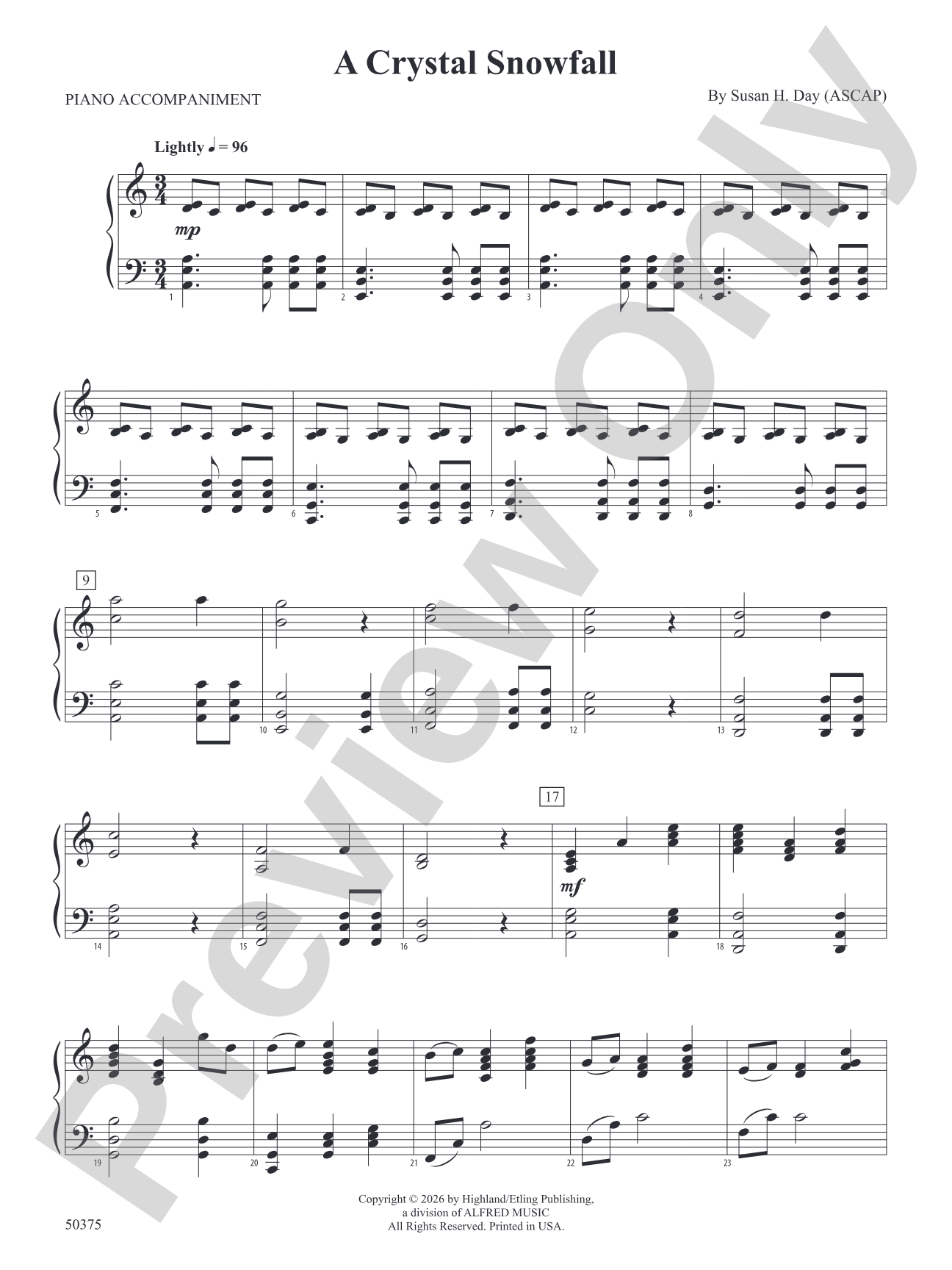
A Crystal Snowfall: Piano Accompaniment Sheet Music Preview

A Crystal Snowfall: Piano Accompaniment

By Susan H. Day

Grade: 2

Item: 00-PC-0019834_K

Digital Download
$3.00
Description
This lovely piece creates a relaxing mood, and although not technically hard, provides an opportunity to practice 3rd position for upper strings and vibrato on the longer notes. Students will get to reinforce playing in 3/4 time, pizzicato, low 1st finger on E string, and executing steady 8th notes. This is a great piece to work on bow placement, bow control, and bow distribution. All parts have a melody line. Dissonances create harmonic tension and release. A perfect choice for your winter concert!

Don't just read it, hear it, play along with it, and watch your students grow with it. In MakeMusic Cloud, A Crystal Snowfall: Piano Accompaniment comes alive with professional accompaniment, adjustable tempo, and built-in practice tools that turn solo practice into real progress.

Sample Audio
0:00
0:00
Sample Video
Additional Details
Series: Highland String Orchestra
Publisher: Alfred Music
SKU: 00-PC-0019834_K

More about this title

Why we love this

Day writes for student orchestras with real pedagogical intention. Every technical demand serves the music, and every musical phrase teaches something about bow control, intonation, or ensemble balance. The dissonances give this winter piece genuine harmonic substance rather than sentiment.

What to expect

Calm and crystalline, like watching snow accumulate in still air. The pizzicato figures and sustained tones create delicate layers, while the gentle harmonic dissonances prevent the piece from feeling too simple or saccharine.

Who it's for

String orchestras in grades 2-3 who are ready to add vibrato and 3rd position to their technical vocabulary. This works for ensembles that have solid intonation in first position and understand basic bow distribution.

How to get the most out of it

  • Map out bow distribution during the 8th-note passages before rehearsal. Consistent bow speed across all parts keeps the ensemble locked together and prevents the texture from becoming rhythmically soft.
  • Work 3rd position in isolated passages first, then gradually integrate it into full sections. Having upper strings finger the passage while the section plays pizzicato is an effective bridge between talking about position and hearing it in context.
  • Balance vibrato on longer notes so it reinforces tone without creating pitch drift. Ask students to vibrato while sustaining a unison pitch with another section to develop control and listening skills.
  • Check bow placement across all parts during the sustained sections. Uneven placement between first and second violins, or between violins and violas, will muddy the harmonic tension you need to hear.

How to use it

This belongs on a winter concert as either a standalone opener or paired with a livelier piece that contrasts its gentle mood. It also works well for festival play-throughs and adjudicated events where judges want to hear precise bow work and balanced tone production.

Skills your students will build

  • 3rd position on upper strings
  • Vibrato on sustained notes
  • Pizzicato technique and ensemble coordination
  • Low 1st finger positions on E string
  • Steady 8th-note rhythm in 3/4 time
  • Bow placement, control, and distribution
  • Listening for harmonic dissonance and resolution
  • Independent melodic lines within ensemble texture

You May Also Like