
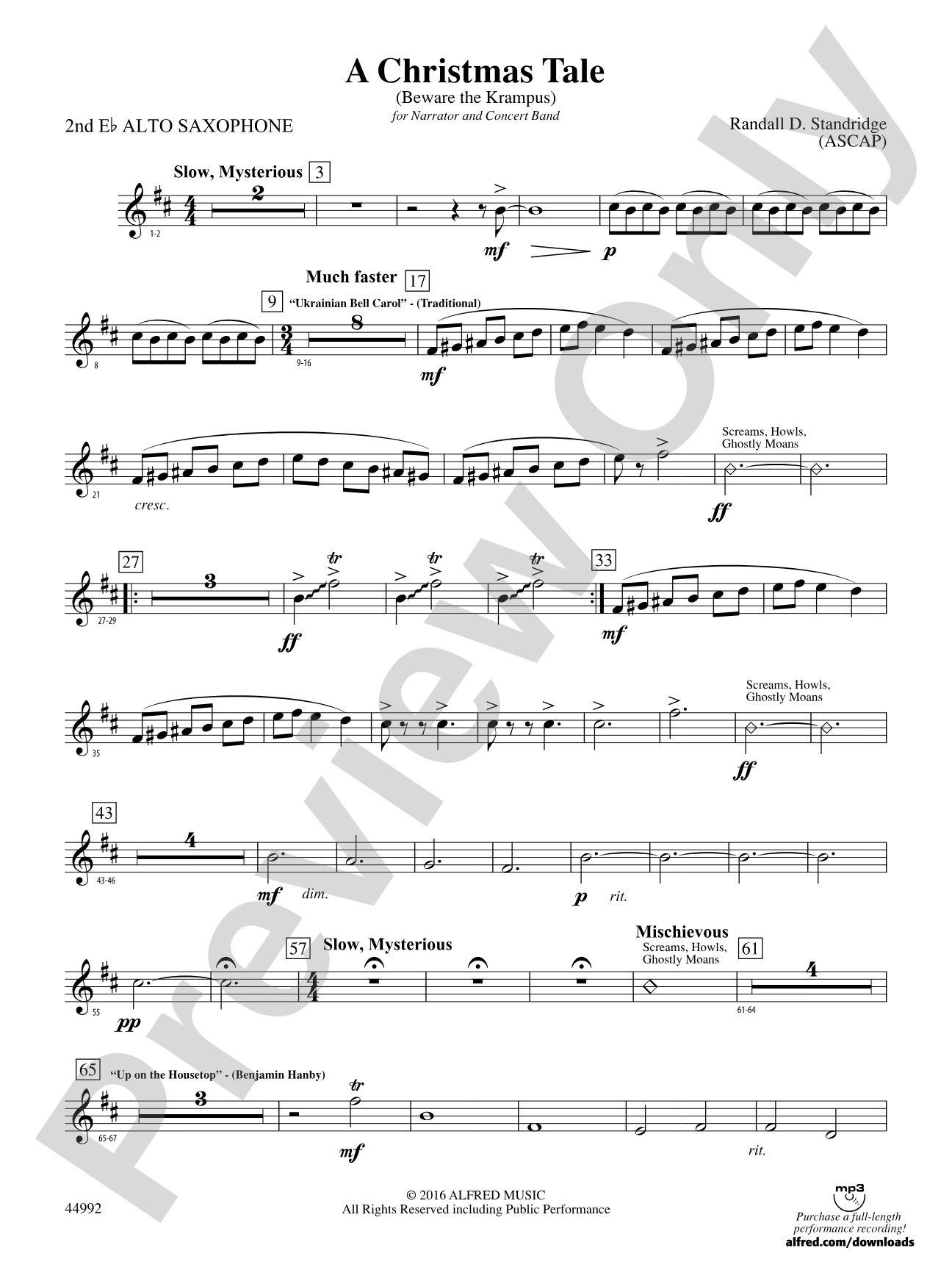

A Christmas Tale: 2nd E-flat Alto Saxophone
Beware the Krampus -- for Narrator and Band
By Randall D. Standridge
Grade: 2.5 (Medium Easy)
Item: 00-PC-0017457_AX2
$3.00
Pickup currently not available
Description
In some European Christmas traditions, Saint Nick (Santa Claus) does not work alone. He travels with the "Krampus," a "Christmas Devil" who doles out punishment to bad boys and girls on Christmas Eve. This work serves as a darkly delightful Christmas piece, intended to educate, entertain, and creep out your audience. The poem "Beware the Krampus" (written by the composer) helps frame the piece as familiar carols "The Ukranian Bell Carol," "Up on the Housetop," "Jolly Old St. Nicholas," and other holiday favorites are distorted. (4:50) This title is available in MakeMusic Cloud.


Don't just read it, hear it, play along with it, and watch your students grow with it. In MakeMusic Cloud, A Christmas Tale: 2nd E-flat Alto Saxophone comes alive with professional accompaniment, adjustable tempo, and built-in practice tools that turn solo practice into real progress.
Open in the Player
Jump straight in and assign it today.
Start Your Free Trial
Open this title and explore the full library in minutes.
Sample Audio
1
Audio File
--:--
0:00
0:00
Sample Video
Additional Details
Series:
Young Symphonic
Publisher:
Alfred Music
Page Count:
292
SKU:
00-PC-0017457_AX2
More about this title
About the Composer: Randall D. Standridge
Randall D. Standridge is a prolific composer and arranger whose work spans concert band, wind ensemble, and choral settings. His compositions for young and intermediate ensembles are known for their musical substance, creative orchestration, and ability to engage both players and audiences without sacrificing artistic integrity.
Standridge has become a trusted voice in music education publishing, consistently delivering pieces that challenge students musically while remaining accessible to bands at developing levels. His arrangements of familiar material often reveal fresh harmonic and textural possibilities, making them valuable additions to concert programming.
Why we love this
This piece walks a satisfying tightrope between accessibility and memorable storytelling. Standridge takes beloved holiday melodies and transforms them into something genuinely unsettling, creating a concert moment that sticks with audiences long after the final note. At Grade 2.5, it's playable by developing bands yet sophisticated enough to hold the attention of experienced ensembles and discerning listeners.
What to expect
Familiar carols dissolve into minor-key shadows and unexpected harmonic turns. The piece has the theatrical quality of a ghost story told around a fire, with moments of dark humor cutting through genuine eeriness. Krampus emerges not as pure evil but as a mischievous trickster, making the whole experience delightfully unsettling rather than genuinely frightening.
Who it's for
Concert bands at the upper elementary to early middle school level, or adult community bands seeking a Christmas program piece with personality and substance. This work appeals to directors who want holiday repertoire that educates audiences about global Christmas traditions while delivering genuine entertainment value.
How to get the most out of it
- Study the composer's poem "Beware the Krampus" with your ensemble before rehearsal begins. Understanding the narrative arc helps players commit to the darkly playful character and control dynamic shifts with intention rather than accident.
- Balance familiarity against distortion carefully. Players recognize the carol melodies, so use that recognition strategically. When a familiar tune appears twisted or fragmented, that contrast becomes the dramatic weapon.
- Shape the piece's pacing to build tension rather than let it drift. At 4:50, momentum matters. Keep transitions crisp and maintain a sense of forward motion even in slower sections.
- Trust the orchestration to create the creepy atmosphere. Standridge's scoring choices (instrumentation, register, harmonic color) do heavy lifting. Resist the urge to add extra effects or exaggerated articulation. The music is already unsettling on its own.
How to use it
Reserve this for a holiday concert finale where it can surprise and delight an audience expecting traditional Christmas cheer. The piece works beautifully when paired with straightforward carol arrangements earlier in the program, amplifying the contrast and earning its darkly comedic payoff. Its 4:50 duration makes it substantial enough to close a set without overstaying its welcome.
Skills your students will build
- Reading distorted versions of familiar melodies and recognizing them despite harmonic and rhythmic alterations
- Balancing sustained ensemble tone while tracking rapid textural changes and sectional interplay
- Responding to conductor cues that shape dramatic tension and pacing across a narrative arc
- Executing precise articulation changes that shift the character of recognizable melodies from cheerful to unsettling