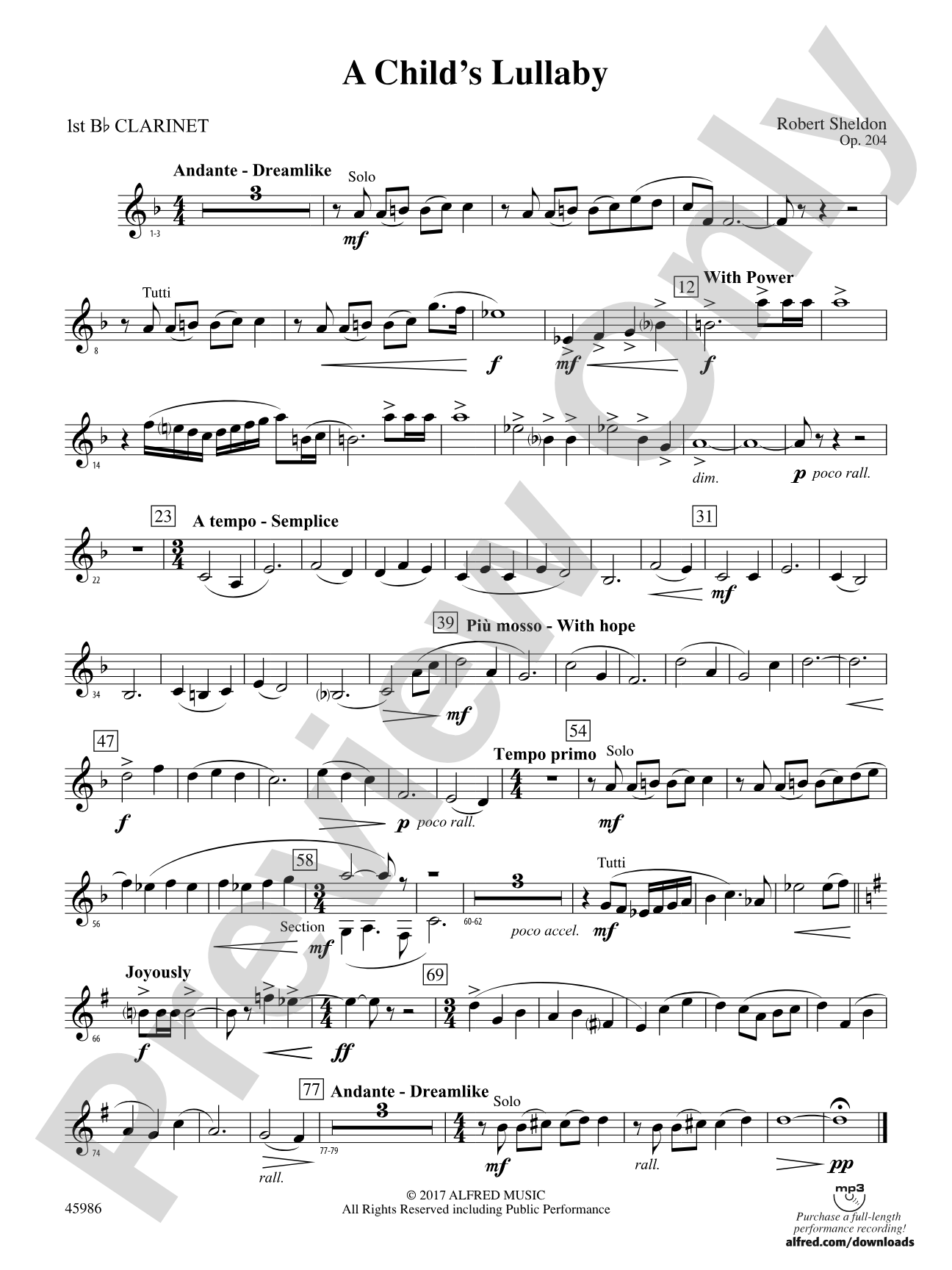
A Child's Lullaby: 1st B-flat Clarinet Sheet Music Preview

A Child's Lullaby: 1st B-flat Clarinet

By Robert Sheldon

Grade: 2.5 (Medium Easy)

Item: 00-PC-0017712_C1

Digital Download
$3.00
Description
This piece is dedicated to Olivia Caldwell---a beautiful and charming little girl who was taken by cancer at the age of 20 months. Her grandparents commissioned this piece in her memory to recognize her sweetness, strength, and courage. (3:45) This title is available in MakeMusic Cloud.

Don't just read it, hear it, play along with it, and watch your students grow with it. In MakeMusic Cloud, A Child's Lullaby: 1st B-flat Clarinet comes alive with professional accompaniment, adjustable tempo, and built-in practice tools that turn solo practice into real progress.

Sample Audio
0:00
0:00
Sample Video
Additional Details
Series: Young Symphonic
Publisher: Alfred Music
Page Count: 128
SKU: 00-PC-0017712_C1

More about this title

About the Composer: Robert Sheldon

Robert Sheldon

Robert Sheldon's compositions for wind band appear on contest lists and concert stages worldwide, performed by ensembles ranging from middle school bands to professional groups. His work as lead author of Sound Innovations for Concert Band and his extensive roster of commissions have established him as a defining voice in contemporary band literature.

Sheldon's impact extends beyond the page. He has guest conducted All-State and Regional Honor Bands across the country and on five continents, led clinics at universities and state conferences, and premiered his works in venues including Carnegie Hall, the Kennedy Center, and the Sydney Opera House. In 2020, VanderCook College of Music honored him with a doctorate for his contributions to music education and composition.

Why we love this

Sheldon crafts a piece that honors profound loss without sentimentality. The Grade 2.5 setting ensures accessibility across ability levels, yet the emotional maturity of the writing gives students something genuinely meaningful to express rather than merely play through. This is the kind of repertoire that reminds a band why they're here.

What to expect

A gentle, unrushed meditation that respects silence as much as sound. The orchestration remains warm and transparent, allowing the simple melody to carry the emotional core. This is music that breathes.

Who it's for

Intermediate concert bands looking for repertoire with real emotional substance. This piece serves ensembles that have moved beyond strictly technical studies but aren't yet ready for Grade 4 complexity. It's equally at home in a festival setting or a concert program anchored by something more demanding.

How to get the most out of it

  • Balance the melody across sections so that it sings rather than speaks. When the line passes from clarinets to saxophones to trumpets, maintain consistent dynamic shape and phrasing as though a single musician were playing the entire passage.
  • Allow breath and silence where the score suggests them. A lullaby's power often lies in what it doesn't fill, so resist the impulse to rush between phrases.
  • Shape dynamics toward specific harmonic or melodic moments rather than following a rigid swell and fade pattern. Listen for the underlying progression and let the band's volume follow the emotional weight of the harmony.
  • Front-load your rehearsal on tone quality and intonation in the mid-range frequencies where most of the texture lives. A lullaby's intimacy demands cleaner blend than showier material.

How to use it

Program this as a set-closing piece or as a moment of repose between more energetic selections. The 3:45 duration makes it an effective anchor for a thematic concert on resilience, memory, or courage. It also works exceptionally well in a festival context where judges and audiences recognize compositional craft even in accessible writing.

Skills your students will build

  • Sustaining lyrical phrasing over long harmonic progressions
  • Listening for and matching principal melodists across ensemble transitions
  • Dynamic shaping aligned to harmonic movement rather than arbitrary crescendo patterns
  • Balancing accompanimental textures so they support rather than obscure the melody

You May Also Like