
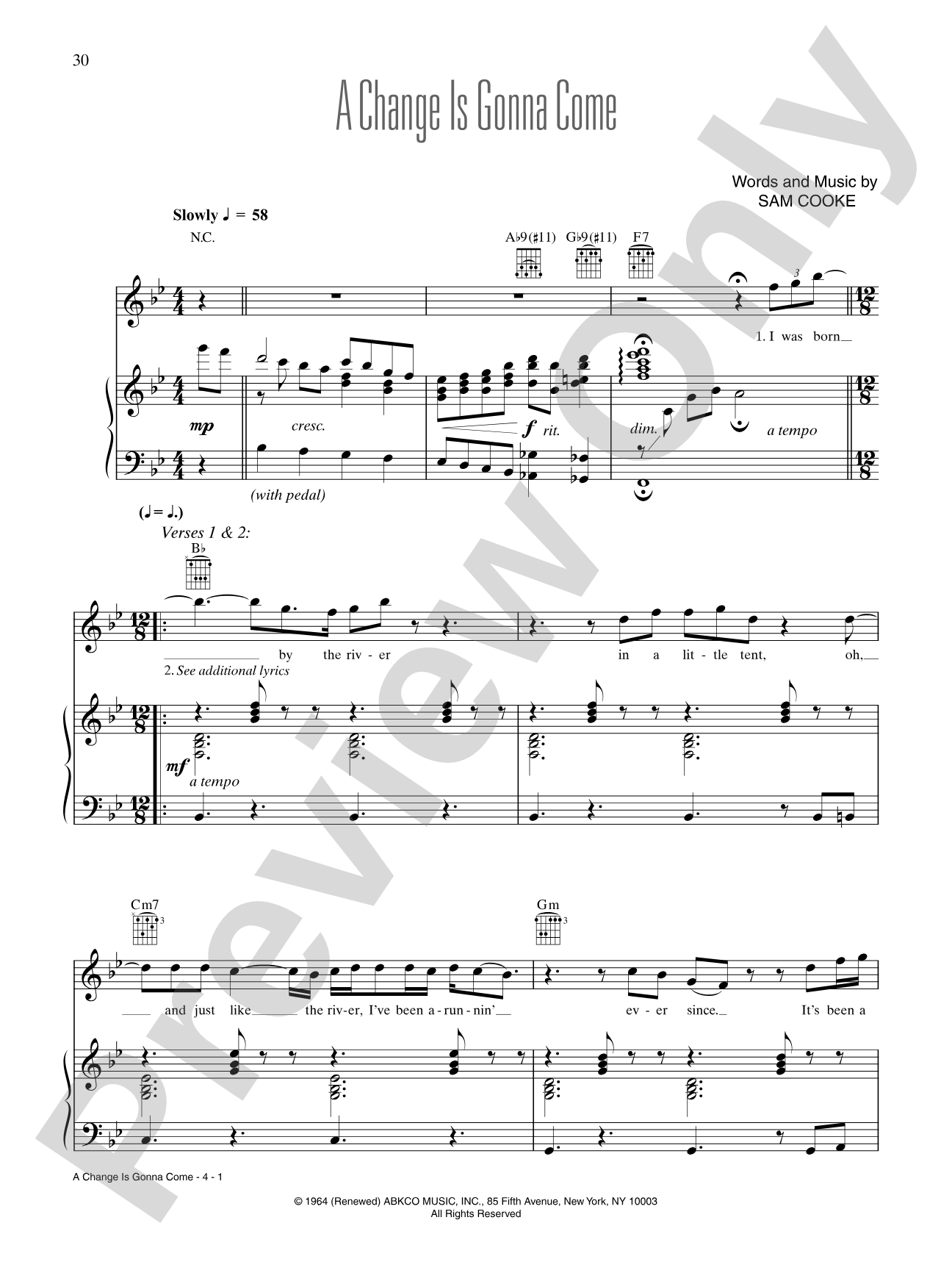

A Change Is Gonna Come: Piano/Vocal/Chords
25 Contemporary, Uplifting Songs
Item: 00-PS-0015732
$4.99
Pickup currently not available
Description
Songs of Inspiration, Perseverance and Hope contains songs meant to help those who are facing a challenge in life. This special collection of contemporary, uplifting songs gives the pianist an opportunity to play and sing for those in need. One dollar from each book will be donated in support of cancer research. Titles: Anyway * Badlands * Bridge Over Troubled Water * A Change Is Gonna Come * Count on Me * Don't Stop Believin' * Feels Like Home * The Greatest Love of All * I Am Beautiful * I'm One * Imagine * In My Daughter's Eyes * Land of Hope and Dreams * Laugh and Be Happy * Let There Be Peace on Earth * My Love Will Not Let You Down * Need You Now (How Many Times) * Only Hope * The Prayer * So Small * Thank You * Waitin' on a Sunny Day * What a Wonderful World * You Light Up My Life * You Raise Me Up.


A Change Is Gonna Come: Piano/Vocal/Chords isn't in MakeMusic Cloud just yet...but it could be. Let us know you'd like to see it, and you'll help shape what comes next. In the meantime, start a free trial and dive into thousands of interactive titles your students can play along with today.
Request This Title
Tell us you want it.
Start Your Free Trial
Explore everything that's ready to play right now.
Sample Audio
No sample audio found.
Sample Video
No sample videos found.
Additional Details
Publisher:
Alfred Music
Page Count:
144
SKU:
00-PS-0015732
More about this title
About the Composer: Sam Cooke
Sam Cooke (1931-1964) stands as one of the most influential soul and R&B artists of the 20th century, and his composition "A Change Is Gonna Come" remains an anthem of resilience and social consciousness. Released in 1964, the song drew inspiration from the Civil Rights Movement while speaking universally to anyone facing hardship or uncertainty. Cooke's ability to fuse emotional depth with accessible melodies made his work enduringly relevant across generations.
For music educators, Cooke's legacy offers a vital entry point into discussions of songwriting that carries both artistic integrity and social meaning. His melodies are memorable and singable, his harmonic language is sophisticated yet approachable, and his lyrics invite reflection on themes of hope and perseverance that resonate far beyond their original historical moment.
Why we love this
This collection pairs one of the most powerful songs ever written about resilience with 24 other contemporary and classic uplift songs, creating a flexible resource for programs that need to address themes of hope, perseverance, and human connection. The roster spans decades and styles, from Springsteen and John Lennon to Carole King and modern pop, ensuring that pianists and singers can find material that speaks to their own artistic voice while exploring the emotional landscape of inspiration.
What to expect
These songs radiate quiet strength. Whether you're hearing the familiar arc of "Imagine" or the soulful swagger of "Don't Stop Believin'," there's an undercurrent of determination and belief in a better tomorrow. The collection feels less like escapism and more like standing alongside someone in the difficult moment, offering a hand and a song that says: you're not alone in this.
Who it's for
This collection serves pianists and singer-pianists who lead community sing-alongs, perform at benefit events, facilitate music therapy or grief support sessions, or simply wish to develop a repertoire of emotionally substantial material. It works equally well for solo recitals, intimate performances in care facilities, and ensemble singing in educational settings where thematic coherence matters.
How to get the most out of it
- Attend to the lyrical content as carefully as the melody. These songs carry stories; your phrasing and tempo choices should honor what the words are saying, not just the musical shape.
- Explore the chord voicings and substitutions suggested in the notation. Many of these songs benefit from jazz-inflected interpretations that can deepen the emotional impact.
- If performing for an audience facing real challenges, allow space for silence between songs. Pacing and breath are as important as the music itself.
- Consider the key of each piece in relation to your vocal range and the emotional arc you want to create across multiple selections.
How to use it
Create a thematic concert or chapel service built entirely around resilience and hope, selecting songs that resonate with your specific audience. Alternatively, draw individual selections throughout the year to accompany poetry readings, speech competitions, or commemoration events. The digital format allows you to print only the songs you need, making it economical for benefit performances where proceeds support cancer research.
Skills your students will build
- Reading piano/vocal/guitar chord charts and understanding chord-melody relationships
- Interpreting lyrical meaning and translating it into musical expression and phrasing
- Accompanying singers while maintaining stylistic integrity across pop, soul, and folk-influenced material
- Selecting keys and transposing appropriately for different vocal ranges
- Building a thematic setlist and understanding how song sequencing affects audience experience