
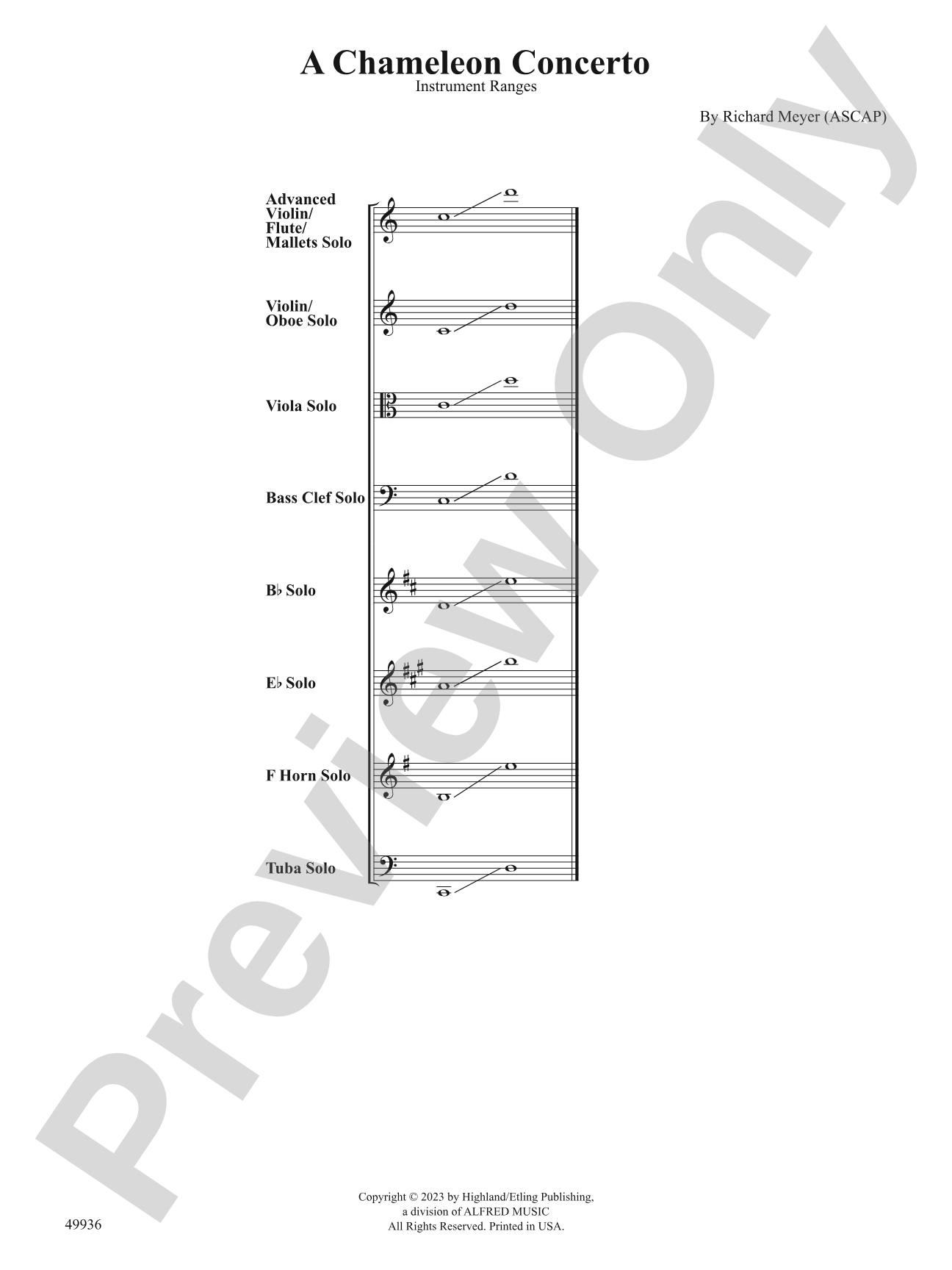

A Chameleon Concerto: Instrument Range Chart
By Richard Meyer
Grade: 3
Item: 00-PC-0018963_RANGES
$3.00
Pickup currently not available
Description
Give your young string orchestra a chance to learn the all-important skills needed to accompany a soloist with this compact, one-movement work that features a soloist playing ANY string or band instrument: oboe, viola, tuba---you name it! A Chameleon Concerto, by Richard Meyer, has catchy melodies that explore various moods. The constant give-and-take between the soloist and strings keeps every section of your group active. There is even a short cadenza toward the end of the piece to offer everyone on stage a complete concerto learning experience. (4:40)


Don't just read it, hear it, play along with it, and watch your students grow with it. In MakeMusic Cloud, A Chameleon Concerto: Instrument Range Chart comes alive with professional accompaniment, adjustable tempo, and built-in practice tools that turn solo practice into real progress.
Open in the Player
Jump straight in and assign it today.
Start Your Free Trial
Open this title and explore the full library in minutes.
Sample Audio
1
Audio File
--:--
0:00
0:00
Sample Video
Additional Details
Series:
Highland/Etling String Orchestra
Publisher:
Alfred Music
SKU:
00-PC-0018963_RANGES
More about this title
About the Composer: Richard Meyer

Richard Meyer brings three decades of string teaching experience into every note he writes. After 22 years directing orchestras at Oak Avenue Intermediate School in Temple City, California, he transformed a program of 29 students into one of 200, while simultaneously overseeing the district's elementary string curriculum. His work with the Pasadena Youth Symphony Orchestra spanned 16 years and took students to perform in New York, Washington D.C., Vienna, Australia, and Canada.
Beyond the podium, Meyer is a prolific composer with nearly 200 published works and served as string editor for Alfred Publishing Company for 16 years. His 2009 "Giving Bach" program gained national recognition for using interactive concerts to reach special needs and underserved students throughout Southern California. He has clinched at the A.S.T.A. National Conference, the Texas Orchestra Directors' Association Conference, and honor orchestras across multiple states.
Why we love this
Meyer understands exactly what young string players need to experience: the thrill of ensemble work that doesn't overshadow a soloist, but genuinely supports one. The flexibility to feature any string or wind instrument means you can bring in a fifth grader on oboe, your best violist, or even that tuba player who wants a moment in the spotlight, all with the same musical result. It's the kind of practical generosity that comes from decades of running real school programs.
What to expect
A Chameleon Concerto has the energy of a conversation between old friends: the soloist and strings trade ideas, interrupt each other, then come back together with fresh momentum. The melodies are immediately engaging, shifting moods without losing sight of the core musical narrative, and the brief cadenza near the end gives everyone a moment to breathe and listen before the final push.
Who it's for
String orchestras at the intermediate and early high school level who are ready to learn the fundamental skills of accompanying a soloist. Any director seeking a flexible, accessible concerto that works with the soloists you actually have on hand will find this piece invaluable.
How to get the most out of it
- Balance the soloist's entrance carefully; the strings should provide harmonic support without covering the melodic line, especially during the opening statements.
- Use the cadenza near the end as a rehearsal anchor. Once students can anticipate the soloist's break and lock back in together afterward, the whole ensemble gains confidence in responding to the solo part.
- Shape the "give-and-take" passages by having the orchestra play with slight dynamic flexibility; let the soloist breathe, then gently push forward when the parts interlock.
- Emphasize the section work during the catchy melody sections. When the strings lock in rhythmically, the soloist's material shines and the ensemble feels more secure.
How to use it
Program this alongside a straight orchestral work to showcase the breadth of your ensemble's abilities and to highlight a student soloist. It works beautifully as a mid-winter or spring concert feature, giving soloists their own moment without requiring a full concerto preparation, and the 4:40 length makes it an ideal fit within a concert that also includes longer works.
Skills your students will build
- Accompanying a soloist with responsive, non-intrusive ensemble playing
- Tracking and responding to another musician's tempo and phrasing choices
- Balancing solo and tutti sections aurally
- Maintaining ensemble cohesion during frequent solo/section exchanges
- Executing short cadenza passages with rhythmic precision