
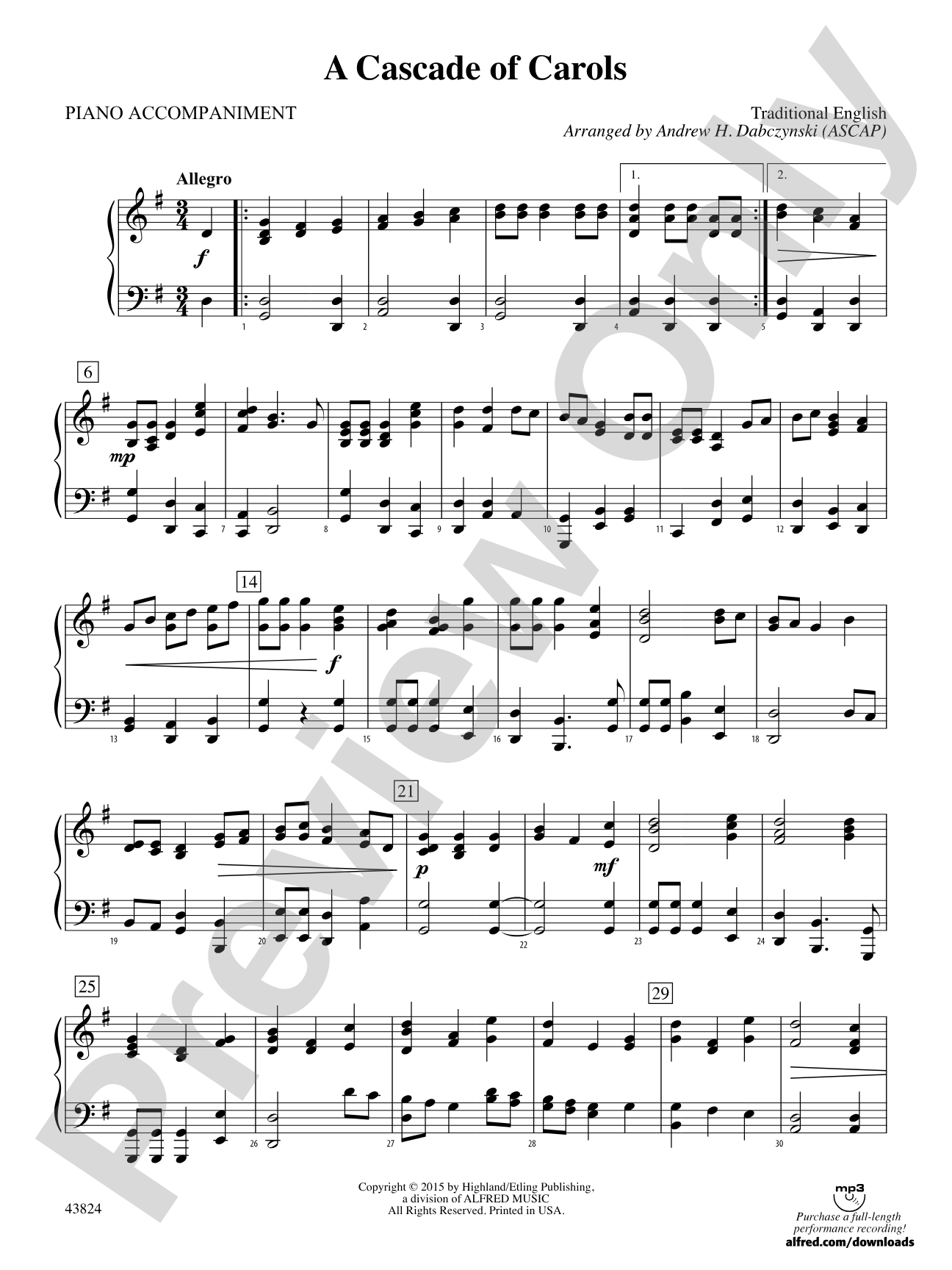

A Cascade of Carols: Piano Accompaniment
Traditional English / arr. Andrew H. Dabczynski
Grade: 2.5
Item: 00-PC-0016920_K
$7.99
Pickup currently not available
Description
In this jubilant new treatment, we hear four less-common carols---"The Holly and the Ivy," "Good Christian Men, Rejoice," "Sussex Carol," and "Rejoice and Be Merry." The medleys are sensitively arranged, and with flowing textures, themes passed throughout the orchestra, and an utterly joyful atmosphere. (3:00)


Don't just read it, hear it, play along with it, and watch your students grow with it. In MakeMusic Cloud, A Cascade of Carols: Piano Accompaniment comes alive with professional accompaniment, adjustable tempo, and built-in practice tools that turn solo practice into real progress.
Open in the Player
Jump straight in and assign it today.
Start Your Free Trial
Open this title and explore the full library in minutes.
Sample Audio
1
Audio File
--:--
0:00
0:00
Sample Video
Additional Details
Series:
Highland/Etling String Explorer
Publisher:
Alfred Music
Page Count:
140
SKU:
00-PC-0016920_K
More about this title
About the Arranger: Andrew H. Dabczynski

Andrew H. Dabczynski spent decades shaping string education at every level, from public school classrooms to university training programs. He founded BYU's New Horizons Orchestra, a pioneering ensemble for adult beginners that doubled as a laboratory for string pedagogy, and earned the Joseph E. White Fellowship in recognition of that work. His roles have included faculty positions at the Eastman School of Music and administration across multiple school districts, plus national leadership with the American String Teachers Association, which named him Higher Education Teacher of the Year in 2005.
As a violist, Dabczynski performed with regional orchestras including the Rochester Philharmonic and Hartford Symphony, and served six years as a member of the Colden String Quartet at Western Michigan University. His deep investment in folk traditions and ethnomusicology shaped his research into fiddling and traditional music transmission. He co-authored the String Explorer method series, widely adopted in schools nationwide, bringing that same clarity and accessibility to his arranging work.
Why we love this
Four lesser-known carols receive fresh, orchestrally sophisticated treatment without losing their essential character. The arrangement distributes themes across the entire string section, keeping every player engaged while the medley structure holds enough momentum to maintain middle-school ensemble focus across a three-minute performance.
What to expect
Warmth and gentle energy flow throughout, with the familiar melodies of these carols emerging and passing between instruments like light through flowing fabric. The orchestration feels generous and unhurried, letting each phrase bloom without strain, creating a performance that sounds both festive and intimate.
Who it's for
String orchestras at the Grade 2.5 level looking for accessible holiday programming that doesn't rely on overplayed arrangements. Directors who want their students to encounter traditional carols but prefer music that features all sections rather than centering everything on first violins.
How to get the most out of it
- Balance the melodic lines between first violins and lower voices by reminding cellists and basses that they're carrying the story forward, not just supporting. Grade 2.5 orchestras often default to heavy doubling on the melody; this piece rewards clarity across all parts.
- Take advantage of the flowing textures by rehearsing phrase breathing as an ensemble. Mark points where the texture shifts or a theme passes between sections, then shape those transitions with gentle dynamic waves rather than sudden changes.
- Use the medley format to your advantage in rehearsal. Isolate each carol section and nail the character of each one before connecting them. The joy of the piece comes from how distinct each carol sounds before they fold into the whole.
- Lock the rhythm section (cellos and basses) first. Once they establish the pulse and harmonic foundation, the upper voices will settle into their roles naturally.
How to use it
This works beautifully as a winter concert opener or closer, bridging a formal concert program and lighter holiday fare without feeling out of place in either context. The three-minute length and moderate difficulty also make it ideal for a themed concert pairing carols with contemporary seasonal works, or as a grounding piece when programming alongside more challenging repertoire.
Skills your students will build
- Tracking melodic material across changing instrumental combinations
- Ensemble balance and blend when themes shift between violin, viola, cello, and bass sections
- Phrasing and dynamic shaping over longer musical lines in a medley structure
- Rhythmic precision in accompaniment patterns that support but don't overshadow melody