

A Blessing: SSA Choral Octavo
Music by Sherri Porterfield
Item: 00-PO-0003966
$2.25
Minimum order quantity: 20 copies
Pickup currently not available
Description
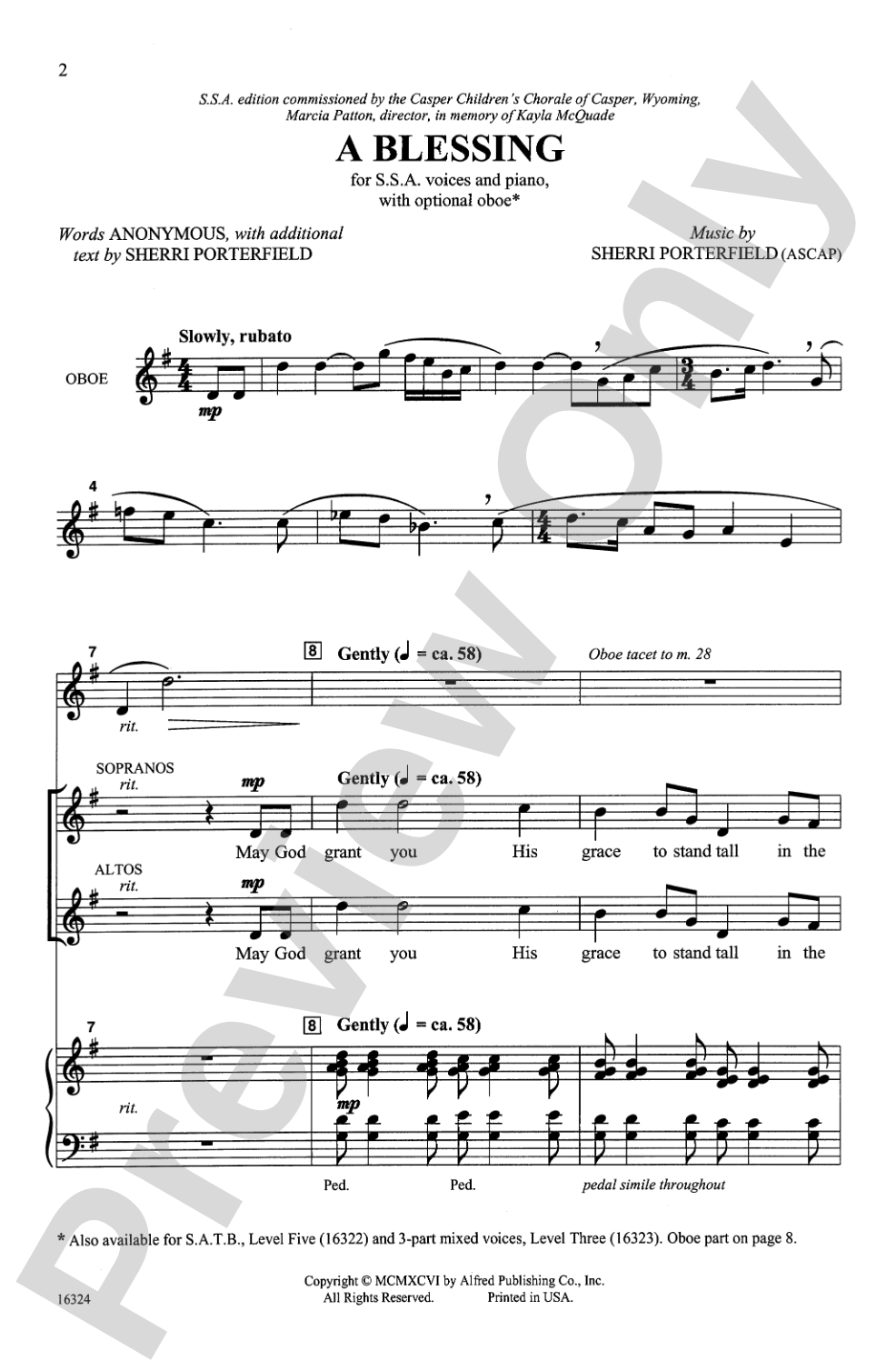
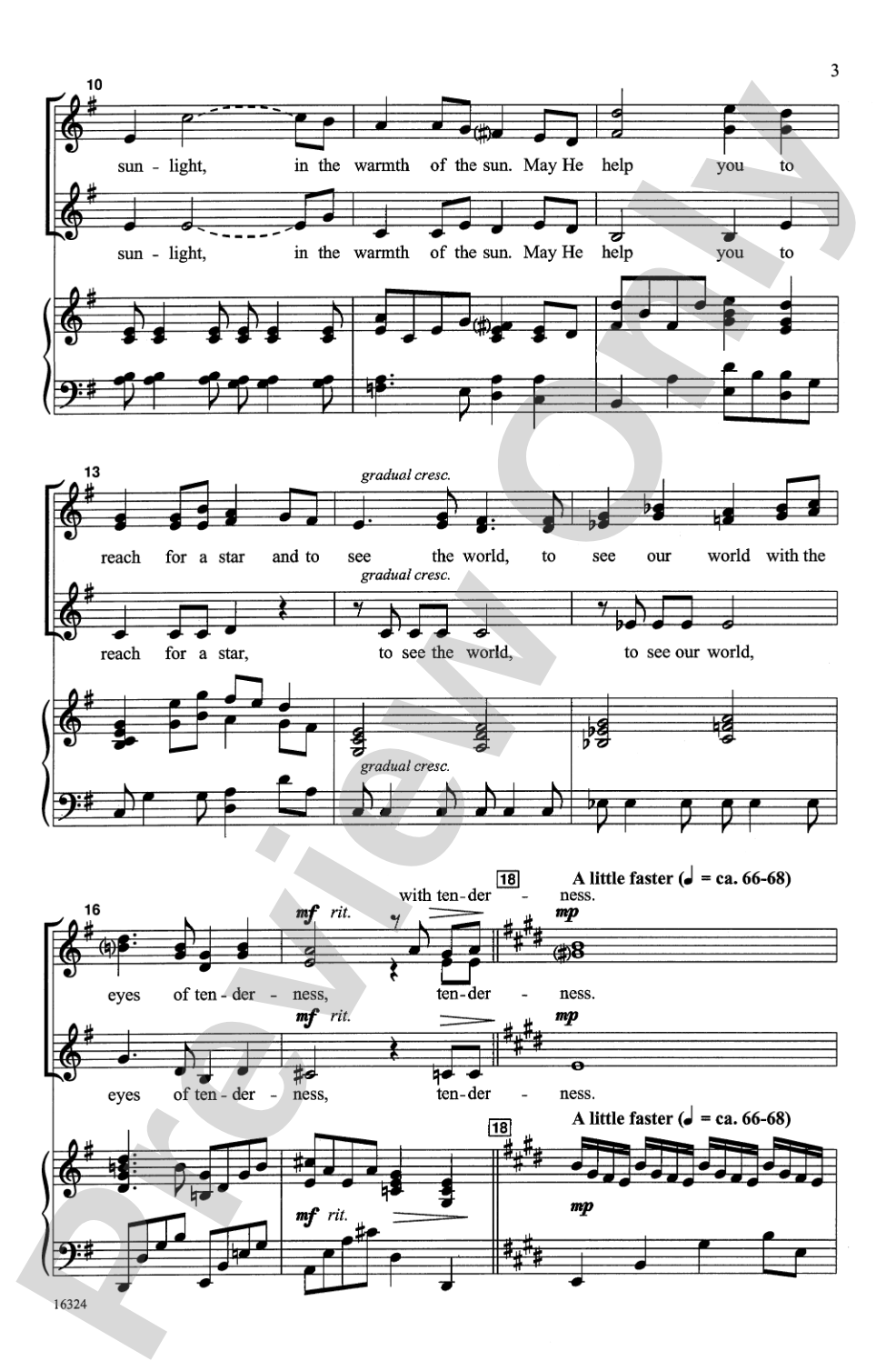
A masterful new choral setting of a moving, anonymous text: "May God grant you his grace to stand tall in the sunlight..." Optional oboe is a haunting and powerful addition to your perfomance. Strong piano accompaniment adds drive and a rhythmic pulse.


A Blessing: SSA Choral Octavo isn't in MakeMusic Cloud just yet...but it could be. Let us know you'd like to see it, and you'll help shape what comes next. In the meantime, start a free trial and dive into thousands of interactive titles your students can play along with today.
Request This Title
Tell us you want it.
Start Your Free Trial
Explore everything that's ready to play right now.
Sample Audio
No sample audio found.
Sample Video
No sample videos found.
Additional Details
Series:
Alfred Archive Edition: Alfred Choral Designs
Publisher:
Alfred Music
Page Count:
8
SKU:
00-PO-0003966
Instrumentation:
Opt. Oboe
More about this title
About the Composer: Sherri Porterfield

Sherri Porterfield directs choirs at Cedar Park Middle School in Cedar Park, Texas, and has built a distinguished career across Missouri, Kansas, and Texas. Her ensembles have earned numerous first-place and sweepstakes awards at competitions and performed at state music educators conventions. She has also served as an adjunct assistant professor of music education at the University of Missouri-Kansas City Conservatory of Music and has been selected four times to Who's Who Among America's Teachers.
With over 175 published choral compositions to her name, Porterfield has maintained an active voice in choral music for decades. Alfred Music Publishing and other major publishers represent her work, and since 1997 she has received yearly ASCAP awards for her compositions. A University of Memphis graduate with a Master of Music in choral conducting from the University of Missouri-Kansas City, she earned Teacher of the Year at Frontier Trail Junior High in Olathe, Kansas (1999) and has worked as a clinician and guest conductor of honor choirs across the country.
Why we love this
Porterfield's gift for pairing strong harmonic writing with accessible vocal ranges shines here. The optional oboe transforms a solid choral piece into something liturgically flexible, allowing you to perform it as purely vocal at a moment's notice or add instrumental color when your ensemble includes capable wind players. The piano part drives the piece forward with genuine rhythmic momentum rather than serving as filler—your singers feel supported and propelled, not dragged.
What to expect
The piece unfolds with quiet dignity and warmth, grounded in the piano's steady propulsion and enriched by the anonymous blessing text. When the optional oboe enters, it adds a contemplative depth that lifts the piece beyond the ordinary—elegant without becoming precious, spiritual without requiring a liturgical setting.
Who it's for
Directors seeking a meaningful, singable graduation piece that works equally well at secular ceremonies, baccalaureate services, or spring concerts. This octavo suits choirs with emerging sopranos and altos who benefit from Porterfield's vocal writing, which sits comfortably within reasonable ranges while maintaining musical substance.
How to get the most out of it
- Bring out the piano's rhythmic pulse in rehearsal by having singers tap their parts against the beat rather than with it; this prevents the piece from settling into a plodding feel.
- If including oboe, balance it as a conversational partner to the choir rather than a soloist; the text should remain the primary focus.
- Attend to the text's emotional arc carefully. The blessing builds toward affirmation, so shape dynamics and phrasing to reflect growing confidence rather than delivering everything at the same volume.
- The SSA voicing allows for seamless divisi in moments of harmonic richness; mark these divisions clearly in rehearsal to prevent doubling that muddies the texture.
How to use it
Position this as your closure to a graduation or spring concert program, where its message of grace and hope serves as a natural benediction. It also works well in a sequence with secular and sacred selections, providing a moment of reflection and uplift that doesn't require the full choral apparatus of larger works.
Skills your students will build
- Singing sustained lines with focused tone across phrase lengths
- Balancing SSA voicing to maintain harmonic clarity in divisi passages
- Interpreting liturgical or devotional texts with emotional authenticity
- Listening to and supporting an optional instrumental partner without losing independence
- Shaping dynamic arcs within a contemplative tempo