
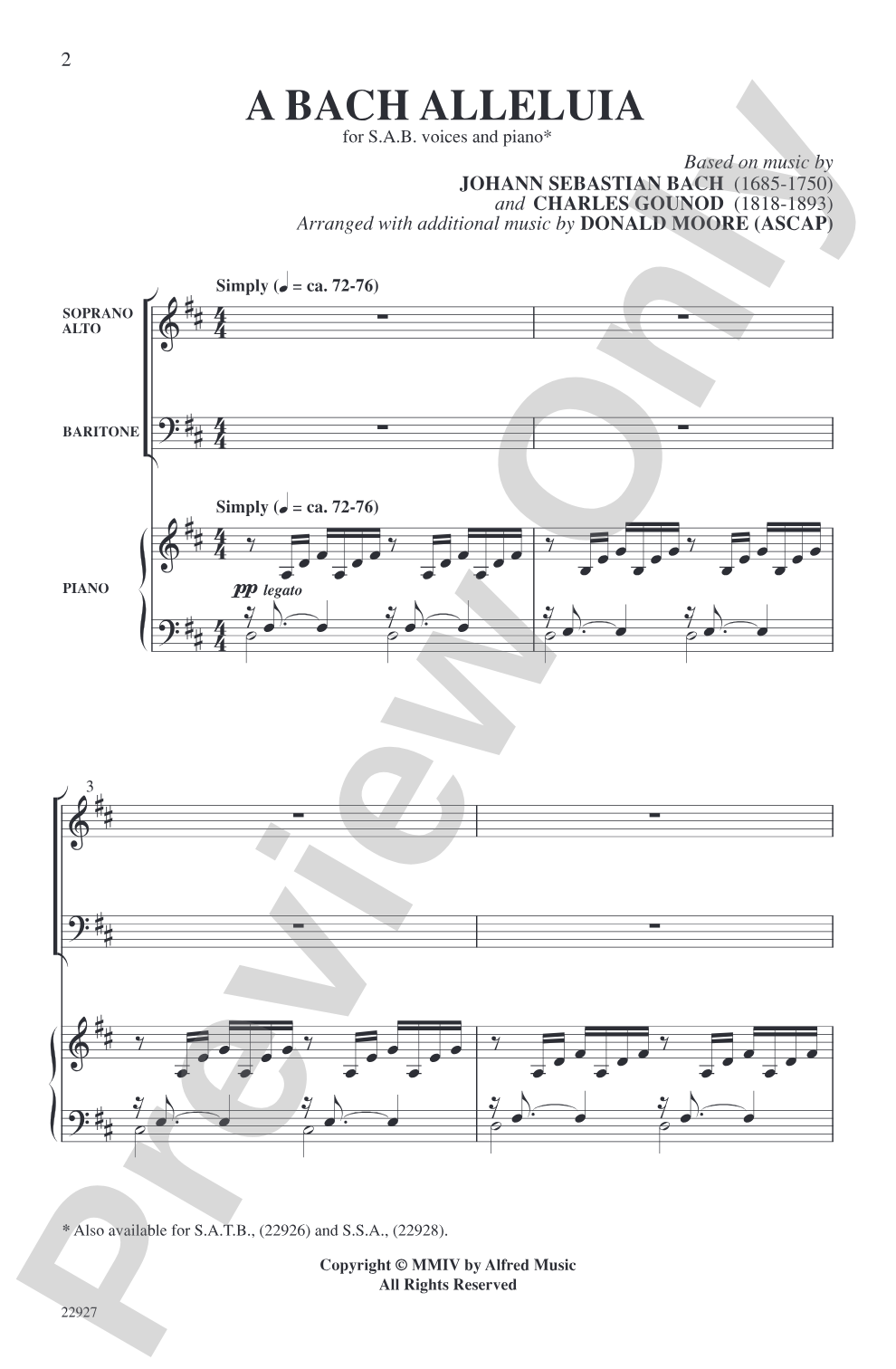

A Bach Alleluia: SAB Choral Octavo
By J. S. Bach and Charles Gounod / arr. Donald Moore
Item: 00-PO-0004315
$2.25
Minimum order quantity: 20 copies
Pickup currently not available
Description
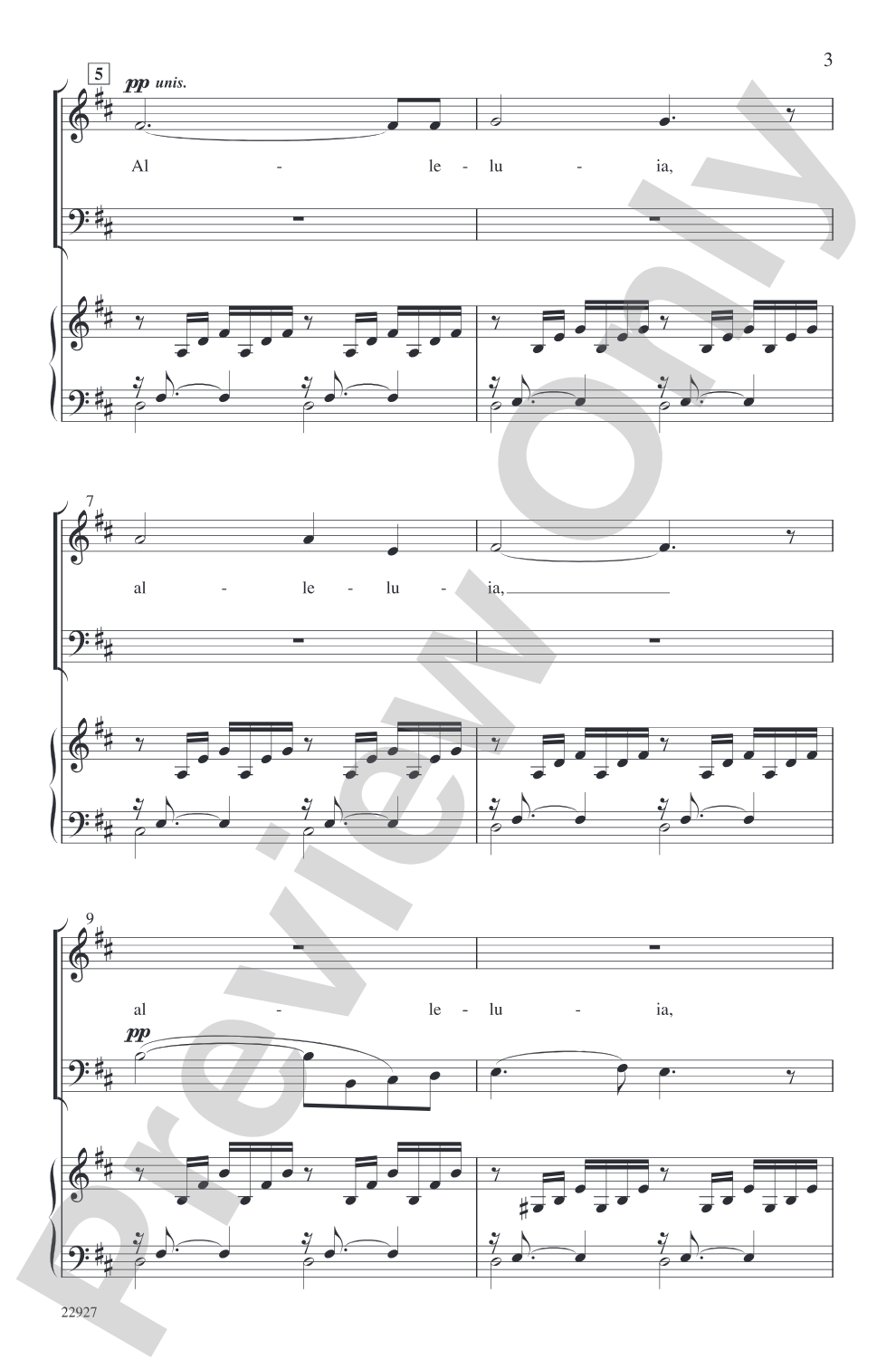
A new classic from Donald Moore: a skillfully arranged version of the famous Bach/Gounod "Ave Maria." Your choir will sound impressive singing these lyric lines and rich harmonies set to an "Alleluia" text with a flowing piano accompaniment. Sensitive dynamics rise and fall in every stunning phrase of this must-have work for your choral library.


A Bach Alleluia: SAB Choral Octavo isn't in MakeMusic Cloud just yet...but it could be. Let us know you'd like to see it, and you'll help shape what comes next. In the meantime, start a free trial and dive into thousands of interactive titles your students can play along with today.
Request This Title
Tell us you want it.
Start Your Free Trial
Explore everything that's ready to play right now.
Sample Audio
1
Audio File
--:--
0:00
0:00
Sample Video
No sample videos found.
Additional Details
Series:
Alfred Archive Edition: Alfred Choral Designs
Publisher:
Alfred Music
Page Count:
8
SKU:
00-PO-0004315
More about this title
About the Arranger: Donald Moore

Donald Moore earned his Bachelor of Music in organ performance and Master of Arts in Teaching from Kent State University. He serves as Organist-Choirmaster at Pilgrim United Church of Christ in Cuyahoga Falls, Ohio, and has built a catalog of over 500 published works across sacred, secular, educational, and pop choral genres, along with organ and piano compositions and instructional materials.
Moore's arrangements and original compositions appear regularly at state contests, regional festivals, and national conventions. He has received the ASCAP Composers Standard Award seventeen times and was recently recognized by the American Choral Directors Association as one of 400 historically significant American choral composers. His work spans multiple publishers including Alfred Music, Hal Leonard, Heritage Music Press, and others.
Why we love this
Moore understands how to extract the emotional core of Bach's harmonic language and reshape it for ensemble singers without sacrificing sophistication. The dynamic architecture here lifts and settles with such sensitivity that singers feel they're shaping something genuinely profound, not just executing a famous tune. Programming a Bach/Gounod arrangement alongside full-voiced anthem works gives your concert intellectual credibility while remaining deeply accessible to a broad audience.
What to expect
Intimate and luminous, with the familiarity of the Bach/Gounod melody anchoring something richer and more intricate than most singers expect. The piano accompaniment flows like a gentle undercurrent beneath the voices, and the "Alleluia" text gives the whole arrangement an air of quiet celebration rather than the romantic devotion of the original Ave Maria.
Who it's for
SAB choirs looking for sacred literature that feels substantial without requiring four-part divisi or extensive rehearsal time. This works equally well for church services, choral concerts, festival programs, and community performances where audiences recognize and connect with the melody.
How to get the most out of it
- Shape the melodic line in the soprano part with continuous phrasing rather than emphasizing individual phrases; this maintains the Bach/Gounod character throughout and prevents the familiar melody from sounding choppy.
- Balance the alto part carefully in measure transitions where it carries harmonic movement the sopranos aren't singing; these inner voices anchor the arrangement's richness.
- Allow the piano accompaniment to breathe slightly at phrase endpoints before the choir re-enters, particularly in the opening and closing sections where the text sets expectations for reverent space.
- Adjust overall dynamics conservatively; the arrangement's power lies in clarity and warmth rather than dramatic swells, so let the harmonic progression itself suggest the emotional curve.
How to use it
Open a sacred concert with this piece to establish reverence and invite audience focus immediately, or close a set of varied anthems with it as an elegant benediction. Its eight pages and SAB voicing make it practical for seasonal services (Advent, Easter, Pentecost) while its artistic depth sustains a full concert program.
Skills your students will build
- Sustaining lyrical phrasing across longer melodic lines
- Balancing three-part harmony where inner voices carry distinct harmonic weight
- Responding to piano accompaniment cues for ensemble precision
- Singing with dynamic sensitivity and restraint in sacred contexts