
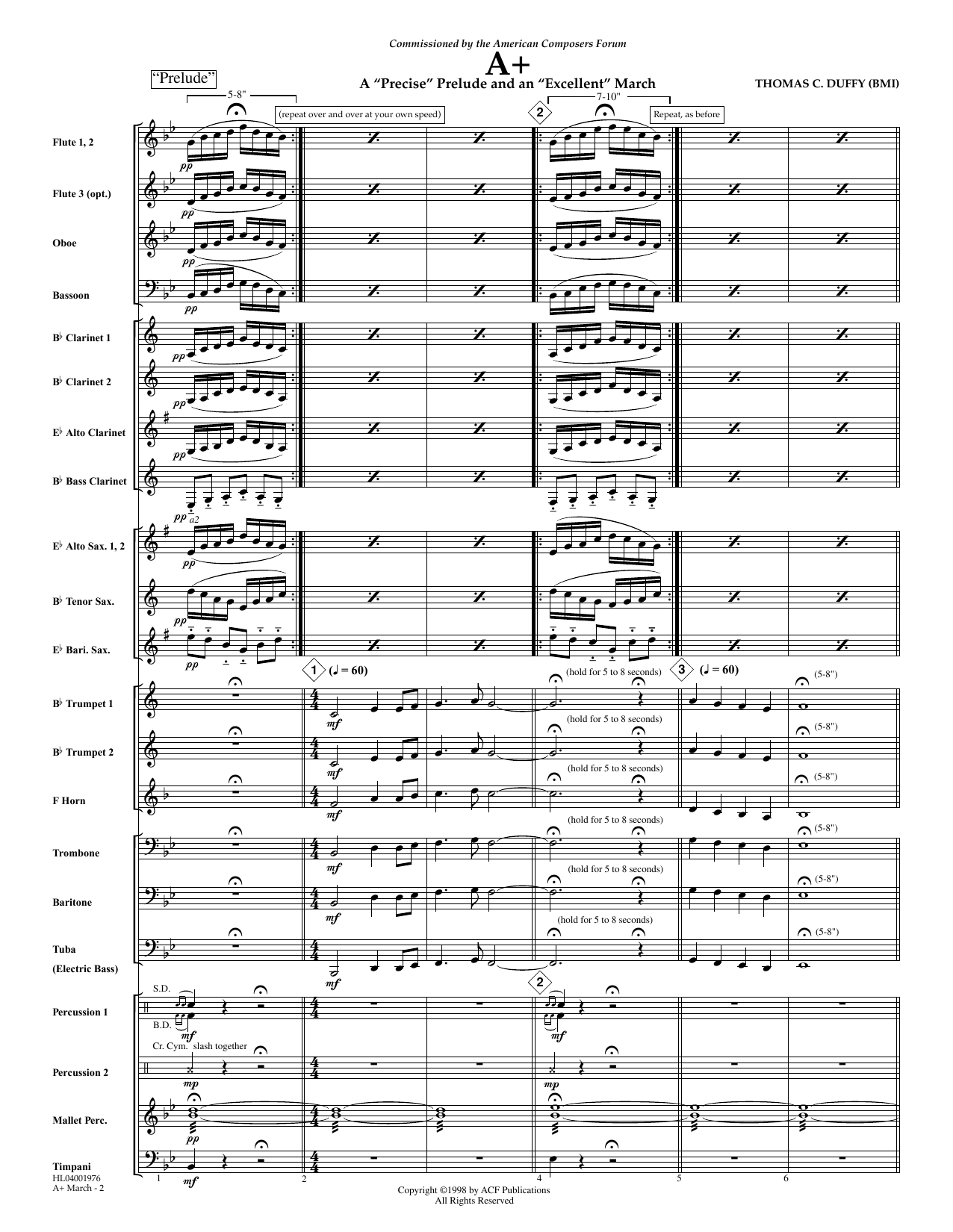

A+: A "Precise" Prelude and an "Excellent" March: Concert Band Conductor Score & Parts
By Thomas Duffy
Grade: 3
Item: 35-PK00425511
$60.00
Pickup currently not available
Buy Extra Parts (Digital PDF Download)
Parts Added to Cart!
Description
Playing one wrong note can ruin the performance of a piece, right? Well, composer Thomas Duffy actually wants the performers to make mistakes in this clever composition! The precise imprecision comes to life as students are asked to intentionally play wrong notes in various parts of the march. After performing this work, you and your students will never look at "perfection" the same way again! Free interdisciplinary curriculum for the piece is available for download at www.BandQuest.org: https://composersforum.org/bq-compositions/a-a-precise-prelude-and-an-excellent-march/
BandQuest, an exciting series of new music and accompanying curricula for band, is a program published by the American Composers Forum. The series was started as a response to feedback from music educators that there is a pressing need for new, fresh band music. The heart of this program is new works written by a diverse group of leading American composers who have created challenging pieces that are a true departure from standard middle school repertoire. Every BandQuest project includes a residency component in which the composer works collaboratively with a middle school as they create their new piece. Many BandQuest pieces are accompanied by an interdisciplinary curriculum designed to assist students as they learn the music and to integrate each piece with non-music studies. Visit www.bandquest.org to learn more about this innovative series, and email bandquest@composersforum.org to request a free downloadable audio catalog.


Discover MakeMusic Cloud: thousands of interactive titles your students can play along with today.
Sample Audio
No sample audio found.
Sample Video
No sample videos found.
Additional Details
Publisher:
Hal Leonard
SKU:
35-PK00425511
More about this title
About the Composer: Thomas Duffy
Thomas Duffy is an American composer whose work spans concert music, film scores, and educational pieces. His compositions often challenge conventional thinking about musical form and performance, inviting listeners and performers alike to reconsider what music can be.
Why we love this
Duffy's concept here flips the traditional performance anxiety on its head by making intentional 'mistakes' part of the artistic vision. Your students gain permission to think critically about what precision actually means in music, and the piece becomes a conversation starter about perfection, creativity, and artistic intent that extends far beyond the concert hall.
What to expect
The prelude sets a thoughtful tone before the march unfolds with an unexpected twist. As intentional errors emerge throughout, performers and listeners experience a subtle unease that's actually quite playful, revealing Duffy's wit and the piece's deeper commentary on artistic authenticity.
Who it's for
Grade 3 concert bands looking for contemporary repertoire that engages students intellectually as well as musically. This works especially well for ensembles ready to think beyond traditional performance values and for programs that value composer-driven innovation.
How to get the most out of it
- Rehearse the intentional wrong notes as deliberately as any other passage. Students need to know exactly which notes to 'play incorrectly' and when, so the effect lands with purpose rather than accident.
- Discuss the philosophical angle before performing. Help students understand that this compositional choice comments on perfectionism and opens space for expressive risk-taking.
- Consider your audience when introducing the piece. A brief program note explaining the concept helps listeners understand what they're experiencing and elevates the work from gimmick to genuine artistic statement.
How to use it
This pair of movements works beautifully on a concert exploring contemporary approaches to composition or as a centerpiece for a program examining how modern composers challenge tradition. The built-in educational value and free curriculum make it a natural choice when you want to integrate music study with broader critical thinking.
Skills your students will build
- Reading and executing composer-specified performance directives within standard notation
- Distinguishing between technical accuracy and artistic intent
- Collaborating to maintain ensemble cohesion while performing intentional variations
- Developing awareness of how compositional choices communicate meaning beyond pitch and rhythm