42nd Street Sheet Music Preview

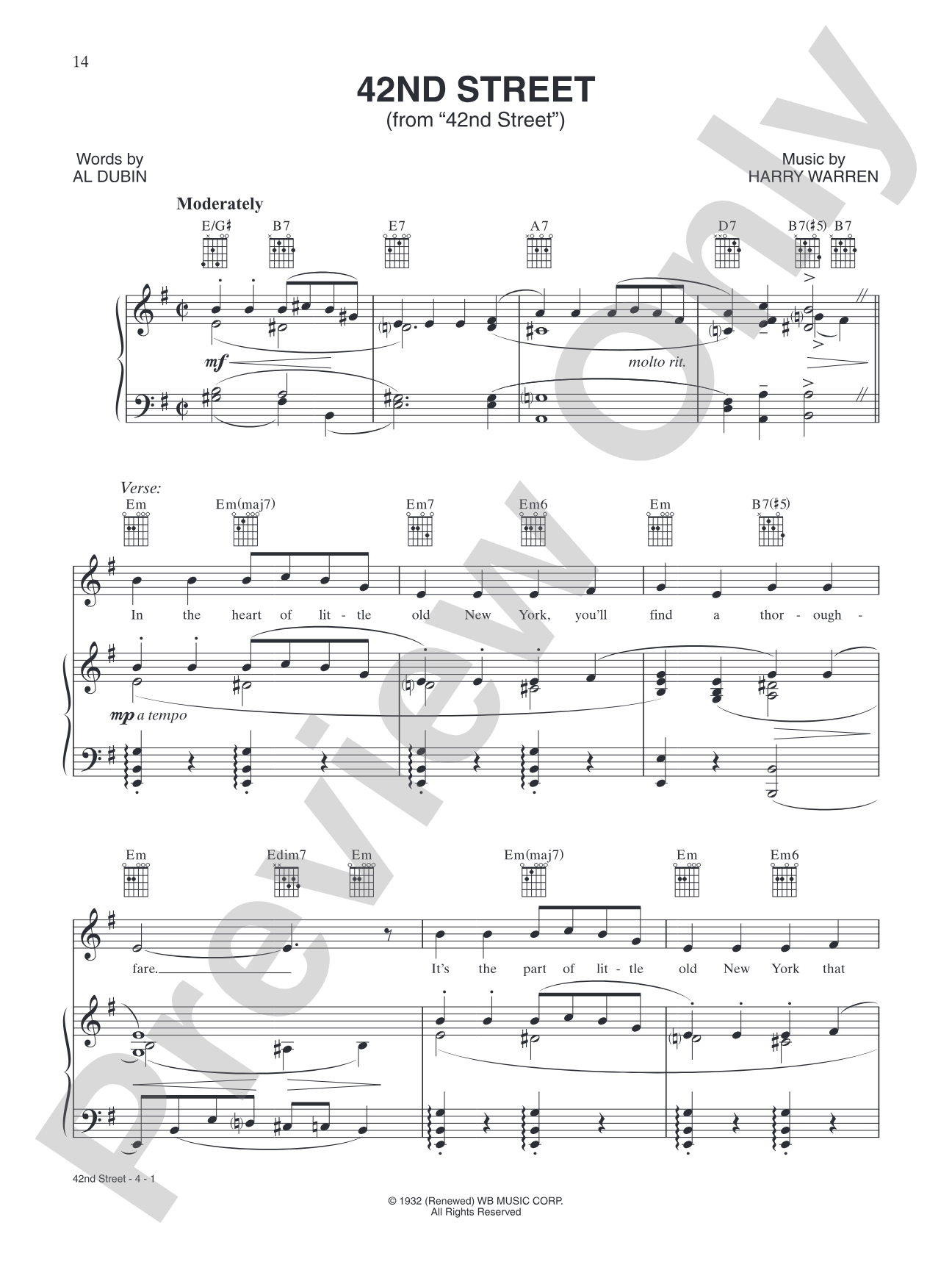
42nd Street: Piano/Vocal/Chords

Over 100 Years of Show Tunes about New York City

Item: 00-PS-0011025

Digital Download
$3.99

One moment…

Description
Almost every theater writer of note has penned songs about New York, including the Gershwin brothers, Rodgers and Hart, Comden and Green, and Cole Porter. This book celebrates over 100 years of show tunes about New York, from George M. Cohan's "Give My Regards to Broadway" to more recent hits from shows like "I Love You Because" and "My Favorite Year." Titles: 42nd Street * At the Roxy Music Hall * Broadway Baby * Confession of a New Yorker * Dancin' on the Sidewalk * Drop Me Off in Harlem * Ev'ry Street's a Boulevard in Old New York * Give My Regards to Broadway * I Happen to Like New York * Let's Take a Walk Around the Block * Lounging at the Waldorf * New York, New York * Sunday in the Park * Take Me Back to Manhattan * The Streets of New York * There's a Boat Dat's Leavin' Soon for New York * Union Square * Wall Street * West End Avenue and many more.

42nd Street: Piano/Vocal/Chords isn't in MakeMusic Cloud just yet...but it could be. Let us know you'd like to see it, and you'll help shape what comes next. In the meantime, start a free trial and dive into thousands of interactive titles your students can play along with today.

Sample Audio
No sample audio found.
Sample Video
Additional Details
Publisher: Alfred Music
Page Count: 256
SKU: 00-PS-0011025

More about this title

About the Composer: Harry Warren

Harry Warren (1893-1981) composed over 800 songs across a six-decade career, making him one of the most prolific and commercially successful songwriters in American musical theater. His melodies are marked by infectious rhythms, singable lines, and an instinctive understanding of what audiences want to hear; he worked with lyricists including Al Dubin, Johnny Mercer, and Mack Gordon to create standards that remain central to the Broadway and Hollywood repertoire. Warren's songs appear in more than 70 films and stage productions, and his work defined the sound of the Golden Age of musical theater.

Why we love this

This collection gathers over 100 years of Broadway love letters to New York in one resource, spanning from George M. Cohan to contemporary shows. The mix of eras and styles gives singers and pianists genuine variety without requiring them to hunt through multiple books, and the chronological sweep makes it natural to program pieces that trace how composers have portrayed the same city across generations. Directors can build entire programs around New York songs or pull individual numbers for revues, cabarets, and audition preparation.

What to expect

These songs pulse with the energy and romance of New York itself: the gleam of theater marquees, the restless energy of city streets, the nostalgia of beloved landmarks. Whether tender or exuberant, sophisticated or playful, each song captures a moment of affection or longing for a particular corner of the city. The collection as a whole reads like a love letter written in many voices and many decades, each one insisting that New York is worth singing about.

Who it's for

This collection serves pianists who accompany singers in lessons, rehearsals, and performances; vocalists preparing audition material or building a cabaret program; and music directors programming revues or concert performances centered on classic Broadway and American songwriting. Teachers of American music history and musical theater will find it essential for introducing students to how composers over multiple generations approached the same subject matter.

How to get the most out of it

  • Study the harmonic progressions in these songs; many of them use chromatic movement and unexpected chord substitutions that define the wit and sophistication of Golden Age songwriting. Lean into the sophistication rather than playing through it.
  • Match the vocal phrasing to the character of each song's lyric and setting. A song about Fifth Avenue breathes differently than one set in Harlem; let the imagery shape your accompaniment texture and tempo flexibility.
  • Use the chord symbols to explore reharmonization options for repeats and reprises. These standards invite personal interpretation, and small harmonic choices can refresh a familiar melody without losing its essential character.

How to use it

Build a full concert around New York songs by programming them chronologically, allowing the audience to hear how the city's image evolved through different eras and compositional styles. Extract 4-6 songs for a 20-minute cabaret slot, mixing tempos and moods to showcase range. Use individual numbers as audition material or as required pieces for voice students studying American song repertoire and character interpretation.

Skills your students will build

  • Interpreting narrative and character through vocal phrasing and accompaniment choices
  • Reading and realizing chord symbols accurately across diverse harmonic styles
  • Navigating varied song forms (AABA, through-composed, sectional) within a single collection
  • Accompanying singers while maintaining rhythmic integrity and supporting their phrasing
  • Understanding the evolution of Broadway song craft and harmonic language across decades

You May Also Like