
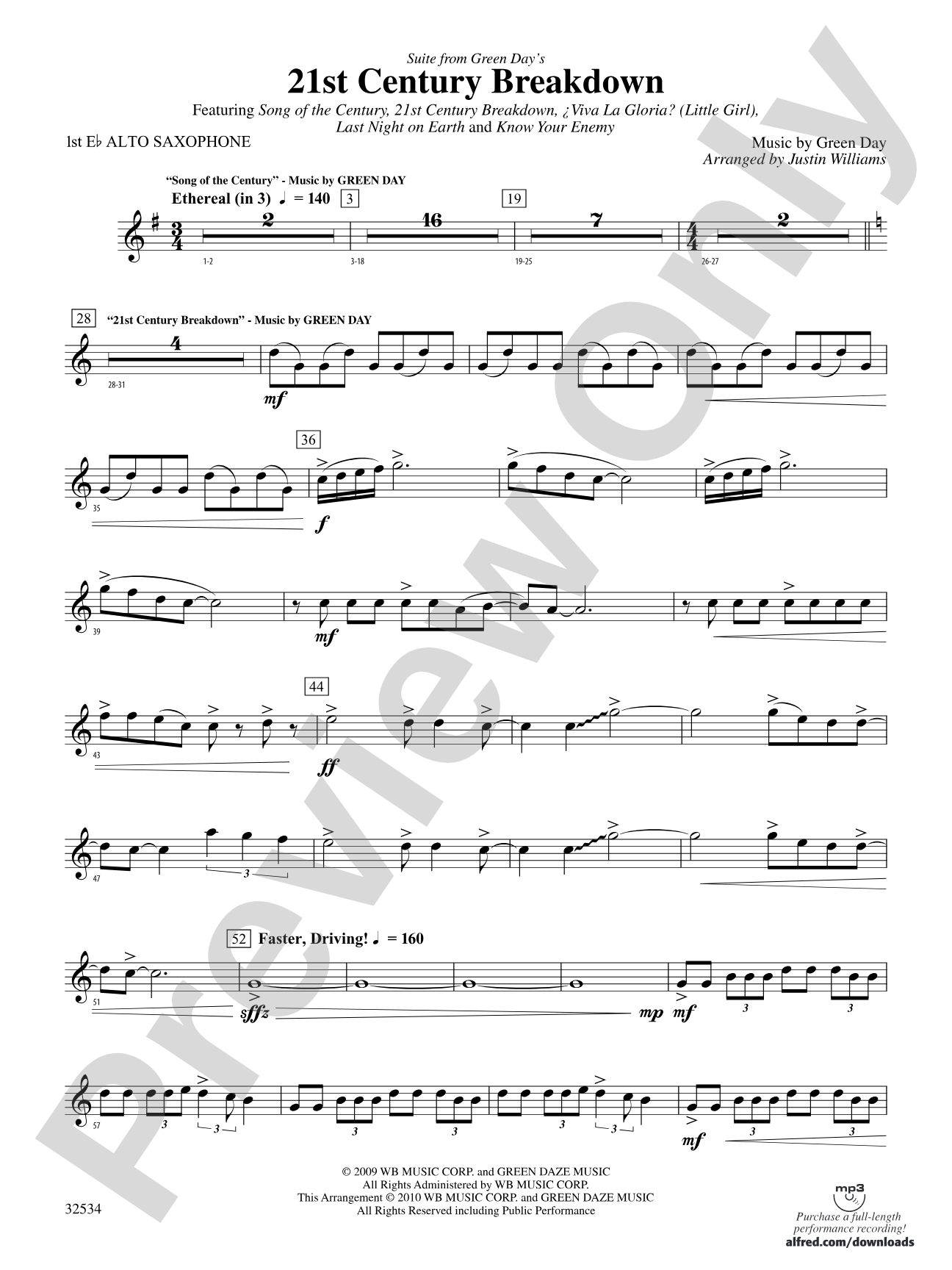

21st Century Breakdown, Suite from Green Day's: E-flat Alto Saxophone
Featuring: Song of the Century / 21st Century Breakdown / ¿Viva La Gloria? (Little Girl) / Last Night on Earth / Know Your Enemy
Music by Green Day / arr. Justin Williams
Grade: 3 (Medium Easy)
Item: 00-PC-0015749_AX1
$5.99
Pickup currently not available
Description
Iconic alternative rock band Green Day serves up another chart topping "rock opera" with 21st Century Breakdown. The album's hard rocking anthems and beautiful ballads are brought to your concert ensemble in this arrangement featuring "Song of the Century," "21st Century Breakdown," "¿Viva La Gloria? (Little Girl)," and the smash hit, "Know Your Enemy." This is sure to be a hit with your students and audience alike!


Don't just read it, hear it, play along with it, and watch your students grow with it. In MakeMusic Cloud, 21st Century Breakdown, Suite from Green Day's: E-flat Alto Saxophone comes alive with professional accompaniment, adjustable tempo, and built-in practice tools that turn solo practice into real progress.
Open in the Player
Jump straight in and assign it today.
Start Your Free Trial
Open this title and explore the full library in minutes.
Sample Audio
1
Audio File
--:--
0:00
0:00
Sample Video
No sample videos found.
Additional Details
Series:
Pop Concert Band
Publisher:
Alfred Music
Page Count:
268
SKU:
00-PC-0015749_AX1
More about this title
About the Composer: Green Day
Green Day formed in the early 1990s in the San Francisco Bay Area and became one of the most influential rock bands of their generation. Their 2004 album American Idiot established them as serious songwriters capable of ambitious, thematically cohesive work. 21st Century Breakdown (2009) continued this trajectory, presenting another full-scale rock opera that explored political disillusionment and personal struggle with both musical sophistication and raw emotional power. The band's ability to craft memorable melodies alongside driving rhythms has made their music accessible to musicians across skill levels.
Why we love this
Justin Williams' arrangement captures the visceral energy and melodic hooks that made this album resonate with millions of listeners, translating them into parts that sit comfortably in the hands of developing musicians. The suite balances crowd-pleasing moments with genuine musical substance, giving your ensemble real rock credentials without requiring virtuosic technique. Students connect immediately to this music because they recognize it, and that connection translates into engaged, purposeful rehearsals and performances that your audience will remember.
What to expect
Raw, urgent, and anthemic. The suite moves between quiet introspection and explosive rock moments, with enough harmonic and rhythmic complexity to feel substantial without becoming academic. There's an underlying sense of defiance and energy throughout, rooted in the alternative rock tradition but arranged to showcase the specific colors available in a concert band.
Who it's for
Concert band directors seeking contemporary, high-engagement repertoire that speaks to student musicians' actual musical world. This suite works for Grade 3 ensembles with solid fundamentals in place and genuine rock feel among the section leaders. The music appeals equally to audiences who grew up with Green Day and younger listeners encountering the band for the first time.
How to get the most out of it
- Lock the rhythm section (percussion, bass, and low brass) as a unit before bringing in the full ensemble. The pocket of this music depends on rock-solid timekeeping, not rubato.
- Emphasize the contrast between the ballad passages and the hard-hitting anthems. These shifts are dramatic and deserve clear dynamic and textural separation in rehearsal.
- Balance the melody carriers carefully, particularly in the vocal-driven moments. Concert band doesn't have a singer, so woodwinds and upper brass need to project the lyrical intent without overshadowing the rhythmic foundation.
- Mark the backbeat explicitly in the parts. Many players will default to classical phrasing; this music lives on beats two and four.
How to use it
Position this as a centerpiece of a contemporary music concert or as the closing act of a pop-focused pops concert. The suite's length (268 pages of score and parts) supports a full-length concert segment and creates a natural arc from opening through finale. It pairs well with other rock-influenced band arrangements or with classical pieces that share harmonic language, creating programming that demonstrates the range of concert band repertoire.
Skills your students will build
- Reading and executing rock rhythms in various time signatures and feels
- Balancing lyrical melody with rhythmic accompaniment in ensemble settings
- Understanding how dynamics and articulation create movement in rock grooves
- Coordinating across sections to maintain cohesion in driving rhythmic passages
- Responding to cues and conducting patterns that guide substantial structural shifts