
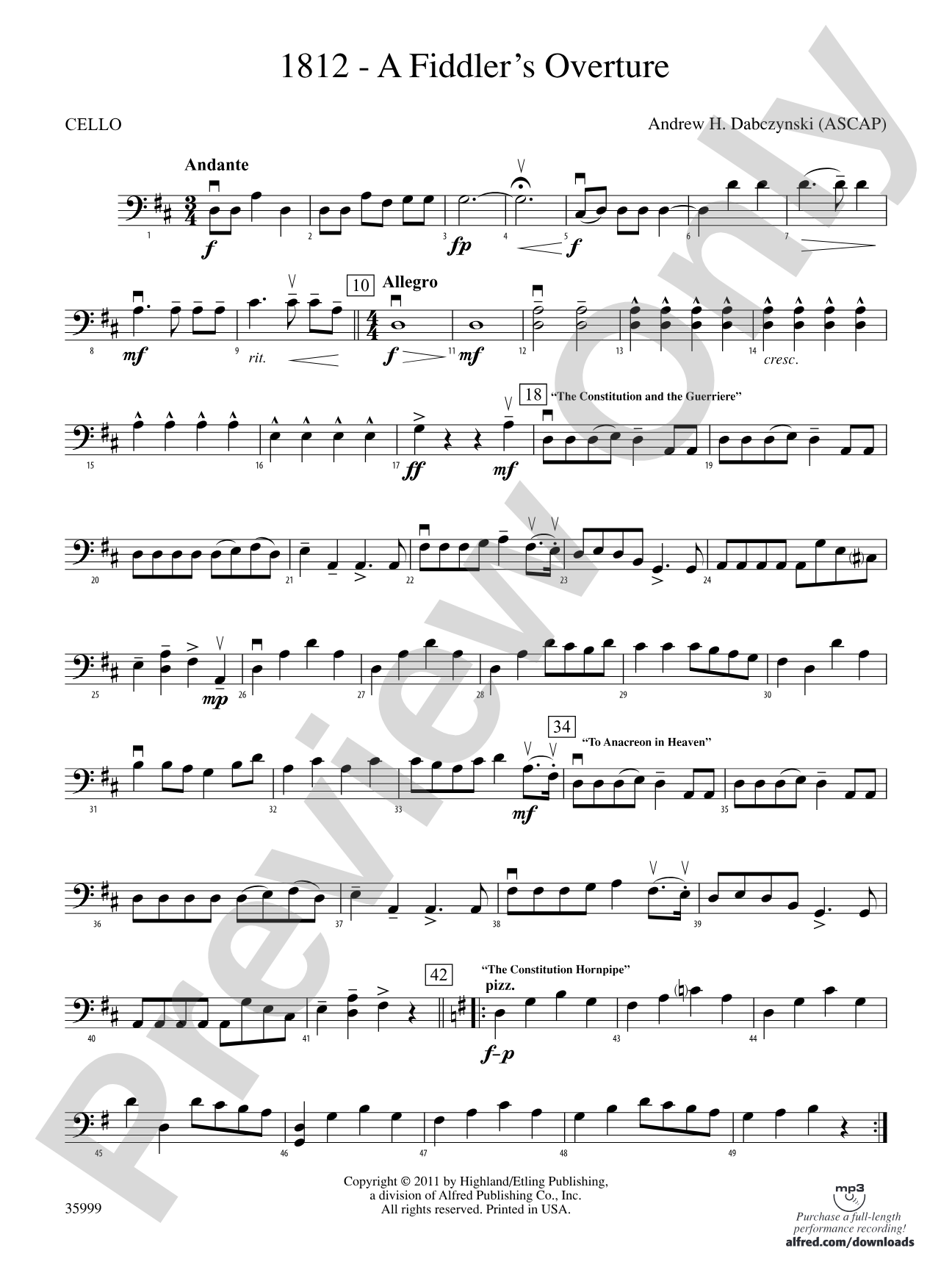

1812 -- A Fiddler's Overture: Cello
By Andrew H. Dabczynski
Grade: 3
Item: 00-PC-0015074_VC1
$5.99
Pickup currently not available
Description
The War of 1812 in America gave birth to some of the country's most beloved folk melodies and fiddle tunes. Here's an original overture where all the sections get a chance to explore those tunes, cleverly combined with famous melodic quotes, in both traditional and contemporary settings. "The 8th of January," "The Constitution Hornpipe," and "The Constitution and Guerriere" appear with distinctive old-time, bluegrass, country, and even Latin flavors. Optional opportunities for solo improvisation are also included.


Don't just read it, hear it, play along with it, and watch your students grow with it. In MakeMusic Cloud, 1812 -- A Fiddler's Overture: Cello comes alive with professional accompaniment, adjustable tempo, and built-in practice tools that turn solo practice into real progress.
Open in the Player
Jump straight in and assign it today.
Start Your Free Trial
Open this title and explore the full library in minutes.
Sample Audio
1
Audio File
--:--
0:00
0:00
Sample Video
No sample videos found.
Additional Details
Series:
Highland/Etling String Alternatives
Publisher:
Alfred Music
Page Count:
124
SKU:
00-PC-0015074_VC1
Instrumentation:
string
More about this title
About the Composer: Andrew H. Dabczynski

Andrew H. Dabczynski is an Emeritus Professor of Music Education at Brigham Young University, where he established the BYU "New Horizons Orchestra" as both a beginning string ensemble for adult learners and a training ground for string educators. His contributions to music pedagogy earned him BYU's Joseph E. White Fellowship for Teaching and Learning, and Utah ASTA recognized him as "Higher Education Teacher of the Year" in 2005 and again in 2014 for his outstanding contributions to the field.
Dabczynski's teaching career spans the Eastman School of Music, public school systems in New York and Michigan, and numerous national string workshops. As a violist, he performed with regional orchestras including the Rochester Philharmonic and Hartford Symphony, and served six years as a member of the Colden String Quartet at Western Michigan University. His scholarly interests center on folk music and ethnomusicology, particularly the study of fiddling traditions and how folk music transmits across generations. He co-authored the String Explorer method series with Alfred Music, a comprehensive resource widely used in string education.
Why we love this
Dabczynski captures the spirit of American folk fiddling without reducing it to museum pieces. The overture weaves together familiar melodies from the War of 1812 era across multiple styles (bluegrass, country, Latin) so that every section gets genuine ensemble moments, not just accompanimental roles. Optional improvisations give your strongest players room to shine while keeping the arrangement accessible at Grade 3.
What to expect
This overture captures fiddle music's energy and playfulness, moving fluidly from the spare, driving feel of old-time Appalachian fiddling to the propulsive swing of bluegrass, with unexpected turns into country and Latin grooves. It feels like a tour through a living tradition rather than a history lesson, with enough wit and rhythmic sophistication to keep experienced ensembles engaged.
Who it's for
String orchestras at the intermediate level who want to program American roots music with genuine rhythmic character. Directors looking for summer concerts, Fourth of July celebrations, or patriotic programs will find material that engages both players and audiences without resorting to overly simplified arrangements.
How to get the most out of it
- Prepare your fiddle tune articulations separately before full rehearsal. The contrast between detached folk-style passages and smoother connected phrases needs clarity, and individual section work lets violins and violas lock the style before blending.
- Treat the optional solo improvisations as a real performance opportunity, not an afterthought. Even if only one or two players take them on, rehearse the ensemble accompaniment as thoughtfully as you would for a concerto soloist.
- Use tempo anchors across the style shifts. When moving from old-time fiddle settings to bluegrass or Latin textures, establish the new groove with your rhythm section (lower strings and cello/bass if available) before bringing in the melody.
How to use it
Open a summer pops concert or patriotic program with this overture to set a contemporary yet historically rooted tone. It pairs well with other American light concert pieces and works especially effectively as the opener before moving to more formal repertoire, since its infectious rhythms and broad stylistic appeal draw audiences in immediately.
Skills your students will build
- Articulation flexibility across multiple folk and contemporary styles (detached fiddle strokes, bluegrass grooves, country swing)
- Rhythmic precision in non-traditional settings and asymmetrical phrasing
- Ensemble balance and rhythmic independence when melody and accompaniment cross between sections
- Basic improvisation and ensemble problem-solving (for students taking optional solo parts)
- Style awareness and listening to how melodic material transforms across different cultural and musical contexts